My all-time favorite Spanish author is hands down, without a doubt, Julio Cortázar. Thanks to Carrie Toth for creating 3 embedded readings for Cortázar's story, La Casa Tomada. First, she took a section from the middle of the story for the first reading, making it comprehensible by limiting the vocabulary and adding clip art for words that may be unfamiliar. In versions 2 and 3, she added more information and vocabulary from the original. The embedded readings change what could be a frustrating experience for students approaching the intermediate proficiency level, to an enjoyable reading experience.
You can find Carrie's three versions of the story HERE.
There is a short YouTube clip of Cortázar explaining how he was inspired to write the story and his reaction that many people have different interpretations than what he was thinking when he wrote it. The Spanish subtitles helped with my students' understanding of the interview. Find the interview HERE.
After reading and discussing the story, and comparing it to previous stories we read such as El almohadón de plumas, (HERE is Kristy Placido's embedded readings of the story; HERE is Mike Peto's blog post on the story; and a stop-motion video as an alternative to the video suggested on Mike's post.), we will watch a short film of the video, pausing throughout to discuss and retell.
Next up, Chac Mool! - another embedded reading gift to all from generous Kristy Placido (found here).
Tuesday, March 24, 2015


Monday, March 23, 2015
"Survivor Cubes" in the MFL classroom

I modified the activity to suit my focus words for the day, oyó=s/he heard and oyeron=they heard. It was a fun, fresh way to give the students a large amount of repetitions of the focus words without them realizing how many times they heard the words.
1. First, I made 5 cubes, each with the same 6 clip art images. I made origami cubes after I watched this video. (To get even more mileage out of the activity, I used an image for "footsteps" because I knew we would be using it later in class for a MovieTalk. This activity introduced the word and when I asked how to say it later in the class period, I got a resounding answer from the majority of the students! I should have been more selective with the other 5 images.)
2. In class, I asked for 5 volunteers, and then I chose another student to help them. The helpers' job was to hold up a clipboard to block the other students from seeing which image the student selected for each round until it was time to reveal their answer.
3. On my computer, I had 6 tabs open from the website FreeSound, that matched the clip art images.
4. Before handing out the cubes to the 5 students and their helpers, we listened to the 6 sound bytes from the FreeSound website. They were super easy to identify. I also wrote the vocabulary on the board because the students were going to write the words during the activity: un tren, un perro, una persona que se ríe, los pasos, una guitarra, una vaca.
5. Then I played a sequence of 9 sounds with the open tabs. (I had made a recording using QuickTime, but I had problems with the sound, so I kept the tabs opened and selected each one as the students listened.)
6. The 5 students with the cubes selected their answer, facing the clip art image toward me. I called the name of a student, who then revealed their answer, as I said, "Elisa oyó un perro. Dennis oyó un perro. Anna oyó un perro. Carlos oyó un tren. Hannah oyó un perro. Cuatro personas oyeron un perro y una persona oyó un tren."
7. Students that were observing (not those with the cubes nor the helpers) had to choose one person and write a sentence about the person using "oyó". Ex: Hannah oyó un tren. Every multiple of 3, the students had to write two students' names that heard the same sound to get practice in writing "oyeron".
8. If a student revealed the incorrect answer, he handed the cube to me and both he and his helper joined the others in writing a sentence for each round.
9. The winner received +1 bonus point in the first "game" when they listened to 9 sounds. In the second round, students listened to 11 sounds, and the winner of that group earned +2 bonus points.
The first few sounds are very easy for the students. They start getting confused with sounds 5 and higher.
 Update: Vicki Antequera emailed me with the document on the right that she will use for her students to do the Survivor Cubes activity. She was kind enough to permit me to share this document with my readers. You can access it HERE.
 After this activity we watched Vampire's Crown. (See the blog post with additional information and resources about it HERE.) I used the MovieTalk method to narrate the action using vocabulary that the students knew. The focus word "oyó" was recycled in the video because the vampire HEARD the boy drinking, HEARD the noise of the sign, HEARD the footsteps, of the dentist, and the dentist didn't hear the footsteps of the vampire.
If the idea of making several origami cubes sounds like too much work, you can simplify the preparation by using cards with the images instead of cubes. I liked the cubes to make it more like Survivor. (Because this was one of those ideas that came to me before I arrived at school, I very quickly made the cubes, as you may have noticed if you looked closely at them.)
Saturday, March 21, 2015
Esperanza - A Verbal Book Report
 |
| Student sketches for Esperanza novel |
For the final assessment on the book, I wanted a project that gave them the opportunity to explain what they thought were the key events in the story.
For the final assessment on the book, I decided on a verbal book report in which students choose events key events of the story, sketch them, and then record their verbal book report. Students chose to work alone or with a partner to sketch 10 events in the story on a long strip of white butcher paper. Then they videotaped their verbal book report using a flip camera.
The day the students recorded the videos, the class went to the atrium in order to have room so they could record without being really close to another group that was recording. They taped their sketches to the wall and took turns filming each other.
Below is a screenshot of the rubric. I designed the rubric so that the sketches and events are worth 10 points, providing base points that all students should earn if they followed the requirements on the rubric. The remaining 23 points focus on the actual verbal presentation. With the first 10 points as a base points, I could more fairly assess the verbal presentation. (Find the pdf of the rubric HERE.)

I strongly dislike the traditional 100 point grading scale with A-90-100, B=80-89, C=70-79, D=60-69, and F=0-59. The rubric is my attempt to offset more points dedicated to a failing grade than a passing grade (59% failing and 41% passing).
Thursday, March 5, 2015
10 Ideas for using Monoface in the WL classroom

I saw the link for MonoFace either on Twitter or on Facebook. Since we didn't have school today, because of the lovely snow, (yes, I still think it is beautiful), I had time to explore the site.
How can this be used in the World Language classroom? For one, I'm always looking for images on Google for different stories and activities for class, which makes this a perfect resource for quick creations. Or for more specific suggestions...
Create the character(s) and then:
1. Describe his/her physical characteristics
2. Describe the character and create a backstory for him/her.
3. Describe the relationship between several of the characters.
4. Make the character the star of your class story - co-create a story with your students about the person.
5. StoryASK with your students. AFTER creating the story, have the students create a character on the website that they think best suits the person(s) in the story. This can be done as homework to preserve class time for comprehensible input. Or, use this activity as a brain break.
6. Change the expressions of the character and add screenshots of the person in the typed version of your story to add more interest.
7. Give the students 5-9 shots of the character (same person but only the expressions are changed - mouth, possible nose and eyes). Let students choose from the pics to match the person's emotions or reactions in a pre-made story.
 8. StoryASK information about a set number of people (ex: 5 people). Then project on the screen some people you have made and students choose which person belongs to which description. Students have to defend their choices, in the TL, of course.
9. (similar to #8) Project a collage of people you created, and read information about a person's life or past. Students listen to the details in the story and then decide which person they think best fits the story. Once again, they will need to defend their decision.
10. Ask students to think of x number of occupations and list them on the board. (x=the number of characters you have created on a collage) Project the collage and students work in small groups to assign an occupation to each person. Compare the answers from each group to see how many are similar.
(variation to #10) Brainstorm fears that someone has, or an embarrassing moments, or (fill in the blank w your idea). Then project the collage and decide which person had that fear, embarrassing moment, etc
Those are a few ideas for using MonoFace in the World Language Classroom that I can think of at the moment, but I'm sure there are MANY more possibilities.
I'm sure there are some other obvious uses that I have overlooked at the present time. If you have some suggestions for how to use this in the WL class, please feel free to share your ideas and activities in the comments below.
Thursday, February 19, 2015
Bulletin Board - Why Learn a Second Language

This week we had our second Back-To-School Night because students started a new semester and new classes in January. This is also the time of year when students, and their parents, are scheduling their courses for the next school year.
To promote our program and educate others about the benefits of learning a second language, I decided to create a display on the bulletin board in our hallway. First I contacted students that have graduated from our school and asked them to send me a statement in what ways they have already benefited from being able to communicate in Spanish, whether it is in college, a job they have while going through college, travel experiences, or how they are using Spanish in their career since graduating from college. My Spanish 5 students also wanted to contribute, so on a small white marker board, they explained why they have continued through level 5. Then I took photos of them holding their whiteboards and added those photos to the bulletin board.
I could have added more information and statistics, but this time I focused on individuals and the benefits each of them has experienced. Do you have any ideas for something I could add to the present board?
Tuesday, February 17, 2015
Sketches with High Frequency Words in the Past Tense

I wanted to recycle the new words (había-there was, quería-s/he wanted, fue-s/he went, and estaba-s/he was) from last week, and introduce a few new words: se llamaba - his/her name was; no tenía=s/he didn't have; and, (no) encontró = s/he found/didn't find.
1. I greeted the students at the door and gave them a quarter slip of paper. The instructions on the board told them to number the paper 1-4 and write the following:
1- the name of a person
2- what someone wanted
3- a place
4- an emotion
When finished, the students put the papers in a basket.
2. We read the story we created last week about the person in the movie theater, (see this post), to review. Then I distributed several short stories from previous years with the above words and we read them together. We also watched a short story that I had made into a video with Educreations using the same words.
3. I projected a paper with 9 squares onto the board. Then I randomly pulled a paper out of the basket to find a name of the person. (There was a boy whose names was Elmo) and I sketched a person in the first square. Then I pulled another paper to find what the person wanted. (Elmo wanted a dog. He had a cat and two rabbits but he didn't have a dog.) The extra information about the animals that Elmo did have are another opportunity for more comprehensible input and reps.
4. I continued the above to find TO WHERE the person went. Students told me if the person found or didn't find the item (if the person found it I circled it and if the person didn't find it I put an X over the sketch). The final frame shows how the person felt. To find the emotion, I pulled another paper and used the emotion that was listed.
This was an easy way to provide repetitions and model the activity. It kept the students' attention because they didn't know if I would pick their paper, and they wanted to see if I could somewhat sketch something that resembled the information on the slips of paper.
5. To change the pace, I then gave each student a half sheet of paper with 3 boxes. They had to sketch a person, what the person wanted, to where the person went, indicate with a circle or X if the person found the item, and sketch the person's emotion in the last square.
6. Students put their sketches in a basket and then I assigned a student to randomly choose the sketches. We put them under a document camera and created the story together. I said most of the story but paused and pointed to the sketch for them to supply the necessary word(s).
Example - the underlined words are what I pointed to and students gave the answers:
1st square: Había un chico que se llamaba Antonio. Antonio quería unas hamburguesas. No tenía hamburguesas en su casa. Tenía helado y tenía avocados pero no tenía hamburguesas.
2nd square: Antonio fue al supermercado. Pero no había hamburguesas en el supermercado. Había pescado y había chicle, pero no había hamburguesas. Antonio no encontró hamburguesas en el supermercado.
3rd square: Antonio estaba triste porque quería unas hamburguesas pero no las encontró en el supermercado.
Tomorrow we'll continue with more of the student sketches. When we find a sketch that all the students seem particularly interested in, I'll use that one to create a full story.
With only a few words, there are a lot of stories that are waiting to be created .
Monday, February 16, 2015
Storyline with Gerunds and Prepositions of Place

Most of my students have learned the basic prepositions of place in Spanish 1, so this story, that I use in Spanish 2, reviews those prepositions as well as allows for several repetitions of gerunds.
The storyline is about a person that went to the movie theater. It was crowded and there was only one empty seat. He sat down and started watching the movie, but there were many distractions throughout the movie.
Ask the students to give suggestions for what the people to the left of, to the right of, in front of, and behind the person were doing. Some of the ideas from my students last week were:
- la persona detrás de él estaba pateando su silla
(was kicking his seat)
- la persona delante de él estaba tócandose su bigote largo
(was touching his long moustache)
- la persona a la izquierda de él estaba llorando
(was crying)
- la persona a la derecha de él estaba durmiendo (y estaba roncando)
(was sleeping and was snoring)
After we worked with this story, we watched episode #3 of BBC's Mi Vida Loca which just happens to be the episode in which Merche gives directions. (When I use series such as that, my goal is always to do more than have the student simply watch it. We have a limited number of hours with the students and we need to be good stewards of that time, always striving to follow best practices and most effectively use the time we have in class.) Also, because Friday was one day before Valentine's Day, we ended the class watching Sr. Wooly's song "Billy y las botas", a love story, of course, between Billy and las botas, which has the lyrics "estaba caminando" and "estaba nevando". It's almost as if I planned that.
In previous semesters I had students act out the actions, but I didn't do that this time. I have to admit, there was something missing without the actors. My suggestion, add the actors whenever possible!
One last note:
Shout out to @nellyhug (Nelly Hughes) for feedback at a moment's notice. :-)
Saturday, February 7, 2015
Student Artists + Notability App = More CI Reps
I am guilty of not utilizing student artists in my class as I should. However, this semester I am hoping to change that. This week I remembered to ask a student to sketch the story as we were creating a story resulting in the following:


I had the students use my iPad and the Notability app. I used to have students use the Educreations app for sketches, but Notability is more user friendly, both when sketching and when moving the sketches to paper.
Providing students the opportunity to contribute to the class with their sketches has several advantages:
1. The student artist, and many times, the students seated near the artist, are undeniably focused on the story because the artist is charged with sketching the details as we develop the story, requiring him/her to pay close attention and neighboring students to provide help when needed.
2. After the class story is completed, I project the sketches and I retell the story and circle the information and the answers. The students are interested in seeing their classmate's artwork so they're focused on the story once again.
3. After class, it's easy to transfer the sketches to paper. I make copies for the students and give it to them the following day for additional review.
(4) This is another opportunity to showcase the students' artistic talents.
Reps, reps, and more reps.
Additional ideas for the copies of the storyboard sketches:
- Students use the sketches to retell the story.
- Cut the paper so there is one sketch on each square of paper. Place the sketches face down. Turn them over one at a time, telling the part of the picture that relates to the sketch. Put in order as sketches are turned over.
- Chose X number of sketches and create a NEW story using the target structures for the original story.
- Teacher says a statement and students point to the sketch it describes.
Both of the stories above follow the storyline of the story I wrote before the class. The structures are the same as my story, but the students' story has different details. You can access the story HERE in present and past tense.
Providing students the opportunity to contribute to the class with their sketches has several advantages:
1. The student artist, and many times, the students seated near the artist, are undeniably focused on the story because the artist is charged with sketching the details as we develop the story, requiring him/her to pay close attention and neighboring students to provide help when needed.
2. After the class story is completed, I project the sketches and I retell the story and circle the information and the answers. The students are interested in seeing their classmate's artwork so they're focused on the story once again.
3. After class, it's easy to transfer the sketches to paper. I make copies for the students and give it to them the following day for additional review.
(4) This is another opportunity to showcase the students' artistic talents.
Reps, reps, and more reps.
Additional ideas for the copies of the storyboard sketches:
- Students use the sketches to retell the story.
- Cut the paper so there is one sketch on each square of paper. Place the sketches face down. Turn them over one at a time, telling the part of the picture that relates to the sketch. Put in order as sketches are turned over.
- Chose X number of sketches and create a NEW story using the target structures for the original story.
- Teacher says a statement and students point to the sketch it describes.
Wednesday, January 28, 2015
Reviewing the Basics with a variation of the Name Game
Last week we started our second semester with brand new students. I have students in my Spanish 2 class that had Spanish 1 in the first semester, some that had Spanish 1 in the previous school year in the fall or the winter semester, and a few that have not had Spanish for two years. Because of the wide variety of time since their Spanish 1 class, I use the first few weeks to review the basics of Spanish 1.
Today I used a version of the Name Game by Martina Bex. I wanted to review the structures:
Voy a... and Quiero + infinitive
I followed the pattern below:
1. Randomly select a student by pulling a card w/ a student name.
2. First person says WHERE he is going and WHAT they want to do.
(Ex: Voy al parque porque quiero correr. I'm going to the park because I want to run.)
3. Pull a 2nd name. The 2nd student repeats what the 1st person said (Ella va al parque porque quiere correr) and adds what that person is going to do (Voy al gimnasio porque quiero jugar al baloncesto.
4. Continue with a few more students.
5. Choose two student names. The 2 students repeat what the previous students have said (they can alternate every other student) and then decide where they are going and why. One student says the first half of the sentence and the 2nd student in the pair says the second half.
Ex: St1 - Vamos al restaurante porque... St2 - queremos comer hamburguesas.
6. Choose another student. That student repeats all previous comments and uses "they" form of verb for the pair of students.
I limited the activity to 20 minutes. The students heard lots of repetitions and were actively engaged in listening because they didn't know if their name was going to be the next one pulled.
A variation of this would be to ask students to sketch their answers and then display them as the students give their answers.
Today I used a version of the Name Game by Martina Bex. I wanted to review the structures:
Voy a... and Quiero + infinitive
I followed the pattern below:
1. Randomly select a student by pulling a card w/ a student name.
2. First person says WHERE he is going and WHAT they want to do.
(Ex: Voy al parque porque quiero correr. I'm going to the park because I want to run.)
3. Pull a 2nd name. The 2nd student repeats what the 1st person said (Ella va al parque porque quiere correr) and adds what that person is going to do (Voy al gimnasio porque quiero jugar al baloncesto.
4. Continue with a few more students.
5. Choose two student names. The 2 students repeat what the previous students have said (they can alternate every other student) and then decide where they are going and why. One student says the first half of the sentence and the 2nd student in the pair says the second half.
Ex: St1 - Vamos al restaurante porque... St2 - queremos comer hamburguesas.
6. Choose another student. That student repeats all previous comments and uses "they" form of verb for the pair of students.
I limited the activity to 20 minutes. The students heard lots of repetitions and were actively engaged in listening because they didn't know if their name was going to be the next one pulled.
A variation of this would be to ask students to sketch their answers and then display them as the students give their answers.
Tuesday, January 27, 2015
First Days of School - Additional Materials
Last July I wrote a blog post about activities for the first day (week) of school. One of the suggestions was to do a MovieTalk of a clip of the video of Mafalda's "Primer día de escuela".
I started with a new group of students last week so I made a few additional materials related to the video clip. I already had the transcript of the story from last semester, both in the present tense and the past tense, so I added:
- screenshots to help students with a retell or a timed writing
- before/after activity
- correct one or two words in a sentence to make the sentence correct
- match sentences to screenshots
- order the events
Since there are so many activities, I can select and choose which ones are right for each class.
There are screen shots of the activities below. I uploaded it to Google Drive so I could get a link to share them, but it changed the formatting of the documents. I'll work on fixing the format changes in Google Drive, but until then if you 'd like any of the files, send me a message on Twitter or leave a message in the comments. If you don't want your email published in the comments, mention that and I will not make the comment public.


Monday, January 26, 2015
My First Published Book!

I use this story every semester with my Spanish 2 students because it has a lot of descriptions of what Pablo used to do (imperfect) and it uses vocabulary that my students already know.
Last month I decided to order a printed copy of the book and today...TA DA...it came in the mail! It's such a cute little book. I can't wait to take it to school and find a permanent place to display it and then read it to my new group of students.
I haven't created anything recently on the Storybird site, but when I checked it a few weeks ago, I noticed that it has an growing collection of artwork just waiting for someone to attach a story to it. Maybe that will be a project for my next snow day.
Monday, January 12, 2015
Subjunctive Hearts - in time for Valentine's Day
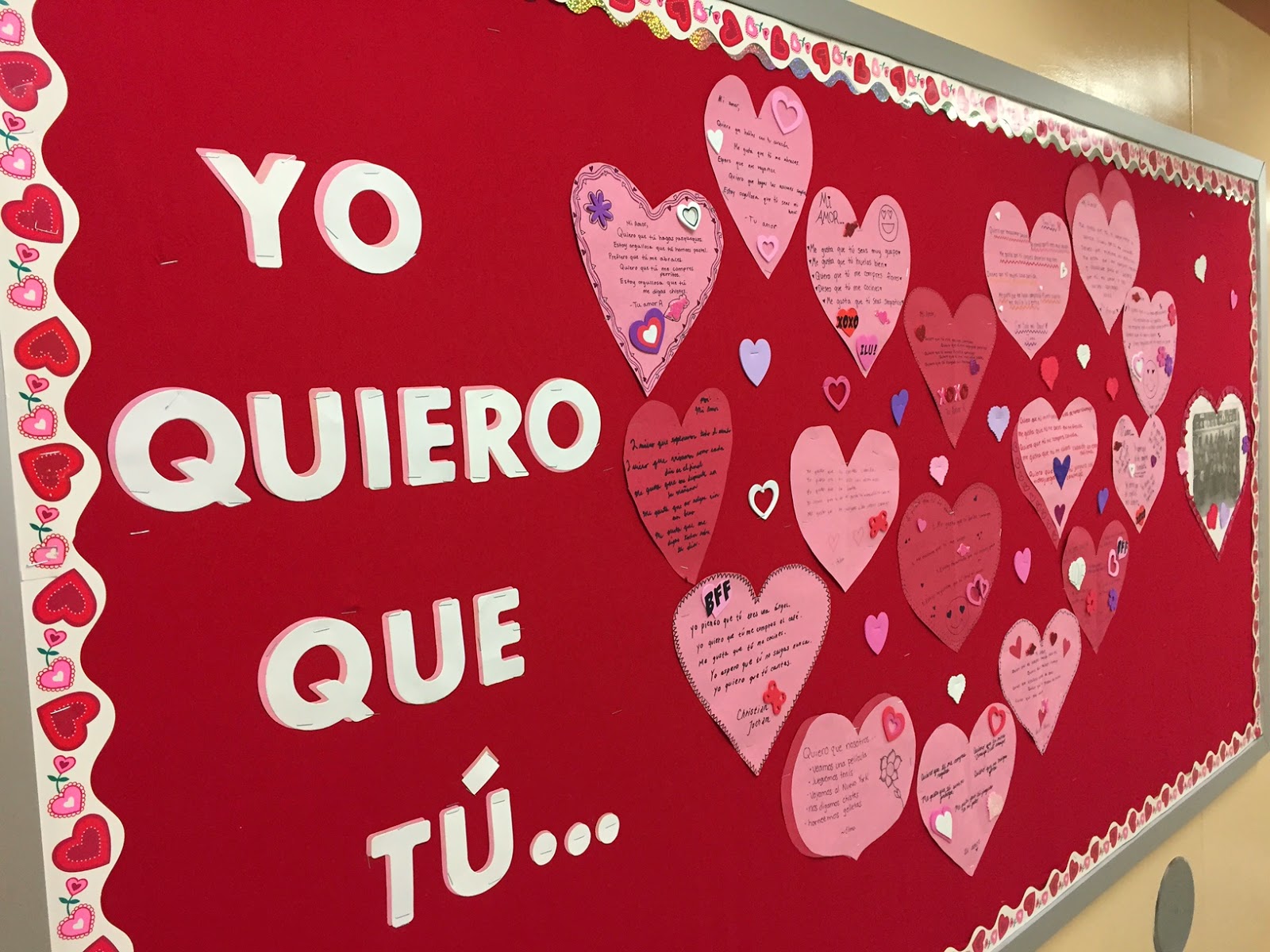
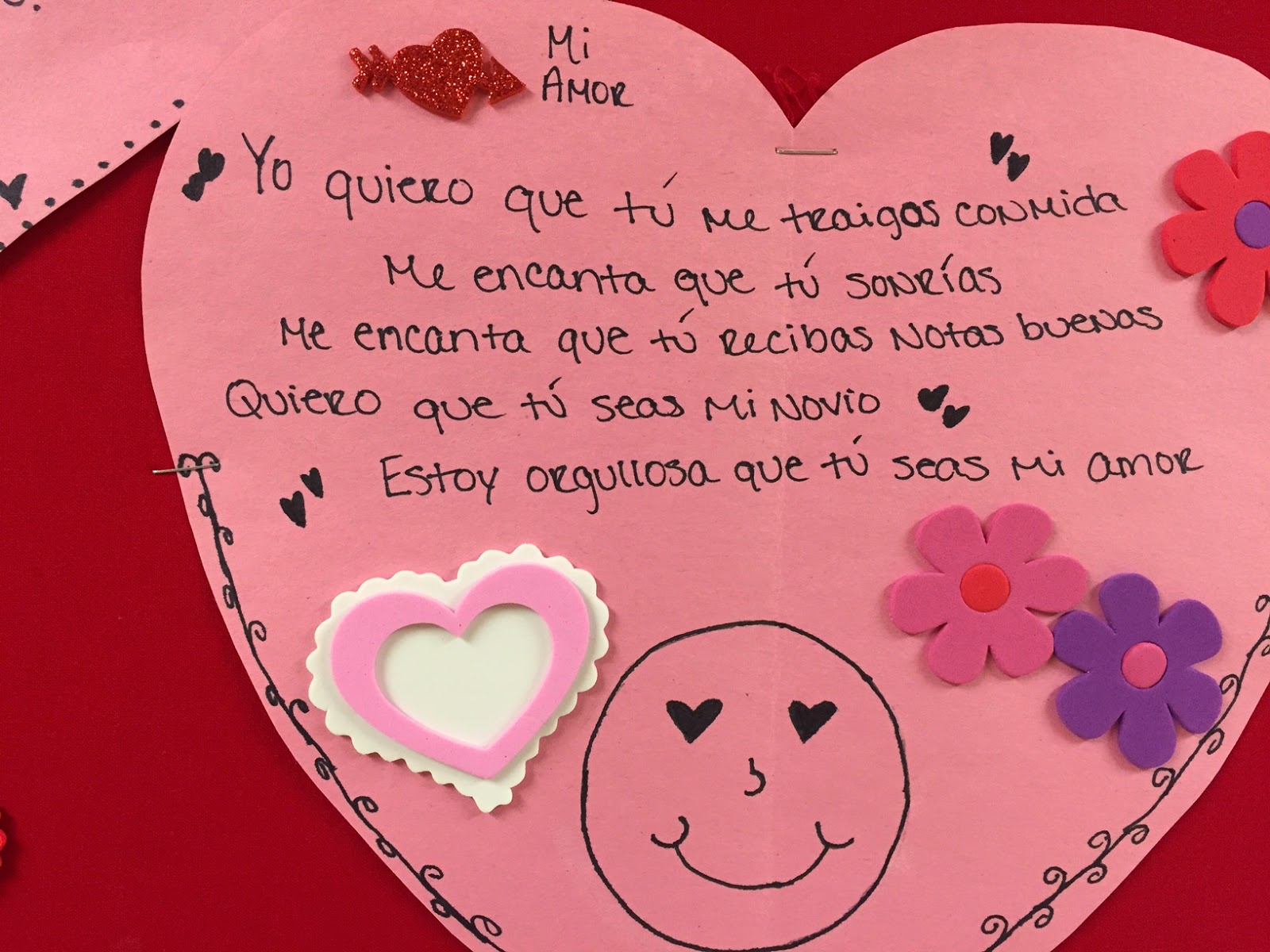 First, my students listened to Victor Muñoz's song, "Mi Princesa". They were familiar with it because I had played it during class changes earlier in the week. After listening to the song one time, I distributed Zachary Jones's cloze activity (found in his Cancionero 2012 book) for them to complete when we listened to the song again. We discussed the lyrics and the multiple examples of the singer wanting someone else to do something - Quiero que tú... (subjunctive indicator) .
 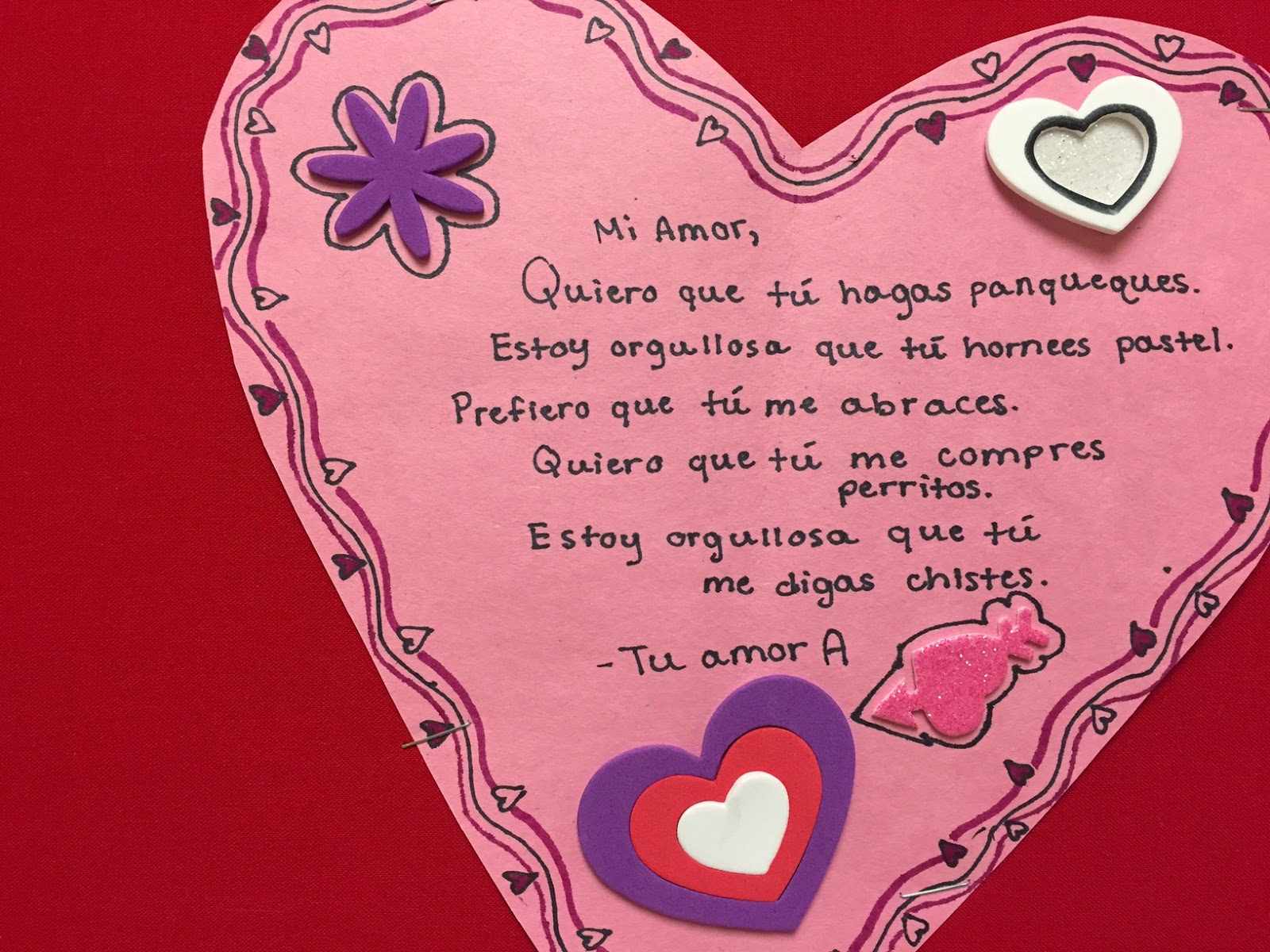 Then the students cut pink and red paper in the shape of hearts, wrote lyrics following the pattern of the song on their hearts, and embellished their hearts with Valentine's shapes.
 As a last minute idea, I decided to post the hearts on the bulletin board outside my room. The students helped me to arrange their lyrics hearts in the shape of one big heart. (My high school doesn't have an Ellison die-cut machine so when I have time to stop at the elementary school, I want to replace the temporary letters with some more polished looking ones.)
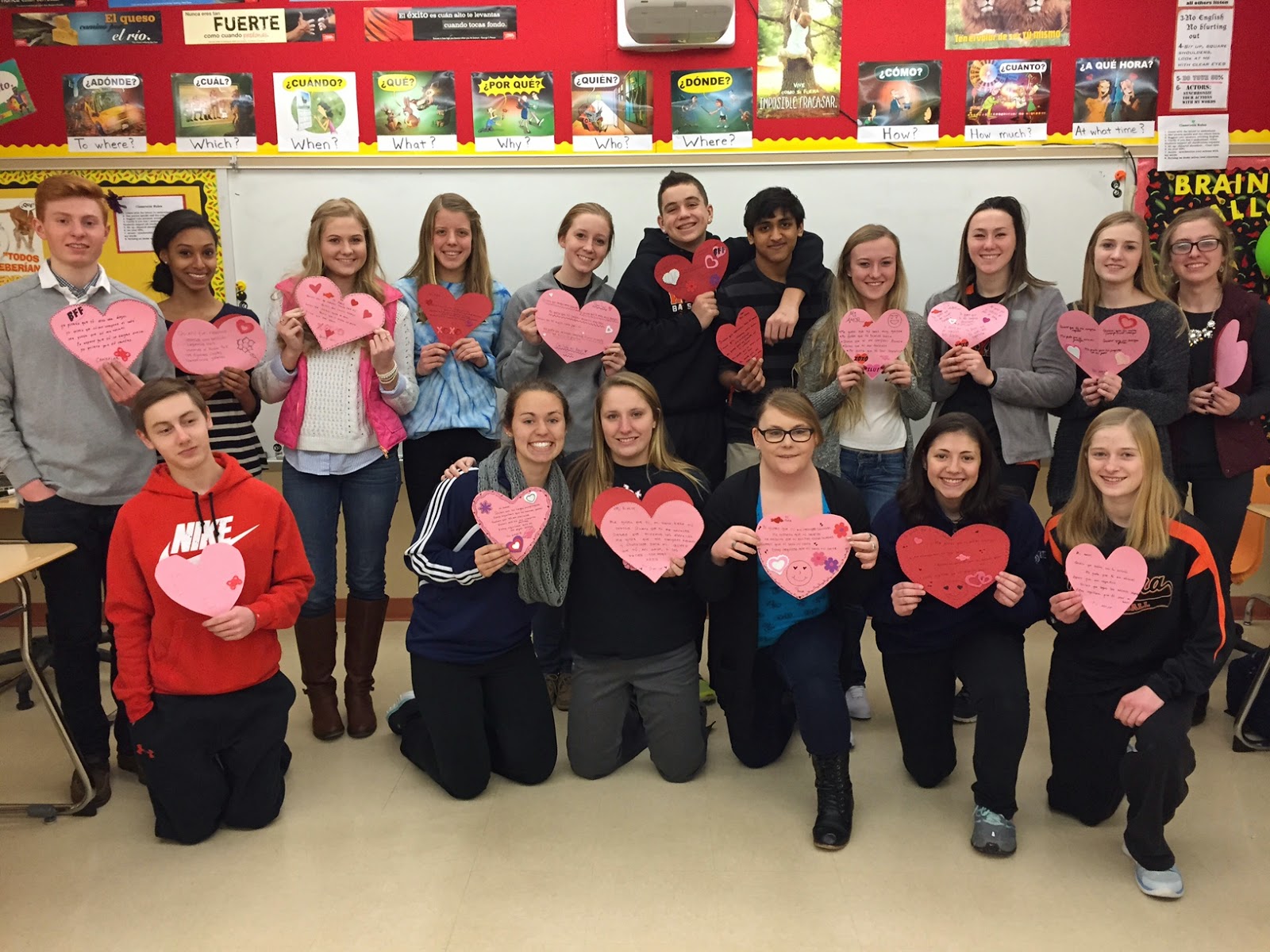 |
| Spanish 4 students with their (Subjunctive) Hearts |
Subscribe to:
Posts (Atom)