Showing posts with label Spanish 3. Show all posts

Sunday, October 20, 2019

10 Uses for Revista Literal: A FREE Spanish Resource

If you're a Spanish teacher and you haven't heard about Revista Literal yet, then I'm here to introduce you to this incredible resource.  Revista Literal is the brainchild of Martina Bex, a language curriculum specialist and also the founder of The Comprehensible Classroom, the SOMOS curriculum, Garbanzo language website, and creator/writer of endless resources on TeachersPayTeachers (not to mention a national presenter and keynote speaker.  I stated above, it is a FREE resource. According to the Revista Literal website, "Revista Literal is a monthly publication for beginning Spanish language learners written by Spanish language learners. Each month, readers submit short, original stories for publication." 

After students submit their stories, Martina invites native Spanish speakers to proof the stories and then she adds glossaries for the stories and volunteers add the English translations to the glossaries. After the stories are proofed and have glossaries, Martina places the stories in an online format, creates a title page listing the stories for the month, and adds graphics to the stories. She credits the writers of the stories using the students' first name and town and state, and credits the volunteer proofers and glossary writers. Then she publishes the stories online as a free resource for Spanish teachers. 

Then, voila, you have a free resource that comes to you each month to use with your students. Some of the stories are written in the present tense and others in the past.

Here are 10 ways to add the stories to your lesson plans.

1. Partner Reading. Students pair up with a partner and read the stories to each other for X number of minutes. This even works for your novice readers because of those beautiful glossaries for each story.

2. Extra Reading Resources. If you have students or parents asking what is available for a student that is struggling, or on the other end of the spectrum, a student that wants to continue learning beyond the classroom, tell them about Revista Literal. I download the resource (yes, you can download it if you prefer to read it on paper) and add it to our learning managagement system so it is always available to students.

3. Bell-ringer. Project a story from Revista Literal and ask comprehension questions for students to answer. Last week I projected the story "EL LABORATORIO" and alongside where it was projected I wrote the following questions for my Spanish 1 students to answer in English.

ANSWER IN ENGLISH:
1. Write 2 descriptions for Dave.
2. Write 3 facts about his job.
3. List 4 things about Karen.

Although I only asked for 2 descriptions for Dave, when I went over the answers with the class and a student responded with 2 of the descriptions, I asked what other descriptions were mentioned. I did the same with #2 and #2, Then we read the end of the story together.

4. Sub Plans! Use your imagination on how you can make your life easier when you need to be absent from work. Revista Literal will continue to provide comprehensible input to your students during your absence.

5. Running Dictation. Read Martina's explanation of Running Dictation here. If you want to put a new spin onto running dictation, use an online crossword puzzle creator and make a crossword puzzle of information from the story. You'll get double-whammy of reading out of the story because students read the story from Revista Literal (in the hall or wherever you have it posted) and then have to read the crossword clues at their "home base" in the classroom. 

6. Chronological Order. Pull some sentences out of the story that can easily conform to a timeline and have the students predict the order of the story. Obviously, do not read the story with the students before this. If you want to do this as a group, show (tape to the board) 2 of the sentences and ask students which one is first in the story, then add another sentence and students decide the placement of the third sentence. Add another and continue; students can change the order as new sentences are added and the story order becomes clearer (or they think it becomes clearer). 

7. Find It. Project the story, read it together with the students, then play Find It with flyswatters as explained here. 

8. Mosaic Story(a). Do this before reading the stories with the students. Pull sentences from 3 different stories from Revista Literal and list the sentences on one paper in random order. Write a brief description of each of the stories (brief!-brief!-brief!) in English (don't mention any of the characters in the story by their name in the story), and the students' task is to determine which sentences go with which story.

9. Mosaic Story (b). Again, do not read the story with the students before completing this task. Pull sentences from several stories and have the students create a story using the sentences. You could tell students they can omit X number of sentences and/or you can tell students to add sentences to make the story flow. The Mosaic Story (b) activity will provide your novice high and intermediate students an opportunity to create with the language.

10. Go crazy! Students use any sentences from the entire monthly issue to create a short story. Limit the students to 10 sentences or whatever number works best for you. Come to think of it, THIS would be a good emergency sub plan to have available when you need it. 

Obviously, since Revista Literal has stories, there are a boatload of possibilities. 

Thank you Martina for making teaching a bit easier.  ❤️


Saturday, September 14, 2019

The POWER of Daily Warm-ups (bell ringers)

How is it that I've only really experienced the power of daily warm-ups this year, after almost two decades of teaching? 

I've used warm-ups to start class, off and on during my years of teaching, but this year is when everything has come together, along with my determination to prepare daily warm-ups and my mindset on what types of warm-ups to use for students to receive the most benefit from them. 

When the teacher is consistent in providing daily warm-ups it provides a comfortable and structured start of the class for the students. I greet my students at the door and they in turn greet me with that week's password. When they enter the room, they see the warm-up projected on the board. They collect the things they need from their backpacks, grab a clipboard (I have a deskless classroom), go to their seat, and boom, they're immersed in Spanish from the very start of class.

My suggestions for creating warm-ups are:
-be consistent! 
-keep it short 
-always...go over it with the students
-connect it with previous lessons
-personalize it to students
-make sure students will be able to complete it without struggling 
-don't collect it (that's right - don't do that to yourself!)

Some benefits of daily warm-ups are:

- Immediately immerses students in language that is comprehensible: the emphasis is on "comprehensible language",  which puts students at ease and instills them with confidence because they know they can be successful in completing the activity

- Sets the tone for the class: we're going to utilize every minute of the class period in experiences that are designed specifically with the students' success in the language as top priority

- Connects to the students: use sketches that students created, and conversations/photos from previous days; students understand their contributions are important elements of the class and they are appreciated! 

- Creates a familiar setting/comfortable routine: students know the routine and are immediately put at ease as they follow the routine (benefits both the quiet students and those that are filled with energy that we may wish we had 😂)

- Provides quiet time: students that complete the warm-up know they will have a few moments to relax after they complete the activity as classmates finish up the warm-up

- Reviews material from previous day(s): reinforces the material introduced/ discussed in the past, providing additional input

- Informal Formative assessment: as teacher moves throughout classroom and glances at students' work, it gives quick feedback on students' progress 

- Provides time for teacher tasks: take attendance, catch absent students up to date, etc, 

Below are examples of the warm-ups I've used in the last few days

1. One of the classes created this OWI (One Word Image). I used the warm--up for all three of the Spanish 1 classes the following day.


2. I used SpanishPlans' lesson "El Niño quiere un dragon" (free on TPT). This was the warm-up the following day. It's the first time students had to form the sentence from scrambled words so I did not put any extra words in the sentences that were not needed. 


3. I created this warm-up based on the conversation I had with students the previous day. The lesson is from Martina Bex's Somos curriculum, Level 1, Unit 1 (free on TPT).  

4. New short stories using previous introduced vocabulary. I don't require students write answers in complete sentences at this stage of their acquisition.


5. OWI reading created previous day. I taped the drawing of the OWI on the board next to where this paragraph was projected for students to refer to.


6. Unscramble sentences. Students did a similar warm-up the previous week (see #2 above). The previous day I had a substitute so students listened to the first half of a story I wrote and put on a video, and then read the 2nd half of the story and answered comprehension questions. This warm-up is based on the video & reading from the previous day.


Yes, I create a new warm-up each day, but NO, it doesn't take much time.  


Saturday, May 20, 2017

Sub Plans that keep the CI Flowing

One of my least favorite tasks as a teacher is to write substitute plans. I can take the easy way out and have the students watch a movie. Movies have a variety of value: there are movies in the target language that students don't understand, movies in the target language with English subtitles, and movies that are in English but are culturally rich. 

What other options are available? What will keep the CI flowing even when the substitute doesn't speak the language you teach? 

Why not have a Spanish teacher in another part of the United States be your sub? Wait...What? Thanks to teachers that are recording themselves telling stories in the target language and making a concerted effort to keep the information comprehensible, language teachers now have another option for substitute plans. Use the videos of other language teachers telling stories that are on YouTube and Vimeo videos, and voila, that teacher can be your substitute for the day!

As more teachers are sharing their recordings online, I have been replacing old substitute plans with the new ones. Below are a few examples of how to write substitute lesson plans that will keep the CI flowing during your absence. The examples are of Spanish, but you can use the ideas for any language as long as you can find videos in your language.

1. Mike Peto!  @mike_peto on Twitter
Have you seen Mike Peto's videos on Vimeo?  If not, click HERE for his Vimeo account page for a list of his videos. In the videos he tells fables or stories that he wrote using high frequency words. He uses any tense that is needed to tell the story, but no worries - he is a genius at making it comprehensible and he uses his /or actions in the story.  At times, he writes the Spanish word and its English translation on the board.  Some of his videos he recorded during the actual lesson with students, so you can observe his comprehension checks with the students. There are other videos that Mike made without any students in class because he made them specifically for an absence this month.

The story I chose for my substitute plans on Monday (I will be attending my daughter's graduation to see her get her doctorate in physical therapy - yeah! - proud mom here) is "El cuervo tonto".   

First, my sub will hand out a paper with questions (see page 1 of 2 below) so students can read the questions to give them a heads up on the specifics they need to listen for. 

Then my sub will play the video and pause it when Mike instructs the students to sketch each part of the video. Students will answer the short questions during the story and complete the English translations as Mike explains them.
I need to add that I don't always have questions for the students to answer. Two weeks ago I was out and my students watched Mike's video "la señora" and their only task was to listen to the story because we were going to discuss it the following day. When I returned the next day, I drew the same sketches as Mike did and paused throughout to ask students questions about the characters and what happened. So...questions are not necessary, but for some students it helps to keep them focused on the story.

Click HERE if you would like to download the pdf of the questions for the "El cuervo tonto" story - 2 pages of questions/area to sketch and the answer sheets.

2. Pablo Román, @langdreamer on Twitter
Pablo is cranking out videos about Spanish festivals and holidays,  legends, and most recently, interviews with other Spanish speakers at the rate of almost one a day. Click HERE for his YouTube channel and check out his blog, Dreaming Languages. 

In the videos, Pablo is in the bottom corner and the rest of the screen he uses to sketch while he speaks to the listener. At times he inserts video clips to show a few seconds of an event that he is describing.

Below is a sample of how to add reading after viewing a video. This is based on his video "St. Jordi". I used this video on a day when I was NOT absent, but with the paper attached below, you could leave it as a sub plan.

1. Watch the video. I paused the video at the end where you can see all of the sketches, and the students and I discussed and retold the story. If this is your sub plan, skip the retell until the day you return.

2. Distribute the paper and students will match the sentences to the screenshots of the sketches.

3. Distribute the script below for the students to read.

The documents for this lesson are HERE. 
(To be clear, these lessons were NOT planned in collaboration with anyone, but rather I saw the videos online and then created lessons from the online videos that I can use in class.)

3. Cameron Taylor @Profe_Taylor
Cameron is a Spanish teacher in Japan. His YouTube channel is HERE and his most recent (I think) video is "Habla demasiado". His technique is very similar to Mike Peto's, in that he tells a story and makes it comprehensible due to the vocabulary he chooses and the sketches. Please note that Cameron's purpose of making the videos was to share with others HOW he does "storytelling" with his students. It is was not shared with the intent to have other teachers use it for sub plans, but I quickly saw the possibilities in providing CI for a substitute plan with this, and other of his, videos.

I do not have a specific document created for the story "Habla demasiado", but my students will read the story script after watching the story.

Two variation on the story scripts (the written text)
a. Omit a few details of the story in the script on a document you create and replace it with lines. Then together as a class, you can fill in the missing information and write it on the lines on the document.

b. Ten Errors (or however many you choose). When you write the script, make 10 minor changes to the details. After the students have watched the video and after you have discussed it or acted it out, distribute the document with the 10 errors. The students' task is to find the erroneous information and replace it with the correct information. (i.e. - if the story said he had two dogs, change it to 3 dogs or to 2 cats.)

4. BookBox
BookBox is a website with children's stories in the target language with subtitles. It has many books for Spanish, as well as a few stories for other languages such as French, Italian, Urdu, and more. This website also provides PDFs for you to download. 

I made a very basic story listening document with questions for my students to complete while listening and watching the story online.  (The screenshot does not show the entire document. If you would like the document, click HERE.)


OPTION: Instead of having students answer questions, the students could listen to the story one time. As they listen/watch it the second time, have them sketch the story that you can use as a retell using a document camera later in the class or on another day.

These generous teachers, and the Bookbox website, are my new go-to lesson plans for substitute teachers.  Feel free to download any of the documents that may be useful to you. They are available at no cost. HOWEVER, what I would like to ask in return, is if you like these options and create something to be used with a video similar to the story videos above, please share it with me.   :-)

Wednesday, February 10, 2016

3-STEP No PREP Extended Reading Activity!

This has to be one of the easiest, no prep extended reading activities ever. You can use it with any text to which the students have access such as:
- a novel (after reading & discussing 1 chapter or several)
- a Movie Talk with an accompanying script 
- a class story with an accompanying script

Part 1
1. Students choose a partner. Students may use the text (book) or script (Movie Talk or class story) for the first part of the activity.

2.  Students write 3 sentences.  Two are TRUE and one is FALSE using the text.  They may copy the sentences directly from the text for the two true sentences.  For the false sentences, sometimes the only thing they will need to do is change a word or two in the text to make the statement false.

3. While students are writing their 3 sentences, the teacher uses a marker and writes a letter of the alphabet on each of their papers. (I had 14 groups so I wrote the letter A on one paper, B on another, etc.)

Students stay with their partners for Parts 2&3 of the activity.

Part 2
4. After students have written their 3 sentences, they tear off the bottom part of their paper and write the letters A-N (or however many groups you have). This paper will be their answer sheet.

5. The teacher directs students in which way they are going to pass the paper with the 3 sentences. They read the paper passed to them, decide which sentence is false, and write the # of the false sentence after the corresponding letter on their answer sheet.

When students have read all of the papers and decided which sentences were false, they hand the papers with the 3 sentences to the teacher.

Part 3
6. The teacher starts with paper A and the students call out which sentence was false. (I read the letter only and I did not read the three sentences. You could read the 3 sentences before asking students which was false, but the students had already read them one time and I wanted to keep the activity moving.)

7. The teacher reads the false sentence and then asks for a volunteer to change the sentence to make it true.

I told you it was an easy, no prep extended reading activity.  The best part is the students copied the sentences AND re-read a lot of the sentences from the text, which was my original goal.

Friday, August 29, 2014

Brain Break Balloons

My new Brain Break Balloons! bulletin board needs a few more balloons and it will be ready to go next week.  I have 70 minute classes and when students are listening to the target language for 90%+ of the class period, their brains definitely need a break. 

I searched Pinterest and other places on the web for ideas for brain breaks.  Then I wrote the brain break activity on a piece of paper and put it inside the balloon before I blew up the balloon.  I stapled the very end of the balloons to the bulletin board.  When my students need a brain break, I'll choose a student to pop a balloon, and the activity listed on the slip of paper inside the balloon will be our brain break activity.

There are a mixture of activities in the target language (such as listening to a Sr. Wooly song) and other activities that aren't in Spanish.  After all, it is a Brain Break, so maybe a break from the language is the route I should take.   

UPDATE:  Martina Bex wrote a post about the science behind Brain Breaks PLUS she made a document of a list of brain breaks which you can download, for FREE!, from TPT. 
- Click HERE for Martina's explanation of the science of Brain Breaks.
- Click HERE for Martina's Brain Break ideas document on TPT. (She also has a large collection of lessons, cultural readings, games, and other useful materials at TPT, so check those out also.)

Some of the activities in the balloons are:  
- watch one of Sr. Wooly's videos
- Simón dice (Simon says)
- Stand up, arms outstretched, palms facing outward, move left hand back and forth and move right hand up and down at the same time; then switch;
- Sing "Los Pollitos Dicen" w/out lyrics: http://youtu.be/oTApI_rUZ2E w/ lyrics: http://youtu.be/PVv7pIssaMc 
- Bolsa Fea - 3 words 
- 5 a Day Hula  
- Teacher chooses a photo from this blog post and students work with partner or small group to create the best caption (in TL or English, may depend on level)
- hokey pokey led by student
- jumping jacks
- Akinator app (1 time)
- Athlete Quotes - read one of the quotes on this site and give the students three choices of which person said it
- Write a statement on the board, such as "My favorite dessert is_____"; the teacher reads the statement and fills in the blank then tosses a bean bag to a student and the student says the statement, tosses bag to another student, etc.
- there are others, but I can't think of them now. I guess I'll have to wait until the students break that balloon to add it to the list.

Newest update: Did you see the "Go Find Momo" photos?  Today Meg Villanueva posted THIS LINK on Facebook, or go directly to the site at http://gofindmomo.com/ . If you want to use the TL, ask students to say where the dog is in the TL, ex: on the left (a la izquierda), etc

Sunday, August 3, 2014

Novels for Spanish 1 through Spanish 5

At my school district, we stress the importance of reading in the target language with our students.  In each level of Spanish, from the introductory course at the middle school, to level 5 at the high school, we read novels with our students. In Spanish 1 through Spanish 5, we read a minimum of 2 novels.  In levels 4 and 5, students are also required to read a novel on their own (outside the class time) per marking period, for a total of 2 additional books per level.

Several teachers have asked what novels others read with their students.  The purpose of this post is to share what we've found to work at our school.  As we constantly review our curriculum and our students' needs, we sometimes need to make changes and adjustments at which level the books are read.  Also, with the growing number of writers publishing new books, the choices are even greater and sometimes we find a new book is a better fit with our curriculum. In order words, our curriculum is a living, changing documents; an aspect I appreciate!

Also, please note that there is a variety of authors represented in the books.  I believe the students benefit from the different writing styles of each author and I look forward to even more new authors publishing books in the future. (Ahem - maybe that will be YOU!)
We are working on updating our Spanish 1 curriculum and during that process we will decide which two books ALL Spanish 1 teachers will read with their students.

Under the photos of the Spanish 2 books, I listed (some of) the major themes in each book.  Our "units" are built around the books and the themes/subjects. 
 
 
There may be changes in level 3 when we update our curriculum.


Last year I read Esperanza with my Spanish 4 class. The publisher of "Esperanza" lists the book as a level 1 book, but it also easily fits into higher levels because:
1) It can be very beneficial for students to read a book that is "below their level". I like to begin the semester with a book that all students feel successful when reading it.
2) This book deals with immigration and Spanish 4 students are better equipped linguistically to hold meaningful discussions in Spanish regarding this issue.
We did not read La Hija del Sastre in Spanish 4 last year, but we will be reading it in both Sp4 and Sp5 this school year.


Last year I had a mixed Spanish 4 and Spanish 5 class. Since the Spanish 5 students had already read the Spanish 4 novels, I read La Guerra Sucia which we usually read in Spanish 5, and added Felipe Alou and La Calaca Alegre.  

This year, some of the students now in Spanish 5 that were in the mixed Spanish 4/5 class last year, have already the Spanish 5 novels, but since I piloted a book last year in Spanish 5, we didn't read La Hija del Sastre (as we usually do in Spanish 4).  My plan is for the Spanish 5 students to read La Hija del Sastre and La Llorona, along with other legends and short stories, (i.e. Chac Mool, La Conciencia, Cartas de amor traicionado),  so as not to repeat the books they have read before.  

The above books and teacher's guides can be purchased at the following:
I recommend visiting these sites to discover other books available to use with your students. 

There are so many great books not listed above that I would love to read with my students, but the limited time does not allow me to do that.  My dream is to have a Spanish reading club, but...somehow I doubt that would attract a crowd. :-)

Please note: In my school district, each Spanish level consists of 90 days of 70 minute classes.  Final exam days, interruptions and short or missed classes due to state testing, weather delays, and assemblies, are included in those 90 days.  The reason I mention that is to make you aware that when students complete Spanish 5, they actually have LESS hours of instruction in the classroom than most students, at other schools that finish Spanish 4, with 4x4 block schedules or the traditional schedules.  In reality, our level 5 is level 4, our level 4 is level 3, etc. Our level 5 is NOT an AP class.

Sunday, July 27, 2014

10 First Day of School Ideas for the MFL Classroom

It's closing in on 2 months since I wrote my last post and now it's closing in on the beginning of school.  The opening day of school for me is less than a month away and thoughts of planning for a new group of students are more frequent. In particular, my thoughts are on the first day of school.  

The list below has some ideas I used in the past, some I found on Pinterest, and from blogs.  A few are ready to go as listed, and others will need changed depending on which level it is used.  The goal is to provide comprehensible input in the target language, even on, or better said, especially on, the first day of school!

Reminder: If the activity requires output in the target language, I suggest to dismiss it for beginning levels, or tweak it and/or provide the scaffolding needed to make it level appropriate.   

1.  Summer photos.
Last year before school started, I emailed my Spanish 4 students and asked them to send me a photo of something they did during the summer.  I put the photos in a powerpoint and our discussion was based on the photos.  It helped the students, and me, to learn about their classmates. This year I may create a Google presentation and share it with the students which will allow them to add their pictures on the presentation. (Work smarter, not harder, right?)

2. A Story!
I used this activity in the past for the first day of class (semester class that started in January) with students that had no exposure to the past tense before.  They had 70 minutes of comprehensible input of the past tense and left class feeling confident that learning does happen when the language is delivered in storytelling format.

3. Schools around the world.
Why not spend the first day of school talking about what your school has in common with other schools around the world?  Click here for a powerpoint of photos of schools around the world, or here is another option. The photos will help to keep the questions and discussion comprehensible.

4. Mafalda: Primer día de escuela
Dive right in and start the school year with a MovieTalk activity. Click HERE for the 45 second video about Mafalda's first day of school.  When I use this video I'll ask them about walking to school with their parents (more like did their parent drive them to school) and if the floors in the hallway were filled with charcos (puddles) from all the students crying. HaHa - this should be a fun discussion!

5. Personal word Clouds.
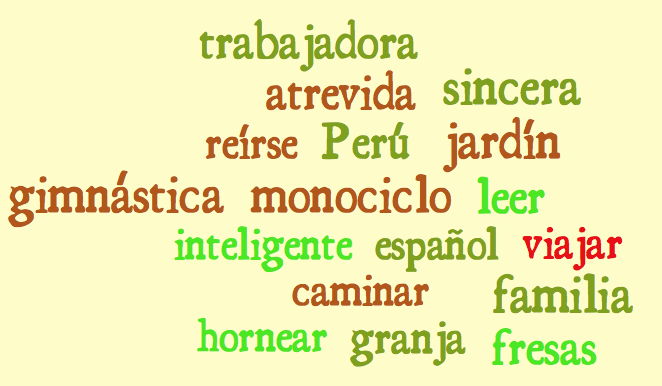
This isn't suitable for beginners, but is another type of get-to-know-your- classmates activity that is suitable for levels 2 or higher.  Choose your favorite word cloud site and fill it with words that describe you, activities you like, or places you have been.  After the students see the teacher's model word cloud, give them the assignment to make their own, but not to include their name.  (My suggestion is not to have the students make this in class, but rather give students 1-2 days to complete the activity.)  

After the students have submitted their word cloud, you can choose several (2-3) to show to the class each day.  Students will guess which of their classmates made the word cloud and then continue the discussion about the student.  This will provide you with more than a week of student-centered topics to set the foundation of a student-centered classroom.

6. Student picture collages.
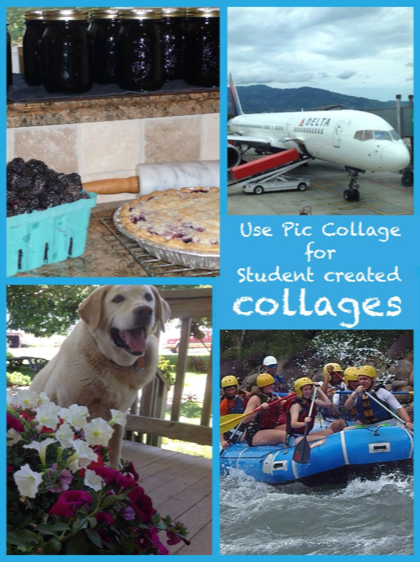
If you haven't added the Pic Collage app to your devices yet, then wait no longer! The app is user-friendly and I continue to find more classroom uses for it. 

This activity is similar to the Personal Word Clouds listed above, but instead of words, students will make a photo collage. Students can use photos from the app or their own photos, as long as it doesn't include people in the photos that will give away who made the collage.  These collages can be printed out to put around the room, or put on a powerpoint or Google presentation. Lead the discussion around the pic collages and the students' interests.

    (If you want to keep it uniform, set guidelines such as: include x no. of photos, 1 should be of an activity, 1 of your favorite food, etc.)

7. The TOP 10 List.
I did this activity several times in the past with my upper level classes.  I give them large sheets of paper and tell them to make a TOP 10 LIST of reasons to learn Spanish.  I encourage them to use their imagination and make them funny, and they have never failed to disappoint me.  

Below are more ideas that I found on Pinterest:

8. M&M game!
Most students are going to be excited about getting chocolate candies on the first day of school, or from my experience, getting chocolate on ANY school day is memorable for them.

The blog post found HERE, explains the M&M game.  It's not a beginning level activity for a second language class because it requires output, but higher levels will enjoy it.  

9. The Name Game 
The teachers from the Creative Language Class blog describe how to use the Name Game on the first day, even with level 1 students. 

10.  Memorias de un verano maravilloso
A Pinterest find. Click HERE for a free download that students can sketch or write their answers.  

Also check out:

- Show what you know (from the Creative Language Class) 

- What does this make you think about? (from Martina Bex)

- Cognate Practice (from the Creative Language Class) 
 
- Todo Sobre de Mí (from Carolina Gómez)

- Getting to know you grid (from Methods and Materials for WL Teachers)

Do you have a favorite activity for your first day of class or are you planning something new that you would like to share?  I'm sure there are other great ideas that I overlooked.

Tuesday, October 15, 2013

Ticket out the Door + Monday morning review

If you are reading a novel with your students and want a short review on a Monday morning after students haven't seen the text for 2 days, or any morning for that matter, here is a quick review that your students can make for you.

Student sketches for review and ticket out the door
During the last 3-5 minutes of class, (they won't need more time so don't waste time by extending it), give the students a piece of 8 1/2 x 11" copy paper. They should fold it hamburger style and tear it into two pieces.  Then tell them to sketch two things that happened in the chapter that are important to know.  Before they leave, they hand their two sketches to you and, if you need a ticket-out-the-door idea, they can say one sentence about one of the sketches they drew. ba-da-ba-da-BING! A review and a ticket-out-the-door, all rolled up in one!

Trust me, even if it is a short chapter, there will still be many different sketches because each one has their own idea of what was important in that chapter.  Also, some students that aren't artistic may choose something easy to draw instead of the important events of the chapter. No problem. A large variety of sketches is good.

On Monday morning, put the sketches under the document camera for all the students to see (or fax them to your computer and project the file onto the board), and ask the students to come up with sentences that describe the sketches.  The sketches will keep their attention because they love looking at their own sketches or those of their friends. 

There are other activities you could do with the sketches, but this one requires very little of your time and it is a good way to remind the students of the events in the previous chapter before continuing with the next chapter.

Friday, March 29, 2013

Short Films & CI: MFL Teacher Collaboration

Last summer at NTPRS12 I met Marta Yedinak, (@mryedinak on Twitter), a Spanish teacher in Wisconsin. Since then, Marta and I have been communicating through emails, phone calls, texts, twitter messages, etc. and sharing our Spanish lesson plans and activities.  Marta had an awesome lesson last week and I invited her to write about it on my blog.  Due to technical difficulties, (on my part, I'm sure), I'm writing the post in her place, but I look forward to having Marta as a guest writer on this blog in the near future!

Marta's Lesson Plan for MFL: Sheep in the Island

1.  Preteach any vocabulary that your students will need to know in order to discuss the video.  Beginning level students should already know basic words such as: corre, grita, se sube, se baja, está furiosa, tiene hambre, but you may need to preteach words such as "chocaron" (they crashed), to describe what happens with the two ships. (Use whatever level of grammar/verbs that is suitable to your class.)

2. Show the video to the students.


3. Story Sequence. Instead of writing a paragraph, students write a list of the events in chronological order in complete thoughts with a partner.

4. Group retell. Students take turns dictating the story as the teacher writes their sentences on the board.  This is the ideal time for pop-up grammar and circling the structures. Students WERE NOT required to copy the story into their notebooks.

5. Class Debate.  Students decide "¿Quién tiene la razón?" which is also the name of a show in Univisión.  Students had to present arguments to defend the sheep or the monster.  Marta said she wished she had videotaped the debate because it was "great" because the students were engaged and responding well.  Several students were using phrases such as "Protesto..." and they ended up having a trial!  

Marta said the next time that she does this activity she will have the students impersonate the characters so they can "interrogate them" as witnesses in a structured trial format.

6. Timed Writing.  Allow 5 minutes of class time for students to retell the story in written format.  (If the students heard a sufficient amount of repetitions of the structures throughout the lesson, this exercise will come naturally to them because it will "sound right" to them as they write.)  The Timed Writing file can be found HERE. Note on the form that the Timed Writing is not for accuracy, but rather to encourage writing.

7. Additional segments.  There are Part 2 and Part 3 segments of this video that can be used for additional activities.

Extra activities that may be added to Marta's activities as time permits:

8. Name who did the action (I have a worksheet for this available that you can find HERE.)
9. Story script (for upper levels).

10. Word Cloud. Show the word cloud to the students either before or after viewing the video.  If before, students read the word cloud and decide on possible story lines based on the words in the word cloud.  If after, students take turns saying a sentence that uses one of the words to describe an action in the video.  Another option, the teacher gives a definition in the TL and students look at the word cloud to find the word that the teacher defined. 

Get Adobe Flash player


Update: There is no longer a free version of Textivate in which you can upload your own materials. 
 11. Textivate activities. The free version of this site allows you to upload your text and make your own vocabulary and matching activities, but you can only embed and share those activities if upgrade to a paid subscription.  However, if you paste the text below into the text box on the textivate website, you will be able to do a variety of activities with your students. Thanks to Martin Lapworth, the creator of Textivate, for making tutorial videos (found HERE) to explain how this website works!
screenshot from Textivate website

###match###
the claws of a monster==las garras de un monstruo
went to investigate==fue a investigar
she tied the foot==ató el pie
she pushed the other box==empujó la otra caja
she flew across==voló a través de
the sheep escaped==la oveja se escapó
lit a fire==encendió un fuego
she fell to the sand==se cayó a la arena
looked at a frog==miró una rana
inside the box==dentro de la caja
she closed the lid==cerró la tapa
there was lightning==hubo relámpago
she became very aggressive==se puso muy agresiva
she imagined that the monster was a chicken==imaginó que el monstruo fuera un pollo
trying to escape==tratando de escaparse
the waves pushed the box==las olas empujaron la caja
a chain==una cadena
he grabbed the fork==agarró el tenedor
he hit the box with a tree==pegó la caja con un árbol
he wanted to eat it==quería comerlo
was floating in the ocean==estaba flotando en el océano


Also, if you paste the typed text of "Sheep in the Island" from #9 above, you will be able to do additional activities in story form.

Saturday, October 27, 2012

La Bolsa Fea - Negotiating Meaning

This is my Bolsa Fea. Two or three times a semester, if I have ten minutes remaining during a Spanish 3, 4, or 5 class, I pull the "Bolsa Fea" out of my closet for a listening activity.

The Bolsa Fea is filled with random words on small slips of paper. First I put the students in groups of 3 and give each group a mini whiteboard. I define and explain the word in Spanish, wait a minute for the students to discuss among themselves, and then they write the word on their whiteboards.  Most of the words are not ones they know in the target language so they write the answer in English.  Some examples of the words are: roadblock, soundproof room, and boar.  

The purpose of the activity is for the students to listen for meaning, not to learn the obscure words that are not high frequency words.  Two or three times a month, I visit my friend from the Dominican Republic to chat with her in Spanish. Talking with her gives me the opportunity to listen to a native speaker and to listen for meaning around some words she uses that I don't know.  Students need to realize that if they talk with a native speaker or read a text that wasn't written specifically for a 2nd language learner, and they don't understand every single word, they can still understand what they hear or read from looking at how the words are used in context and using those context clues to find meaning.  

The students enjoy this activity, so I'm careful not to overuse it.

A side note: I don't think the purse is "ugly" per say, but it certainly is not my style. I called it "Bolsa Fea" one time and it stuck.  

Click HERE for the list of words that I currently have in la Bolsa Fea.  There are some words that students may already know in Spanish but I don't discard those words because it is still a good word to describe to them in Spanish.  If you teach lower levels and describing these words are too challenging, make a list of more basic words, even many that students know, and the activity will work just as well.

Thursday, March 15, 2012

"We're Going on a Bear Hunt"

http://bit.ly/zuhHOC
Do you remember the children's activity, "We're going on a bear hunt"? It is a story for children and as you tell the story, the children do actions with you. I did something similar to this with my Spanish 3 students today.

This week our juniors are taking high stake state tests in the morning. By the time I see them in the afternoon, the second to last period of the day, they don't have much left to give. Today, they were taking the second part of a test and by the time they were finished, there was only 22 minutes remaining in class. My lesson plans called for a TPRS story. However, after taking a quick inventory of their body language - slouching, droopy eyelids, wiped out expressions - I was afraid I wouldn't get quality participation because they were so worn out. Just then a thought crossed my mind and my plans were diverted.

I took the story I was going to use for TPRS and wrote 20 of the words on the board. Some were vocabulary words they had just learned, and others were new or ones we hadn't focused on. I told the students to stand up, (the first crucial step to help breathe life into them again). We went over the list of words for their meaning and then I asked them to come up with motions for each word - and they didn't disappoint me - the motions were fun and energizing. After 7 words we stopped and practiced them; then did the same thing with 6 more words; reviewed all; and decided on motions for the last set. I told them we were ready to start the story, and I quickly got a protest that we hadn't practiced all of the words together. No problem, more repetitions.

Now that we had the motions down, I told them that I was going to read the story and when they heard one of the words that we had made motions for (they were in the correct order of the story), they should make the motions. I read three sentences and they did the motions. One student asked for clarification, so then we started from the top again. The second time I got through the first paragraph, the phone rang - a counselor wanted to talk to one of the students. So, we started from the top...again. This was the 3rd time so they had the motions down perfectly.

We made it to the end of the story. I then asked them to tell me in English what happened in the story. Three students, that always participate raised their hands, but then I saw another student that doesn't participate as much as the others, with his hand raised and I knew the English translation was his. He did a great job, and when he missed the part about the fast food, others were quick to add it, and when he had a few questions about some parts, others helped him with the details.

We finished with 4 minutes left. No way was I going to lose those precious 4 minutes. I asked for 2 volunteers and they picked a partner to work with them. They went to the front and I told them that I was going to read the story again and the class would vote on which group did the best job with the motions. The class enjoyed watching the 4 students and I liked the fact that they were hearing the story AGAIN.

When the bell rang, I watched and listened as an energized, chattering, smiling group of students left my class. What a difference from 22 minutes ago when they were ready to slump over their desks and call it a day. Another plus - THEY energized ME!

Wednesday, February 1, 2012

MAGIC happens when you least expect it

One thing I love about TPRS is that you never know when the students will help to spin a story that turns into MAGIC. I'm learning that many times this happens when you don't follow your plan A. Susan Gross explained to me that the story I have planned should be considered "Plan B", one that should only be used if all else fails. After she said that, I realized that the day before, I had experienced exactly that with my Spanish 3 students. Below is how I shared the story with Susan Gross last week:
I can relate to what you said about my story being plan B. That happened to me on Friday. I wanted to review le/les gustaba(n) and en vez de. But, during PQA I found out I was the only one in the classroom that had never heard of the singer "Drake". When they asked me what music I like and I said Brad Paisley, one of the students (a great guy that has a great sense of humor) said, "oh, you're country" and then made kind of a "duh" sound. And a that moment I remembered a story about a guy that goes into the town village every day. All the villagers think he's dumb so they offer him a nickel or a dime and he always picks the nickel because it's bigger. They laugh at him because they think he's stupid and the next day the same thing plays out. This continues every day. Then one day a stranger sees this take place and pulls the guy aside to tell him he should pick the smaller coin because it's actually worth more. The guy then says that he knows that, but if he picks the dime, they won't offer him the choice every day and he won't be able to pocket the 5 cents every day.

I knew that the words for city and country were coming up in the near future so I decided the "dumb" person would be from the country and he would go into the city every Wednesday. When I asked the kids who the person from the country is, of course they said "Sra. Hitz". (The previous day we had a discussion, in Spanish, about how I live on a farm and that I wake up at 4:10 a.m. every morning to feed the cows before I come to school and at times help deliver calves - yes, even to the point where my hands go where no hands should ever go in a cow. If you live on a farm you know exactly what I'm talking about.)

So, I chose actors to play the other parts, and of course I played myself, and you know what Susie?, I had a blast and the actors were awesome. The students were so focused on what was going on in the story. It was PURE MAGIC! Of course then the story was over and I laughed when I saw my "focus words" of gustar, etc on the board and someone said, "Yeah, whatever happened to the person going to the Drake concert?" and right on the heels of that comment another student said, "I like stories. I learn a lot" (or something similar).

I know I can't expect that every day, or at least not until I relax more and learn to let things play out in a natural way, but WOW, it was enough to energize me and make me want to see it happen again.

That happened last week and to my surprise, my students in my two Spanish 4 classes served up more MAGIC yesterday when we talked about the fears of some of the students. (Who would have thought that a high school student would be ok with acting like a bird?)

Be assured, this
MAGIC doesn't happen every day in my classes. Admittedly, there are days when the story just falls flat and I'm left wandering what went wrong. But, just knowing that the potential for that energizing MAGIC to pop up at any time is there, makes the start of each story an interesting and unpredictable adventure.

Thanks Susan for telling me to move my Plan A to the Plan B spot and leave the door open for
MAGIC to enter the classroom.