Showing posts with label readers. Show all posts

Sunday, August 9, 2020

More Social Distancing = More Social Networks


While we are social distancing when we are in person, Social Networks are the exact opposite especially when it comes to announcing offers for bundles of online books and FVR libraries. 

With COVID-19 concerns, the procedures for sharing materials (books) are more restrictive and not permitted. Publishers have seen this need and responding with what feels like a new offer popping up each week (in fact I had to update this post before I even published it!) My school has made it clear that there is no money for purchases, so at this point, anything I buy for the students will be out of my ow pocket. I’m still trying to determine which is the best option, or if I need to change up my curriculum and format for FVR and make it work with the books I already have. (Option: I have class sets of various books so I could have each class read a different book, but oh, the extra planning, time, and energy needed for that exhausts me just thinking about it.) 

E-book, and FVR libraries, and good deals - oh boy! 

Over the years I have spent much of my school department money on books for my students - class sets and books for my FVR library. I’ve also spent an untold amount of my personal money buying new books at conferences, from publishers, and from Amazon.

These are the offers that I know of for online FVR books and for class novels. They are listed in alphabetical order. If you know of others (appropriate for the needs and levels of non-native learners in a K-12 setting) and want me to add them to the list, let me know. 

- E-lit App - Combination of French, Spanish, & Japanese titles
*Unable to verify when this app will be available. 

Check the website for the current number of texts and novels included in the offer.
Digital subscription library with leveled texts and novels, states more texts/novels are being/will be added; online access through August 31, 2021, $199 for 180 students’ $249 for 250 students; $299 for 350 students
Price available through August 31, 2020

- Fluency Matters - online FVR library - French, Spanish, & German novels
Various choices depending on the target language and number of books in the offer. Order in multiples of 25.

Baker’s dozen, 13 pre-selected Spanish novels, 1 year online access,  $50 for 25 students
Six pre-selected Spanish novels,1 year online access,  $25 for 25 students
Current price available through Sept 30, 2020

- Mira Canion - online FVR library or individual books - Spanish novels 
Each package below is for 1 teacher, up to 300 students, for one full year from date of activation (“renting” the books online)
1) A Single title written by Mira: $68. 
2) 8 Spanish books written by Mira; online access for up to 300 students for one full year, $258 thought August 31, 2020; $298 after 8/31/2020
3) Elementary FVR Library - 4 book titles, $108 through August 31
4) 10 titles - Mira’s books and other authors, Spanish 1/2 FVR Library - $298 through 8/31/2020
5) 10 titles - Mira’s books and other authors, Spanish 2/3 FVR Library - $298 through 8/31/2020

- Mike Peto - purchase individual online books - Spanish, French, German, Japanese, Portuguese & Latin
The online access to the books you purchase is available through July 1, 2021. It appears as though there is a sale currently going on with book prices of $24.99 for up to 300 students and 1 teacher. 

- Storylabs - Spanish, French, Latin, and English novels & stories
You’ll have to check this website yourself because there are many different price points. For example, one book is listed at $249 for 180 students and with Teacher resources available; while another book is listed at $60 for 175 students. My guess is that each author set the price, but I don’t know that for sure.

It appears as Storylabs doesn’t offer anything similar to other publishers in which you can have a collection of texts/novels for a set price. If Storylabs does indeed offer a collection for a set price, I was unable to find it on the website.  


Two years ago, the blog “Spanish mama” posted a list of free online resources. I have not checked if all of these are available still today, but it may be worthwhile to check out the post HERE.


Note, there are other online resources available at different price points but I am not going to list them here because there are many and, for sure, I will end of making an incomplete list. What I suggest you do, is check the Facebook groups listed above and scroll through the posts. When people find resources, or when they are introducing and/or “advertising” their resources, they generally post it on a Facebook group where others will see it. 


Wednesday, September 12, 2018

Leer es Poder

The World Language department at my school is making reading in the target language a priority this year. Below is the bulletin board outside of my Spanish classroom and Krista Kovalchick's French/Latin classroom. There are four 5x7 photos of the 4 WL teachers and the other photos are some of the students in Krista's and my classes. There are a few photos that we will add in the next few days to complete the bulletin board.

I have a rather extensive classroom library partially from buying books with our school budget, but the majority of the books I buy from amazon or the publishers with my personal money.  Krista does the same with buying books for her classroom, but it is a bit more difficult for her because there are not as many French and Latin books written specifically for second language learners are there are for Spanish language learners.

My plans are to write a grant and buy additional books to build up the classroom libraries so all the WL teachers have a nice selection in their classrooms from which the students can choose during SSR. 

I'm waiting for 4 new books from Fluency Matters as well as other books that I have heard about that will soon be published. You can never have too many books for your students, right?  :-)

We continue to read class novels together; 1 in level 1; 2 in levels 2 and 3; 3 (or more) in levels 4 and 5. Below are photos of my classroom library. One of the racks has children's books that I rotate after two or three weeks. I have a huge collection of children's books from an earlier grant and from a teacher that moved to the middle school and gave the books to me. I don't make those as accessible because the language and grammar is usually more difficult than the novels. 


Sunday, August 26, 2018

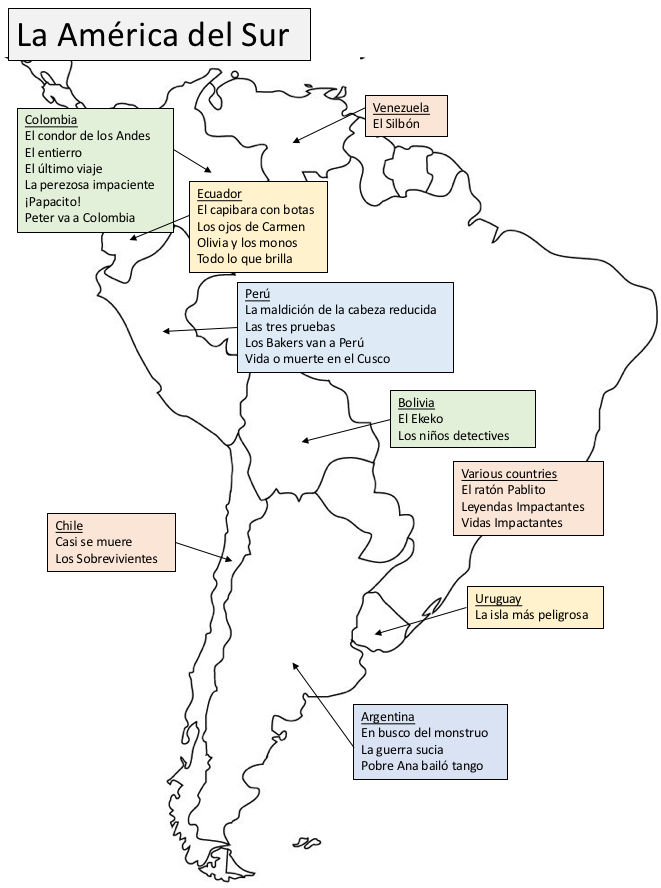
A Map of Spanish Readers

In 2004, when I left my middle school Spanish job and moved to another district to teach high school Spanish at Palmyra, there were very few Spanish readers/novels available to use in the classroom. The previous teacher left me with a class set of novels that was more suitable for an upper college level class, (and which were still shrink-wrapped so he must have had the same reaction to the books), and a splattering of other readers, such as El Cid, Don Quijote, Leyendas lationamericanas, Historias de la Artámila, and several others.  The ones that were most useful were 3 readers by Arturo de Rosa about the detective Pepino González. I used the Pepino readers with my Spanish 4 class although it took a lot of scaffolding to make it accessible, (especially since teaching with CI was not common practice at the high school when I started working at Palmyra so their reading in the language experience was very limited).  

However, in the last several years the number of Spanish readers available have exploded! Spanish teachers have a wide variety of readers to choose from to read with their students and to add to their class library for independent reading. If you're like me, and you want to keep the most recent Spanish books in your classroom to give your students a full range of books from which to choose, you are quite busy buying books throughout the year.

Not only are there loads of novels to choose from, and more added each year, but you can find a reader/novel that takes place in almost every single Spanish country, with only one exception - Paraguay.

I like visuals, so I created a map of the countries aligned with the readers that take place in each country. 


(I'll give the authors a week or so to email me any corrections and then I'll upload the maps to google docs so you can download them if needed.)

The danger to writing this post and making the visuals, is I may have unintentionally omitted a book. If that is the case, please let me know and I can add it although it may take a few days until I can update this post. The three main sites I cross-referenced for the list above was CI Reading (blog by Mike Peto), Fluency Matters, and TPRS Books. 

In addition, there are some readers that are listed in language catalogs that I have that I did not add because I do not recommend them for any level. 

There are only a few books in the lists above that I have not read; some I have not read because they are not available for purchase yet. Obviously, I have my favorites and there are some on the list that I was disappointed with, for various reasons. However, that is a personal preference and what I thought was not an interesting story, may be something that one of my students like, so I continue to make as many books available to my students as I can.  
I also add a few Spanish children's books in the selection and switch them out for different ones after a month or so. Since I liked the Pepino series, I make them available too.  :)  

Saturday, February 10, 2018

ESPERANZA the novel: Ideas and Resources

Esperanza novel  - Fluency Matters
One of the novels in my Spanish 4 curriculum is Esperanza, written by Carol Gaab. I selected this book for Spanish 4 because:

1. It is an easy read for my Spanish 4 students. I chose it as our first class novel of the semester because I want the students to feel successful right from the start of Spanish 4.
2. It is based on a true, compelling story about a family that fled Guatemala.
3. Using it at a higher level allows me to include resources about immigration, strikes, etc. that need minimal scaffolding.
4. I love learning about Guatemala, a country that is on my bucket list. This semester is really fun because two of my students went on mission trips to Guatemala with their church, so we're able to learn from their first-hand experiences.

For Esperanza, I rely heavily on the Teacher's Guide by Fluency Matters. I especially like the cultural readings and suggestions for discussions before each chapter.

In addition to the Teacher's Guide, here are several lessons and activities that I use before reading the book and during the reading.

1. Discussions (in Spanish) on strikes.
    - Ask students to write two lists; in one list write 5 businesses/organizations that you would not care if they went on strike and 5 business/organizations that you would be upset if they went on strike. The students readily participate in this conversation.

     - Watch or tell the story "Clic Clac Mu, Vacas Escritoras". I use the video on   Discovery Streaming. Then we follow-up with what would happen if farmers went on strike; the effects are far-reaching!

      - What would happen if your mother went on strike? The Canadian mother in THIS ARTICLE did. Before we read this, I ask students what they do to help around the house, who in the family does the most house work, etc. 

2. Previous knowledge of Guatemala. Ask students to make a list of things they already know about Guatemala. Then show them Ricardo Arjona's music video "Mi País". THIS is the Pepsi version but there are others of the song without Pepsi products shown throughout.
This morning I learned about this video by Gaby Moreno filmed in Guatemala

3. Guatemalan Legend. The currency in Guatemala is quetzales. Quetzales are mentioned when the aunt gives the mother money and again when the mother pays the men on the bus. 

After reading chapter 5, I "story listen" (story tell) the Guatemalan legend, "Quetzal no muere nunca". Telling this story, usually takes 30 minutes or more. After I tell a part of the story, I pause, tell students to tell their partner in English what happened, and then I chose one person to tell the whole class what happened, in English. If you want to try telling this story, don't get hung up on the fact that they're retelling increments of the story in English. It is actually a refreshing break for them and it ensures all understand. 

There are many ways to review the story after telling it if you want to recycle the words and structures again, such as Marker Partner Plus. One of my FAVORITE follow-ups with this story happens when a student is absent on the day I tell the story. Since the returning absent student has not heard the story, I  put the entire class in charge of telling the story to the student in Spanish. The student that was absent and I are the only two that can talk in English. 

Two days ago my Sp4 class had to retell the story to two students that had been absent. I was amazed at what they remembered and how well they worked together to tell the story in Spanish. Out of 20 students that were present to tell the story, I think all but 3 at some point joined in the retell, many times several students were raising their hands to continue the story where their classmate had stopped. Granted, that type of participation in the retell doesn't always happen, but when it does - WOW, sit back and enjoy it!

4. Password. After reading chapter 6, I compiled a list of key words, mostly from chapter 6 but from other chapters too. I'll write a new blog post to explain how we play Password and link it here. 
Hint for planning: schedule this activity for the end of the class period to monitor how long they play. If you don't they'll want to play the whole class period. 

5. Game Smashing with word clouds. I made this game based on chapters 6 and 7 of Esperanza. Refer to this post for the directions. I used a similar game for my students in Spanish 2 and it was a success.  


I had planned to use the game for Esperanza below on Friday, but the students were doing such an excellent job of retelling the story of Quetzal no muere nunca (see #3 above) that I needed to move this activity to next week. 
The game is made and ready to go and I can't wait to try it out with my Spanish 4 students.

6. Put things in perspective. This is an interesting visual to use while reading Esperanza. It is easy for us to forget what 'luxuries' we have in comparison to the majority of the people in the world. 

Click HERE to find it on Pinterest.

7. Si tuvieras que inmigrar a otro país...
I give each student a small slip of paper and they write "Si tuviera que inmigrar a otro país, yo inmigraría a _____, porque ______." I collect the papers and read their answers. The students have three guesses for who wrote the sentence. If they're right, I put those papers on one pile and if they're wrong, I put those on another pile. After the first round, I re-read those the students did not guess correctly for a another chance to figure out who wrote the answer read.

This is an easy way for your students to learn more about their classmates and even find out that they may have some things in common they didn't know about.

My lesson plan for teaching Esperanza is a living document, in that I make additions and subtractions with the purpose to continue improving it. As I find new materials that will enhance the lessons and the students' experience of reading the novel, I add them and, in delete activities from previous years when I find something better to replace it.

For more ideas and resources, you should definitely check out:
 Martina Bex's blog, The Comprehensible Classroom 
 Sharon Birch's blog El Mundo de Birch, 
 Alison Wienhold's blog Mis Clases Locas
 Elena Lopez' blog Aprendemos Juntos 

Follow this link for information on a verbal book report that I used to do after reading the book. I did not assign this to the students last semester and have not decided if I will assign it this semester. I 'm sharing it because it may spark ideas for you on what you want to do after finishing the novel.

If you are willing to share activities and resources that you have found to be helpful when teaching this novel, I'd love to hear them!


HAPPY READING!!!

SaveSave

Sunday, October 15, 2017

Review of Sr. Wooly's "La Casa de la Dentista"

If you are counting the days until you receive your order of Sr. Wooly's graphic novel "La Casa de la Dentista" than you know that the wait is almost over. It's been months since Sr. Wooly leaked information that he was working hard, day and night, (insert mad scientist music and an evil laugh here) on his second graphic novel. It is related to his cult-favorite music video "La Dentista" released in 2011, but it isn't necessary to have seen the video to understand the book. I guarantee you that every minute of that wait will be worth it! 

I was one of the lucky ones granted the opportunity to read the novel before the official release. I strongly recommend this book for Spanish teachers that are searching for engaging reading materials for their students! I promise you that you are in for a treat, perhaps a little unsettling and disturbing, in true Sr. Wooly fashion (and you know you wouldn't want it any other way). Your students won't know what hit them!

I haven't seen the digital teacher's guide for the book, but I have some advice on how to read this book.

In my opinion, the most important thing to keep in mind is: this book is not meant to merely be read. It is meant to be FELT. When reading, you have to FEEL...what the characters are feeling; FEEL...their fear; FEEL...the intensity; FEEL...the tension and FEEL...the uncertainty that surrounds them. 


Feel their FEAR. 
How do you do that?  Read it slowly!
That's worth repeating: 
READ it S-L-O-W-L-Y!  

Look at every.single.frame. 
Look in the characters' eyes to sense what they are feeling. 
Look at the intricate details and the coloring of every illustration. 
Don't cheat yourself from fully experiencing this novel. Don't give in to the temptation to read it quickly to see what happens. Don't do it. Don't rush. Take your time. Soak up every detail and every word and get the full effect. Connect to the characters. Put yourself in their shoes. Stare directly at the danger from their viewpoint and FEEL IT!


Seriously, the only thing that can make this great book even better, is how you read it.
The one & only, La Dentista

I currently have one hardbound copy. I'm going to read the book to my students a few days before Halloween, with the use of my document camera, and I'm going to read it to them exactly the same way I read it to myself - slowly and OUT LOUD. When there were illustrations without words, I added sound effects - gasps, breathing, the sound of waves splashing, sighs, footsteps, the buzz from electric lights, background music, and so much more. 

When there was dialogue, I read it OUT LOUD with emotion and in a voice to match the words and the expressions on the character's faces. There's even a part where the teacher sings to her school students, and you know what? I sang those words, making up my own little melody. All those extra sounds and pacing when reading, pulled me deeper into Sr. Wooly's little nightmare of a book.   

Carolina's dad nagging her, again.
You may be itching for some hints about what happens. Unfortunately, I can't help you out with that. I refuse to take any punch away from the story by giving out plot twists. But, if you picked up one of Sr. Wooly's preview editions that he was handing out at summer conferences, then you already know about the first several pages. The story begins with a young girl named Carolina whose parents are constantly nagging her to brush her teeth. The first three pages are illustrations only, no dialogue. You may have to use your imagination for the first few pages, but then the dialogue begins when the family is gathered at breakfast time. If you have an active imagination, you'll almost "hear" the eye-rolling by Carolina and her dad in reaction to the mother's drama. Then there's a phone call and from that point on, you'll be hooked. The story, the artwork, the coloring, and the lettering will reel you in. Don't bother trying to guess what happens, other than expect the unexpected.

I almost envy you because I want to be able to read it again for the FIRST TIME.   
So ENJOY IT! Both YOU and your students, will devour this book in no time! I predict it will be popular with your students for generations to come!

Do you want to hear some cool facts about the collaboration on an international level that went into this graphic novel? The contributors are from five countries on three different continents. Where they reside, their name, and their contributions are:

Illinois, USA: Jim Wooldridge (or Sr. Wooly as many know him) wrote the book
Colombia: Juan Carlos Pinilla illustrated the story  
Brazil: Davi Comodo did the coloring of the illustrations  
Argentina: Lucas Gattoni did the lettering
Spain: Lara Talens edited the book
Check out the artwork & coloring. Superb!

Obviously, Sr. Wooly sought out the best talent which resulted in a masterpiece. As Hunter S. Thompson said, "Anything worth doing is worth doing right" and this graphic novel is done right!

A few extra notes: 
- It is recommended for 6th grade and up.
- It's available as a hardbound book or paperback 
- *A digital teacher guide is available
- It is in pre-order and will ship in November.
- *If you're not sure how to teach a GRAPHIC novel with your students, Sr. Wooly and Carrie Toth made video tutorials on how to teach his first graphic novel "Billy y las Botas". Carrie does an awesome job, but then I may be a bit biased :)
I linked Sr. Wooly's website throughout the blog post. Click on any of the links on the words "Sr. Wooly". 

*I'm sure my plans on how I'm going to read this to my students don't match up with what the teacher guide or the video tutorials suggest, because I am going to read it in ONE class period. It will be a special class period devoted to storytelling and the only thing my students will have to do, is listen to the story.  
SaveSave
SaveSave

Sunday, February 26, 2017

Thank You CI Authors!

While reading a student novel last week, I had a deeper appreciation and realization of how fortunate we are, as second language teachers, to have a growing number of CI-focused authors that provide us with a steady stream of COMPREHENSIBLE and COMPELLING novels for our students. These authors have taken writing for second language learners to a new level.

However, not all novels written for second language learners are created equal; far from it! 

For several years I have been doing an activity with my students beyond level 3 called "Book Talks". Students choose a novel, read it, and then they sign up on the Book Talk calendar to talk with me in Spanish about the book. 

In order for me to talk about the books, I need to have read them, all of them. I've read the books from the authors that I know and those whose books are published by publishers that have a strong record of selling comprehensible and compelling books. However, there are a few books that I ordered from a world language catalog (it will remain unnamed), that I haven't read. I think it's fair to say I'm an optimistic person, and although I have been greatly disappointed with many of the novels from this source in the past, I continue to purchase a few books each year with the hopes that things will change for the better and I will find a few compelling and comprehensible books to add to my classroom library.

Well, last week I was "forced" to read one of those books, because a student signed up for a time to discuss her book and it was a new one that I had not yet read.  I spent my planning period reading the book and it was a painful experience. The story line was dull and predictable. As I was reading it, I felt as if the writer was specifically including words from a textbook vocabulary list and checking them off after the words were added to the story. Instead of being drawn into the story, I found myself time and again, checking to see how any pages remained. If I had to read more novels like that, I would lose my love of reading very quickly.

I look forward to talking to the student this week so I can guide her towards a more compelling story for her next novel.  She moved into our school district this year and had no experience reading Spanish novels on her own or in class. I want her to know that there are many books available at or below her level that are interesting and will be an enjoyable experience.

In my experience of reading novels specifically written for second language learners, I've learned that there are two types of books: 1) those that are written with the goal to use X number of vocabulary words, and 2) those that have an interesting story that the author has written in a manner that makes it comprehensible to the reader. When the author focuses on the story first, and works to develop the plot and the characters, they have a better chance of writing a book that students will find appealing. The STORY is the focus; making it comprehensible is the goal.  The second type of book is a treasure that the community of CI writers have shared with second language teachers. They use their gift in writing and our students benefit.

I originally wanted to write a list of authors whose books I would recommend without reservations, but I'm certain I would miss a few and I don't want to take that risk.  Instead, I'll suggest a few publishers and you will easily find dozens of compelling books at the websites. 

There are MANY compelling and comprehensible books available today, especially for Spanish teachers. Don't settle for ho-hum. 

Check out these publishers (listed alphabetically) or websites that tell you where to find books by independent publishers.  


CI Reading
Fluency Fast

Fluency Matters
Mira Canion
Sr. Wooly - new graphic novel
TPRS Books


Monday, February 20, 2017

Preparing to Read a Novel: Ideas for El Escape Cubano and other novels in general

Reading novels with my students is an important element to my curriculum, as well as SSR. Preparing to read the novel involves a great deal of backwards planning on my part to ensure the students have the cultural background knowledge to understand the plot and the location to better connect to the book. Even when I am certain that the book I am going to read with the students is at their level or below their current reading level, I search the chapters for words and/or structures unfamiliar to my students, and then plan stories and CI activities to introduce those words to the students. I look for words that are high frequency and/or that are important to the plot. My goal is that when the students read those words in the novel, they will immediately recognize them and understand their meaning. When that happens, the students' minds are freed up to focus on the action and the plot and more deeply enjoy the story.

Last fall I read Mira Canion's "El Escape Cubano" with my Spanish 2 students for the first time. The book is about a family escaping from Cuba and is written from the perspective of a young 13 year old boy as the action occurs.  Most importantly, the subject matter connects with growing interest in Cuba, but as a teacher, I like that the book is packed with first person singular in the present tense. When my students read the book, I know they will be receiving an enormous amount of compelling, comprehensible input in the YO form.  In all levels, I choose a first novel that is below their reading level. One reason is because I want to give the students a confidence boost, but the bigger drive behind this decision is to accommodate the students that haven't had Spanish class for a year or longer, which is not an uncommon scenario when you teach on a 5x5 block schedule.

This year, second semester started on January 17, 2017, and I started reading the novel, El Escape Cubano, with my students on Wednesday, February 15. That's a month of CI activities, some specifically chosen with El Escape Cubano in mind. In other words, the vocabulary from El Escape Cubano is pre-taught over weeks, which allows me to provide a lot of repetitions in different contexts.

Below are a few activities to pre-teach vocabulary that are specific to El Escape Cubano, but the general ideas can be used with culture and vocabulary specific to any novel. The suggestions below are BEFORE READING activities. I will write additional blog posts to share the class activities and plans for specific chapters. 

Before READING: 
1. Look at the CI activities and stories you are currently using with your students to see if there is an easy opening to include one of the vocabulary words from the novel. 

On the first day of Spanish 2, students receive construction paper on which they need to draw 3 things: 
- what they like to do, 
- a favorite place/where they like to go
- their favorite class from last semester or last year

Throughout the next several weeks, students take turns being "interviewed", in Spanish, about what they have sketched. Over the years, I've noticed that many students choose to draw palm trees, or beaches and swimming, for their favorite place. One of my questions is with whom do they go to the beach and then I follow that question with, "cuando tu familia va a la playa, ¿se queda tu familia en un hotel, se queda en una casa, o se queda en un apartamento?"

This was already an activity in my lesson plans before Mira's book was written, but now, since I know students will need to know se queda for the first few chapters of El Escape Cubano, I make certain to ask this question and discuss the students' answers more in-depth. I also weave in uses of quedarme and quedarse in questions or my responses/dialogue so students hear that structure also.

2. Use photos and personals experiences that include vocabulary you want to pre-teach.  
At some point in the first few weeks when the students and I are talking about pets, and this subject always comes up because everyone likes to talk about their pets, I project this photo of my dog, Cooper. Cooper has acres and acres of room to enjoy and explore on our family farm, but when he sees movement on the other side of the road on our neighbor's farmland, such as a groundhog, a squirrel, or other animal, he leaves our farm and runs after it. I show this powerpoint slide to my students and we talk about Cooper and how he doesn't STAY (se queda) at home and sometimes he CROSSES (cruza) the street.

3. Use riddles and jokes. Riddles are fun to use in the classroom because it gives the students the chance to stretch their minds and think outside of the box WHILE solving the problem in a second language.  
I gave this riddle (shown right) to my students on the day before we read chapter 1. Students had to write the solution for what object the man takes across the river and what objects he leaves behind. It can be solved in 7 steps. The arrows are helpful in reminding the students in which direction the man is going each trip. I told the students to write what the man takes in the balsa with him and leaves behind for each trip. When students work together to solve the riddle, they write sentences using se queda, la balsa, and deja. The link to access the document is HERE. If you have problems accessing it, please let me know.

4. Short films (MovieTalk) and TPRS. Look at the film shorts you currently use to see if they would serve their purpose better at a different time in the semester, i.e. before a novel. If you can't find anything that specifically meets your needs, write a story that includes vocabulary and structures from the novel and "storyask" a la TPRS.    
My school subscribes to Discovery Streaming and there is a video series on Discovery Steaming named My Tienda de Luis. I use the first segment (videos 1,2, 5 & 6) in Spanish 2 to provide a large amount of comprehensible input at the beginning of the semester. (This was part of our curriculum even before Mira's book, El Escape Cubano, was published.) Fortunately, the actions SUBE and BAJA occur often in this segment. I also have a story that I "storyask" my students that involves a taxi driver and the people that get in and out of his cab. If students didn't know SUBE and BAJA before entering Sp2 they know/have acquired them after the Discovery Education series and the TPRS taxi story. 

5. Culture - Vimeo. Everyone knows there are videos available on YouTube for any topic, but have you considered checking Vimeo first? Do a search on Vimeo for the country or for an event/celebration in a country, and you will most likely find a short film that is appropriate for class.  
There are two videos about Cuba on Vimeo that I use to help the students envision the land and people of Cuba.  The first one is "Cuba 2016" which you can find HERE. I give the students a paper with a grid of the following categories: la ciudad/las casas; deportes; transportación; terreno; animales, la escuela; cosechas/agricultora; pasatiempos; and música. Students watch the video and write information about the above category that is shown in the video. They also have to guess which country it is. There are a few seconds near the beginning of the video when it the title is on the screen so I disconnect the computer from the projector for those few students so the answer isn't shown. Then we discuss what they have written about Cuba.

The second video on Cuba I show is also from Cuba. You can find it HERE. This gives more footage of Cuba and it's people.

6. Culture - powerpoint. You don't have to create everything by yourself, especially when there are excellent resources that teachers sell on TeachersPayTeachers or that they share on their blogs and at conferences or even during Twitter chats such as #langchat.   
I used this Fidel Castro powerpoint (pictured at right) by Martina Bex to introduce students to Fidel Castro  and Cuba. One of the slides that my students found particularly interesting was how food was rationed for the people in Cuba. In the future, I am envisioning expanding this with an activity to demonstrate to the students how difficult it is to live with such meager rations. I have some ideas, but they'll have to wait until summer.  

7. Maps and facts. Do the students know where the novel takes place? Could they find it on a map? What does the location itself tell us about the country? Cuba is 90 miles from the coast of Florida so I made a powerpoint with the map of Cuba and the United States to give the students a visual of the distance. I listed two cities that are 90 miles from our high school to compare that distance with the distance between Cuba and the US. There are also photos of Cubans trying to cross the stretch of water between Cuba and Florida. Those pictures help impress upon the students the cramped space, primitive boat/raft structures, and the dangerous conditions that people endure in their attempt to reach Florida. Those photos are followed by I statistics on how long the trip takes and the number of people that die each year.

The above are examples that I specifically used before reading El Escape Cubano, but there are other possibilities depending on the novel and the level of your students. Think outside of the box. Take a risk. And then share with others so we can continue improving our teaching.       

I'm excited to share in other blog posts what I've done with some of the chapters, but it's 60 degrees in February and we have off school for President's Day, so it's time to go enjoy the weather, with that crazy dog Cooper.  :-)