Showing posts with label listening skills. Show all posts

Saturday, July 20, 2019

One Word Images & ChatterPIX PLUS App Smashing

I stumbled across an app earlier this year that when combined with One Word Images (OWI were originally created by Ben Slavic. Read about & watch a video of a OWI on Mike Peto's Blog) will provide various possibilities for World Language teachers. 

The app is called ChatterPix and it is available for IOS devices AND Android devices. Better yet, it is FREE! As soon as I saw the app I couldn't wait to add it to my presentation "Make Technology Count in the CI Classroom" for #iFLT19 in St. Petersburg, Florida, to share it with other world language teachers.

The ChatterPIX app allows you to upload a photo, draw a line for a mouth on a person or on any object that is in the photo, and then you record your voice and the "mouth" moves as you are recording.

When I was experimenting with the app and searching for photos on my camera roll, I came across a photo of a OWI that my Spanish class had created and the idea to use the app on the OWI was born.

On the right is a photo of the OWI my Spanish class created. To summarize, Mahe is an umbrella that is afraid of rain and has a friend that is a sponge. (If you're wondering how did we decide on a name such as Mahe; students couldn't agree on a name so I asked four students to tell me a letter of the alphabet and from those letters I created the name Mahe. 😂)

I uploaded the photo to ChatterPix and added the voice.


Some of the uses when combining ChatterPIX with OWIs are:

- teacher creates the recording for students to access for additional input
- teacher creates the recording with the OWI asking true/false or short answer questions for students to answer
- teacher creates the recording with a few changes to the details/story; students  find the differences between the recording and the original class story
- students create a recording as if they were the object; summarize information about the object
- students create a recording as if they were the object; add new information about the OWI (character)


In general, students can use ChatterPIX for presentational mode, especially for students that don't want to have their own photo on the end product. The finished products can be uploaded to your school's LMS (Learning Management System, such as Schoology, Canva, Edmodo, etc.)

- students draw a character from a novel the class is reading and record as if the students are the character; what are his/her thoughts on what is happening?; what does he/she hope does/doesn't happen?; how does s/he feel?
- choose a painting and have the painting tell what is represents (great for art "units")
- teacher uses photo and records a voice; students decide if what the person or object says is logical or illogical in reference to what is happening in the photo
- students create a comic strip and upload it to a powerpoint or googleslides; make characters talk with ChatterPIX

Below is an example that MadameMoran tweeted which uses ChatterPIX. (#greatmindsthinkalike) 😊

Next...

If you want to step into App Smashing, try combining a app or website that removes the background in photos of people (and objects if you're willing to pay extra or do extra detailed work), then add a new background for the people in the photo, and make either the people talk with ChatterPIX or pick an object in the photo to talk TO the people. (Thanks to Krista Kovalchick for permission to use the photo with her and me.)


Below is a screenshot of a slide from my Tech Presentation at #iflt19 on Appsmashing with ChatterPIX and the website Removebg.com followed by the steps I followed to create the above video.


1. Take a photo. Make sure there are not other people in the background!

2. Upload the photo to removebg.com and remove the background. Download the photo from the removebg.com website.

3. Choose another photo to which you want to add the person/people on the downloaded file from removebg.com. (My friend, Karen, sent the photo in this step when she was at Epcot and I was at in-service. Years ago I was at Epcot but not with Krista, the woman in the photo with me.)

4. Layer the edited photo from removebg.com to the new background.

5. Upload the new photo to ChatterPIX. Choose a person or an object to animate with a voice. Download the video with voice recording to your camera roll or computer for use in your world language classroom.


This website takes all the work out of removing backgrounds. I used it with ChatterPIX but I'm sure you'll find uses for it for other activities in your World Language Classroom. Or, have fun using it and surprising your friends with the photos. After all, having fun with tech shouldn't be limited to our classrooms!!


Tuesday, April 9, 2019

Countdown: A Listening Activity for the WL Classroom


Countdown is a listening activity/game in which students listen to 5 clues about the name of a person, or a word. The goal is to guess the word that is described by listening to the fewest amount of clues.

Countdown is an activity for students to sharpen their listening skills in L2 and to use some higher order thinking, as well as a bit of strategic play added in the mix.

My example below is how we played Countdown with names of women in my Spanish 4+ class. We played this at the beginning of our Mujeres Unit, but Countdown can be played with any category of words, or even words not in any specific category.

Preparation for the game

1. Students had to think of a woman that has had a positive impact in society and to NOT share the name with their classmates.  

2. Students had to write 5 sentences about the person, without mentioning her name in any of the sentences. The first sentence should be very vague; one that after listening to it their classmates may have an idea, but not be absolutely sure if they have the correct person.

The second clue should give a little more information about the person.
The third clue should allow the listeners to narrow down whom it might be.
and so forth for the fourth and fifth clue. By the fifth clue, EVERYONE should know the person that is being described.

(If you play this with a beginning level class, I suggest that the teacher write the clues.)

I gave #1 and #2 as a homework assignment because I did not want to take class time for the research and writing part of the activity.

3. Each student needs a marker board, a marker, and eraser. (You can use paper instead if you do not have mini-marker boards.) Students should sit in a large circle, facing inward, allowing for as much space as possible between each student to deter them from seeing what their neighbor has written.

Playing the game & scoring

Students will take turns reading their clues OR the teacher can collect the clues and read it to the students (which allows the teacher to make any needed corrections in the sentences on the spot, while reading).

1. Clue A (first clue), worth 5 points: Read Clue A in the TL. If a student thinks she knows the correct answer, she will write it on her marker board, hiding her answer so others cannot see what she wrote. She also writes #5 on the marker board because her written answer, if correct, is worth 5 points. (If students write the point value when they write their answer, it will be easy to tally the points at the end of the round.) 

She then puts the mini-marker board on the floor in front of her, face down. This makes it easy for the teacher and the students to see which students have written their response.

After a student, writes the name and places the board on the floor in front of her, she can NOT change her answer. If she writes the answer after listening to only one clue (Clue A) and when she hears the next clue (Clue B) she realizes that she has the wrong answer, she may NOT pick up the board and change her answer. This is where the strategic element comes into play.

2. Clue B (2nd clue), worth 4 points: Students listen to Clue B which gives a little more information about the woman. If a student knows the answer, she writes it on the marker board, along with #4 because it is worth 4 points if it is correct, and places the board face down in front of her chair.

This continues with Clue C (the 3rd clue - worth 3 points), Clue D (the 4th clue - worth 2 points), and Clue E (the 5th clue - worth 1 point).

3. After all clues have been read, the students will hold up their marker board and the teacher, or the student reading the clue, will share the correct answer. Students will keep track of their own points on their marker boards.

Example:  Below are the clues that I use as a model for the students. It is written in English below for the purpose of sharing it on my blog which is read by those who teach languages, not necessarily all Spanish teachers, but I read the clues in Spanish to my students. 

Clue A: Her father was a school teacher.
Clue B: She worked for the equality of education for girls from a young age.
Clue C: She published her autobiography when she was 16 years old.
Clue D: She is the youngest person to have received the Nobel Peace Prize.
Clue E: She is from Pakistan and was shot by the Taliban.

I have played this for several semesters. Some of the names that appear often are:
Rosa Parks
Ophra Winfrey
Frida Kahlo
Amelia Earhart
Helen Keller
Harriet Tubman
Hilary Clinton
Sally Ride
Serena Williams


You could play this game with cognates, foods, animals, occupations, or words not in any specific category. Playing with names of people was easy because the students didn't need to know the words in Spanish.  

Please let me know if there is anything unclear in the instructions that you would like me to clarify.

Saturday, December 16, 2017

Marker Partner PLUS (a fun variation of Marker Partner)

In May of 2014, I wrote a blog post explaining The Marker Partner game. It is a fun way for the teacher to check student comprehension after listening to a story or after reading a text and to provide additional input through listening. Earlier this fall, I created a variation of the game that goes one level deeper into checking student comprehension and holds the students more accountable in earning points for their team. I'll refer to it as the Marker Partner PLUS game.

The set-up for the game is identical as for the Marker Partner game. Divide the students into two teams. If you have desks, the students move their desks so they are facing each other with a marker placed where the two desks meet. The students can place the paired desks in a circle formation or in a long row, if your room allows for this. If you do NOT have desks, you can do the activity in the cafeteria and the students sit at the long tables across from their opponents.

Marker Partner PLUS in a classroom w/o desks

Another option, one that I use when I have class during lunch periods and the cafeteria is not available, is to have the students place their chairs in two long rows so they are facing their partners, with an extra chair between them and the marker placed on the chair as shown in the photo on the right.


The students listen as the teacher reads a script of the story they have recently heard or a script of a story that they have read. (Or you can use this with any text, not limited to a story.) The students are actively listening for a changed detail as the teacher reads. When they hear an inaccurate detail, they grab the marker before their partner does. The students on each team hold their marker up and the teacher counts which side has more markers. The team with the most markers earns 1 point. 

Now for the twist. The teacher then chooses ANY student from the winning side that is holding up a marker and that student needs to say WHAT the error was and then must CORRECT the error by restating the sentence, or part of the sentence, with the correct information. The student cannot receive any help from his teammates. If the student can correctly identify the error and make the correction, he earns another point for his team, for a total of 2 points for that round.

However, if the student that the teacher choose to identify the error and correct it is unable to do so, the opposing team can earn 2 points if the student that the teacher calls on from the side that didn't earn 1 point is successful in stating the error and correcting it.

When I call on a student from the team that has the most markers, I always call on a student that is holding a marker. My reasoning is, if the student grabbed the marker, then she knows there was false information. When I call on a student on the opposing team when the first team member was unable to make the correction, I call on anyone on that team, whether they were first to grab the marker or they didn't beat their opponent.

I like this version BETTER! Why? Because the teacher is able to read more than one sentence at a time. I have played this version and read 4 or 5 sentences before I insert an incorrect detail. The students are intently listening for a longer period of time in anticipation for the incorrect detail. The next time I may chose to read only one sentence until I mention an incorrect detail. This keeps the students on their toes because they don't know how long they will need to listen before they grab the marker.

If you and your students like playing Marker Partner, then I predict you will also like Marker Partner PLUS

Saturday, May 20, 2017

Sub Plans that keep the CI Flowing

One of my least favorite tasks as a teacher is to write substitute plans. I can take the easy way out and have the students watch a movie. Movies have a variety of value: there are movies in the target language that students don't understand, movies in the target language with English subtitles, and movies that are in English but are culturally rich. 

What other options are available? What will keep the CI flowing even when the substitute doesn't speak the language you teach? 

Why not have a Spanish teacher in another part of the United States be your sub? Wait...What? Thanks to teachers that are recording themselves telling stories in the target language and making a concerted effort to keep the information comprehensible, language teachers now have another option for substitute plans. Use the videos of other language teachers telling stories that are on YouTube and Vimeo videos, and voila, that teacher can be your substitute for the day!

As more teachers are sharing their recordings online, I have been replacing old substitute plans with the new ones. Below are a few examples of how to write substitute lesson plans that will keep the CI flowing during your absence. The examples are of Spanish, but you can use the ideas for any language as long as you can find videos in your language.

1. Mike Peto!  @mike_peto on Twitter
Have you seen Mike Peto's videos on Vimeo?  If not, click HERE for his Vimeo account page for a list of his videos. In the videos he tells fables or stories that he wrote using high frequency words. He uses any tense that is needed to tell the story, but no worries - he is a genius at making it comprehensible and he uses his /or actions in the story.  At times, he writes the Spanish word and its English translation on the board.  Some of his videos he recorded during the actual lesson with students, so you can observe his comprehension checks with the students. There are other videos that Mike made without any students in class because he made them specifically for an absence this month.

The story I chose for my substitute plans on Monday (I will be attending my daughter's graduation to see her get her doctorate in physical therapy - yeah! - proud mom here) is "El cuervo tonto".   

First, my sub will hand out a paper with questions (see page 1 of 2 below) so students can read the questions to give them a heads up on the specifics they need to listen for. 

Then my sub will play the video and pause it when Mike instructs the students to sketch each part of the video. Students will answer the short questions during the story and complete the English translations as Mike explains them.
I need to add that I don't always have questions for the students to answer. Two weeks ago I was out and my students watched Mike's video "la señora" and their only task was to listen to the story because we were going to discuss it the following day. When I returned the next day, I drew the same sketches as Mike did and paused throughout to ask students questions about the characters and what happened. So...questions are not necessary, but for some students it helps to keep them focused on the story.

Click HERE if you would like to download the pdf of the questions for the "El cuervo tonto" story - 2 pages of questions/area to sketch and the answer sheets.

2. Pablo Román, @langdreamer on Twitter
Pablo is cranking out videos about Spanish festivals and holidays,  legends, and most recently, interviews with other Spanish speakers at the rate of almost one a day. Click HERE for his YouTube channel and check out his blog, Dreaming Languages

In the videos, Pablo is in the bottom corner and the rest of the screen he uses to sketch while he speaks to the listener. At times he inserts video clips to show a few seconds of an event that he is describing.

Below is a sample of how to add reading after viewing a video. This is based on his video "St. Jordi". I used this video on a day when I was NOT absent, but with the paper attached below, you could leave it as a sub plan.

1. Watch the video. I paused the video at the end where you can see all of the sketches, and the students and I discussed and retold the story. If this is your sub plan, skip the retell until the day you return.

2. Distribute the paper and students will match the sentences to the screenshots of the sketches.

3. Distribute the script below for the students to read.

The documents for this lesson are HERE
(To be clear, these lessons were NOT planned in collaboration with anyone, but rather I saw the videos online and then created lessons from the online videos that I can use in class.)

3. Cameron Taylor @Profe_Taylor
Cameron is a Spanish teacher in Japan. His YouTube channel is HERE and his most recent (I think) video is "Habla demasiado". His technique is very similar to Mike Peto's, in that he tells a story and makes it comprehensible due to the vocabulary he chooses and the sketches. Please note that Cameron's purpose of making the videos was to share with others HOW he does "storytelling" with his students. It is was not shared with the intent to have other teachers use it for sub plans, but I quickly saw the possibilities in providing CI for a substitute plan with this, and other of his, videos.

I do not have a specific document created for the story "Habla demasiado", but my students will read the story script after watching the story.

Two variation on the story scripts (the written text)
a. Omit a few details of the story in the script on a document you create and replace it with lines. Then together as a class, you can fill in the missing information and write it on the lines on the document.

b. Ten Errors (or however many you choose). When you write the script, make 10 minor changes to the details. After the students have watched the video and after you have discussed it or acted it out, distribute the document with the 10 errors. The students' task is to find the erroneous information and replace it with the correct information. (i.e. - if the story said he had two dogs, change it to 3 dogs or to 2 cats.)

4. BookBox
BookBox is a website with children's stories in the target language with subtitles. It has many books for Spanish, as well as a few stories for other languages such as French, Italian, Urdu, and more. This website also provides PDFs for you to download. 

I made a very basic story listening document with questions for my students to complete while listening and watching the story online.  (The screenshot does not show the entire document. If you would like the document, click HERE.)


OPTION: Instead of having students answer questions, the students could listen to the story one time. As they listen/watch it the second time, have them sketch the story that you can use as a retell using a document camera later in the class or on another day.

These generous teachers, and the Bookbox website, are my new go-to lesson plans for substitute teachers.  Feel free to download any of the documents that may be useful to you. They are available at no cost. HOWEVER, what I would like to ask in return, is if you like these options and create something to be used with a video similar to the story videos above, please share it with me.   :-)

Saturday, April 1, 2017

The MANDATO Challenge: Spanish Commands

Have you ever thought of how often you hear commands throughout your day or how often you say a command? It has to be one of the most used features of a language.

The language of mothers and fathers, especially those with young children, are packed with commands. Are you a fan of cooking shows or DIY shows? Think of the amount of commands you hear during those programs. 

Likewise, teachers' days are full of commands as they instruct their students and give directions.  I doubt teachers realize how often they say a command.

Last semester, I wanted to make my Spanish students aware of how often they hear commands during the class period, so I proposed a simple listening competition. When I say a command in Spanish, I will listen for the first student to call out Mandato!". Then I write the student's name on the board with a tally mark. 

I am repeating The Mandato Challenge again this semester. I started it two days ago and the tally marks are growing. Interestingly enough, some students that are usually quiet in class, are among the high scorers! In other words, the fact that they're quiet does not mean they aren't listening and acquiring the language, but rather that their comfort zone in the second language classroom looks a little different than the students that want to answer every, single question or even comment on things without a question. (To be clear, I do like having those that are like a fountain of language that doesn't have an off switch in class because they add energy and content to our discussions.)

If I can't discern which person said ¡Mandato! first, it's a draw and nobody receives a tally mark. A new addition to The Mandato Challenge this semester is if I say a command and nobody hears it, which usually happens if I am speaking to only one student or a small group of students, then I receive a point. I've earned a few points, but I predict next week I'll earn a big 'ole goose egg because they are s-h-a-r-p!

Side benefits of The Mandato Challenge
An unexpected benefit to this challenge, is that sometimes to avoid saying a command, I say Quiero que ustedes pongan sus papeles en mi escritorio (I want that you all put your papers on my desk) instead of Pongan sus papeles en mi escritorio (Put your papers on my desk), which provides input of the subjunctive in context at a time they are paying close attention

Eventually students notice that many times the words (verbs) are the same when I say "I want that you..." as when I directly tell them to do something. 
 
Sometimes when I say a command and one or two, (or sometimes 10 or more), students call out ¡Mandato!, and I add a tally mark, there may be a student that didn't hear it and will ask, "¿Qué dijiste?" (or sometimes they blurt that out in English - we're still in the real world here folks). They asked, so I write what I said on the board for them to see it in print. It's like "pop-up grammar" but they initiate it! Other times after I add a tally mark I'll ask the class to tell me what I just said and then we quickly move on to what we were doing.

It adds energy to class because the students are waiting, listening, ready to shout ¡Mandato! which captures everyone's attention.

If you want to see how this works, give The Mandato Challenge a try in your classroom. Have FUN with it! 

Saturday, January 30, 2016

Scaffold Authentic Resources for Listening Comprehension Success

If I had my wish, I would insert another 50+ hours for each level of language at my school.  I don't foresee that happening (ever) in the future, which means I need to make every minute count in my classroom. This translates into scrutinizing my lessons and activities for what is best for the students in helping them increase their proficiency in the language in the limited time that I have with them. 

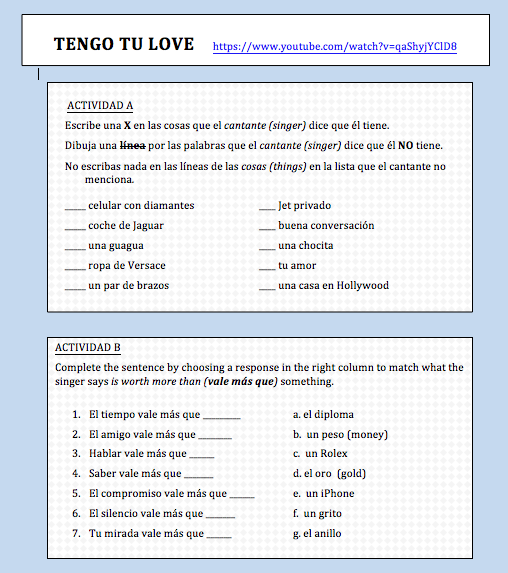
I've used the the group, Sie7e's song "Tengo tu love" in the past as a simple cloze activity with my Spanish 2 students. After preparing my lessons this week that included this song, I decided it was better to trim down the focus to a smaller portion of the song.  


With that in mind, I created two activities for students to complete while listening to this authentic resource.

First, we listened to the song and watched the video. I wanted them to enjoy the song, plus I suspected if students had to complete the activities the first time they heard the song, they would be more interested in watching the video than listening for specific information.

Activity A - The singer mentions things that he does and doesn't have.  The reason I chose the song was the high use of TENGO so I wanted to have the opportunity to use TENGO when going over the answers with the students. I listed the following for activity A:
- things the singer says he has
- things the singer says he doesn't have
- things that are not mentioned in the song

Students listen to the first portion of the song and check or cross out the items depending if the singer says he has or doesn't have the item.

When we went over this activity, I asked students, ¿El cantante dijo, "Tengo un celular con diamantes" o dijo "No tengo un celular con diamantes" o no lo mencionó?

Activity B - The expression VALE MÁS QUE is heavily used in the second half of the song. Finding a song that includes comparisons is a plus because I often forget to include comparisons in our class stories. I listed the comparisons that the singer makes and students match the answers from the list on the right that will complete the sentence.  The sentences are in order of the song to make it easier for students to follow.

I paused and replayed the above two sections of the song to give students additional opportunities to hear the lyrics. Thanks to the scaffolding, the students reported that the activity was at their level and they were successful in hearing specific words in the lyrics.   

If you are interested in the document, you can find the pdf HERE

Thursday, January 21, 2016

Ice-breakers!


At the beginning of a new school year or semester, do your students know the names of their classmates? To find out, ask your students if they can name everyone's first name. Then ask if they can name their last name too. If they don't know their classmates' names, then it's safe to assume they know very little other information about their classmates.

I asked my students the above questions and only one student was brave enough to try to name everyone in the class, although he did say he was unsure about many of the last names.  He started in the front row and after he said the student's name, the student then had to (1) stand-up, (yes, I asked them to stand for a semi-formal introduction of themselves) and (2) tell us something interesting about themselves. It is always interesting to me to hear what the students want to share about themselves. It gives me a hint to what is important to me.  

This was my Spanish 4 class so they completed all of the activities in Spanish. There are 27 students in the class and this part of the ice-breaker lasted more than 20 minutes.

Then I gave each person a quarter slip of paper and instructed them to write their name on the paper, and then to the 4 questions pictured above.  
For those that need a translation, the sentences/questions in the box are:
1. A food that you never want to eat
2. The vacation of your dreams
3. Someone with whom you want to eat a meal
4. What do you want to do after graduating (from PHS).

The students handed in their papers face down and then I randomly picked 6 of the papers and wrote the names on the board.  The students wrote 1-6 in their notebooks. I read the answers on the first paper and students looked at the list and choose a person that they thought wrote the answer from the bank of students' names.

After I had read the information on the first 6 papers, we went over the answers and the students checked their own papers.  
Scoring - 6/6 correct - 8 pts
              5/6 correct - 5 pts
              4/6 correct - 4 pts
              3/6 correct - 3 pts
              2/6 correct - 2 pts
              1/6 correct - 1 pt

We proceeded to the second and third round before we had to stop because we ran out of time.  

I liked this activity because:
- the information students had to provide was different than the typical questions such as do you have a pet?, do you play a sport? what is your hobby? etc.  
- it turned into a backdoor review of foods with the focus not specifically on the words but rather on guessing which person had written the answer
- it provided me with information about the students for use in future classes
- the students learned their classmates' names and a little information about them

Next time, I might consider switching out one of the questions for: 
Of what are you afraid? or...anything that comes to mind on that particular day.

Can you tell I'm having a good time getting to know my new students?  :-) 

Monday, May 18, 2015

The Telephone Game

When I was little, I used to play a game called "Whisper down the lane".  Everyone sat in a line. One person whispered a sentence into the ear of the person next to him.  The next person listened to what was said and then repeated it to the next person in line. When the last person has heard the sentence, he shares it with the group to see how much it has changed.

For several years, I've been doing an activity similar to this with my Spanish 4 classes.  My students always call it the Telephone Game. This year I tweaked the activity and made it suitable for level 2 also.  The two versions are listed below.

It's best to do this activity where you have a lot of space because you don't want students to hear others not on their team. That makes it an ideal outdoors activity.  

1. Write a story in your TL that has a lot of details.  HERE is the story I wrote in the morning the day of the activity. I used this as an oopportunity to recycle structures and vocabulary that I taught throughout the school term. Write questions about the information in the story.

2.  Divide the class into teams of 3 or 4.  It works best if all teams are equal.  If the numbers aren't equal, you can recruit the extra students to serve as "eavesdroppers" (they listen to the students to make sure they are speaking in the TL).

3.  Everyone will need a writing utensil.  When we go outside, each student takes a clipboard and a pencil with them.   

4.  The teams should each form a line, with a lot of space between the first person in line and the second person, between the second person and the third, etc.

5.  The teacher tells (reads if necessary but be sure to "tell" the story and add emotion) the story to the first member of each team.  They should listen well because they will be in charge of retelling it to the next person in line.

6.   After you, the teacher, have told them the complete story, they walk to the #2 person of their team and the 1st student tells the story to the 2nd student on their team.

7. After the 2nd student has heard the story, student 2 walks to student 3 and tells her the story.  While student 2 is telling the story to student 3, the teacher should hand a paper with questions about the story to student 1. 

8. When student 3 has heard the story, she tells it to student 4.  Student 2 then has time to complete the questions about the story.

9. After student 3 is finished telling the story to student 4, hand each of them a paper with questions for them to answer.  

When all the papers are completed, redistribute them to grade.  The team with the most correct answers is the winner.

2nd version
 This is the version I used with Spanish 2.  

1. Students form groups of 3.  
2. Tell the exact same story that you used for a higher level BUT this time ALL the students listen as you tell the story.  
3. Hand 1 question paper to each team to complete after you tell the story.
4. The team with the most points wins.

Another variation is to have the students work in groups of 3 but only 2 students from each team listen to the first version.  Those two students work together to retell the story to the 3rd student on their team that didn't hear the original version.

Two years ago I had 3 stories that weren't quite as long as the one linked above, but, of course, they are temporarily missing.  

Suggestion: If you are doing the activity in the first version, tell the students that the person that feels most comfortable with listening activities and retelling should be the first or second student.  If the first few students miss information, the rest of their team will miss out on more points.

I demonstrated this to my Spanish 4 class by having 6 students go out to the hall while I told the story.  Two students in the class then had to tell the story to 2 students that were in the hall.  Then 2 more students came into the class that were in the hall and listened to the story from the students that listened to my version, etc.  The students enjoyed listening to how the information was not communicated correctly, or not communicated at all!

The students enjoyed this again this year. They enjoyed it so much that I'll be writing new stories to use for another time before school ends.

Monday, December 15, 2014

A Super Fun Christmas Game

My daughter was looking for ideas for our extended family Christmas get-together and she found THIS GAME.  After reading it, I thought, "I can translate the directions to Spanish and use it with my Spanish classes."

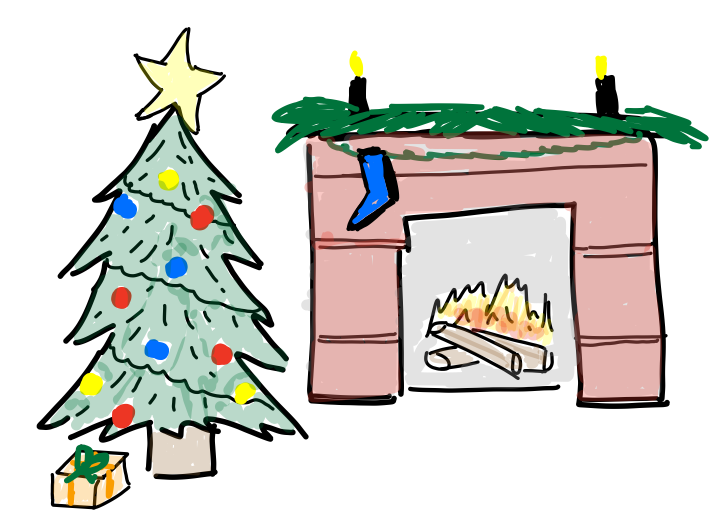
Then I thought, "wouldn't it be fun to ask other MFL teachers if they wanted to complete the activity with 1 (or more) of their classes.  If they tweet or email their best sketch to me, I can create a photo collage of the sketches or post photos of their sketches."

I am going to do this activity with all of my Spanish classes this week.  I'll probably buy a small prize for the sketch with the most points and/or the best sketch for each class to provide extra motivation for them to concentrate while drawing.

Update: Below are links to two google slides presentations to use with your class:
  1. Presentation from 2014 made by Elena Lopez
   2. Presentation from 2015 made by Ashley Soriano


Are you interested in joining in?
If so...
1. Complete this activity this week with 1 (or more) of your language classes in your Target Language. Update: @lopezelena saw the tweets about the activity and then created and shared this Google Presentation of the activity - ready to go for Spanish teachers. Thanks Elena.
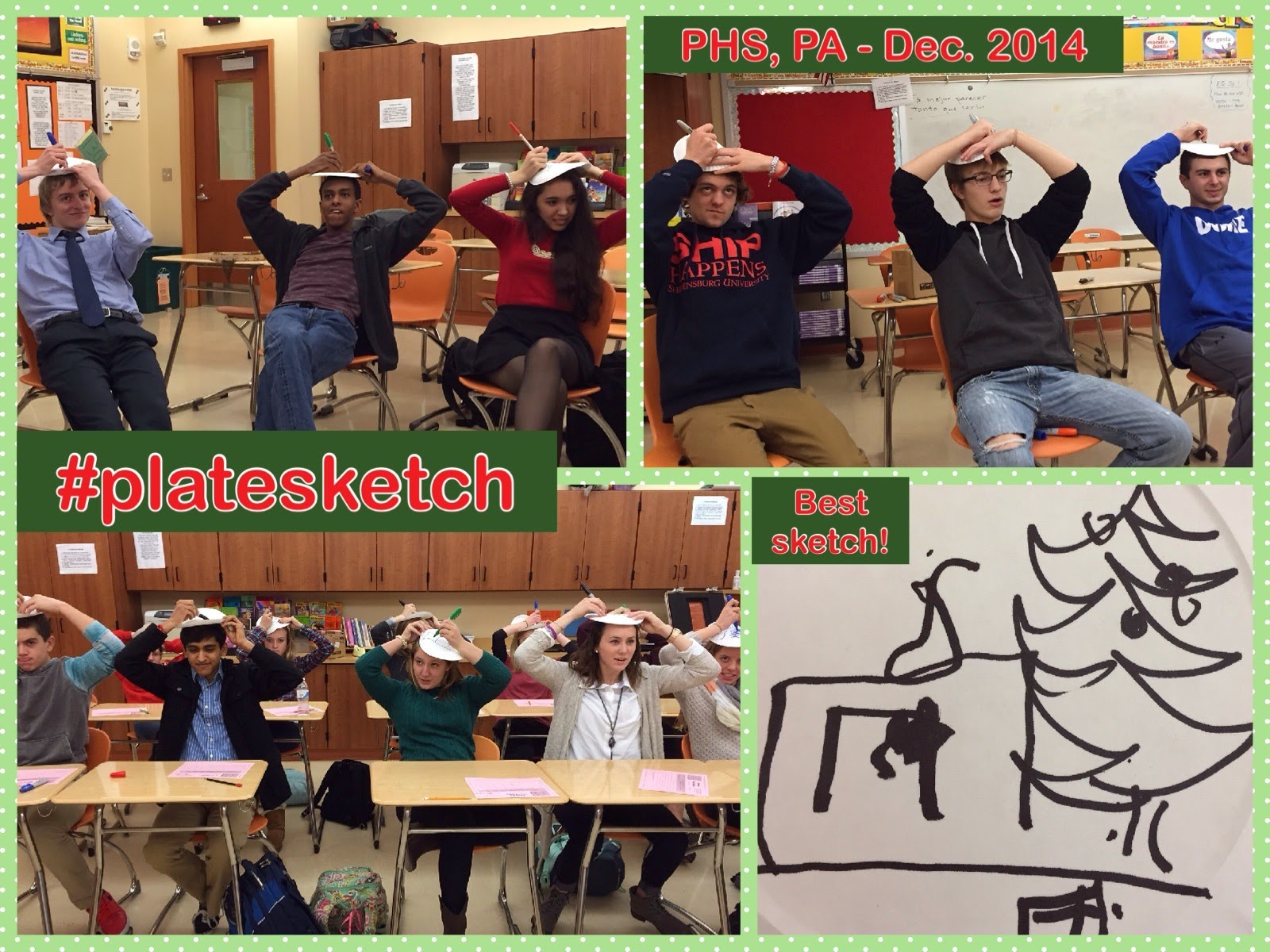
2.  TWEET the best sketch(es) with the hashtag #platesketch or email the sketch(es) to me by Friday afternoon, December 19.

I'll make a collage or use another way to share the sketches on my blog and Twitter.

HERE is the link to the document I shared on Twitter. Let the fun begin!
UPDATED version (as seen below) click HERE

After Christmas I discovered that there were many other #platesketch tweets that I had missed, so I uploaded a second book.  Click HERE to view the second book.


Photo Collage from Palmyra High School - Dec. 15, 2014


Sunday, October 5, 2014

4 - Part Guided Storytelling Activity

Last week I used Bryan Kandel's story about Viernes Negro (found here and other story scripts by Bryan found HERE), even though I took Black Friday out of the equation and made it more general: someone wanted to buy a present for someone else.  The class helped to create a story, we reviewed it, and then I distributed Bryan's version and we read that together.  We also watched an online story I made a few years ago on the website UtellStory (mentioned on this post), followed by reading the script for the story that was also on the previous handout.

After the class story, the two readings, and the online story, I was tempted to move on with new words, but I decided to give the students yet more exposure to the structures with some small changes.  Plus I wanted to experiment with a new idea I had for a 4-part guided storyasking activity.

Part 1. The target structures that the students copied were:
estaba desilusionado/a = s/he was disappointed
le dio = s/he gave to him/to her
lo compró = s/he bought it
la compró = s/he bought it

Then I projected the chart below onto the white board.

 For this story, I wanted both characters to be students in the class.  The first character, (the one that wanted to buy a gift) was permitted to decide to whom s/he wanted to give a gift and, when students gave suggestions for the other answers, s/he had the right to overrule them and not accept their suggestion.

The story in the guided storyasking format was successful in engaging the students since THEY provided the compelling information.  I think the fact that they could see the entire storyline from the beginning, made it easier for them to organize their suggestions and save their best suggestions for last.

As the students created the story, I wrote their answers directly on the whiteboard creating a reading at the same time. This format also helped remind me to pause for short grammar pop-ups such as asking about the LO or LA answers and the O ending in "desilusionado". When we finished, I read the story to them and added small additional phrases in the TL (such as before the "le dio" sentence I added, Alica fue a la casa de Manuel y....le dio el libro a Manuel). 

Part 2. When I was ready to review the story with the students, I tried a different technique that came to me at that moment. I left the completed grid projected on the board with the information, and I retold the story, but with some misinformation.  I told the students to CLAP their hands ONE TIME if I said something that was not correct information. It worked beautifully.  The unison ONE CLAP when I gave wrong information told me they were listening intently for meaning. Plus...there were receiving more input, more repetitions of the structures.  :-)

Part 3.  Students formed groups of 3 and I gave each group a copy of the blank document that I had projected on the board, as shown above.  (Click HERE to access the document.) Their job was to "write" a story by filling in the information as we had done as a class.  In the bottom right square of the chart, they had to decided how the person felt about the last gift and why.
Example of a completed story grid


I gave them 5 minutes to fill in the information on the chart.  Then I gave each group 4 sheets of paper and they had to decide which four parts of their story they wanted to illustrate on the paper.  They actually could have easily made several more illustrations for their story, but I wanted to limit the time spent sketching. When the students finished they paper-clipped their story grid on top of their illustrations and gave them to me until the next class.

Part 4. The following day, I distributed typed copies of the class story from yesterday for additional reading and to help students become reacquainted with the guided storyasking format grid. Then I randomly chose one of the student stories.  I used their story grid to tell the story verbally, (making on the spot corrections if needed). While I read/told the story, the students revealed their illustrations at the appropriate time to match what I was saying.

I have done something similar to this in the past. I'm convinced that projecting the actual grid onto the board so the students can see it when they help create the class story plays a key role in making parts 3 and parts 4 go smoother.