Friday, August 29, 2014

Brain Break Balloons

My new Brain Break Balloons! bulletin board needs a few more balloons and it will be ready to go next week.  I have 70 minute classes and when students are listening to the target language for 90%+ of the class period, their brains definitely need a break. 

I searched Pinterest and other places on the web for ideas for brain breaks.  Then I wrote the brain break activity on a piece of paper and put it inside the balloon before I blew up the balloon.  I stapled the very end of the balloons to the bulletin board.  When my students need a brain break, I'll choose a student to pop a balloon, and the activity listed on the slip of paper inside the balloon will be our brain break activity.

There are a mixture of activities in the target language (such as listening to a Sr. Wooly song) and other activities that aren't in Spanish.  After all, it is a Brain Break, so maybe a break from the language is the route I should take.   

UPDATEMartina Bex wrote a post about the science behind Brain Breaks PLUS she made a document of a list of brain breaks which you can download, for FREE!, from TPT. 
- Click HERE for Martina's explanation of the science of Brain Breaks.
- Click HERE for Martina's Brain Break ideas document on TPT. (She also has a large collection of lessons, cultural readings, games, and other useful materials at TPT, so check those out also.)

Some of the activities in the balloons are:  
- watch one of Sr. Wooly's videos
- Simón dice (Simon says)
- Stand up, arms outstretched, palms facing outward, move left hand back and forth and move right hand up and down at the same time; then switch;
- Sing "Los Pollitos Dicen" w/out lyrics: http://youtu.be/oTApI_rUZ2E w/ lyrics: http://youtu.be/PVv7pIssaMc 
- Bolsa Fea - 3 words 
- 5 a Day Hula  
- Teacher chooses a photo from this blog post and students work with partner or small group to create the best caption (in TL or English, may depend on level)
- hokey pokey led by student
- jumping jacks
- Akinator app (1 time)
- Athlete Quotes - read one of the quotes on this site and give the students three choices of which person said it
- Write a statement on the board, such as "My favorite dessert is_____"; the teacher reads the statement and fills in the blank then tosses a bean bag to a student and the student says the statement, tosses bag to another student, etc.
- there are others, but I can't think of them now. I guess I'll have to wait until the students break that balloon to add it to the list.

Newest update: Did you see the "Go Find Momo" photos?  Today Meg Villanueva posted THIS LINK on Facebook, or go directly to the site at http://gofindmomo.com/ . If you want to use the TL, ask students to say where the dog is in the TL, ex: on the left (a la izquierda), etc

Sunday, August 24, 2014

CI Teachers & the Parent Question "What should my child study?"

How often has a parent asked you "What should my son/daughter study?" or "Can you give my child a study guide for the quiz or test?" If you are a teacher that uses Comprehensible Input and has discarded the long vocabulary list and grammar worksheets, this question can stop you in your tracks.  If you are teaching for true acquisition, "studying" for a quiz, is not what you want your students to do.  In fact, the majority of the quizzes students take in my class are unannounced, in part, to prevent the last minute cramming and memorization practice before a quiz that students have been conditioned to do. 

A few days ago I was at a Tri-State TCI gathering of world language teachers in Pennsylvania and one teacher asked how we respond to those parent questions.  When a parent asks me this question, I respond with "read the class stories and transcripts in his/her Class Stories folder". 

What is a Class Stories folder? It is a pocket folder with 3 prongs that I distribute to the students at the beginning of the semester in which the students put typed copies of the class stories we create in class.

What are class stories and how are they created? Approximately two times per week, I introduce 3 new vocabulary and grammar structures (I call them focus words) through storytelling. Before class, I type a story that includes those focus words.
 
To begin class, I list the Spanish words and English translations on the board, ask personalized questions using the words (PQA), and then weave those words and structures into a story.  (There are other methods I use to introduce the words such as powerpoints and songs.) The students help to create the story by giving details such as names, places, items, etc.  The students hear many repetitions of the focus words in the form of yes/no, either/or, and short answer questions. In addition, we may sketch the story, order the events, create a parallel story with a class member or various other methods to focus on meaning while receiving multiple repetitions of the structures.  

When do students read the stories? If time allows at the end of the class, I project my pre-written typed story that uses the same focus words and we read the story, accompanied with more questions and comprehension checks.

After class, I type the class version of the story and add it on the same paper as my original story and print copies for the students. 

Note: During class, a student is assigned the job to write what happens in the story (it's their choice to write in English or Spanish).  I use the student's notes to refresh my memory when I type the story.

The following day, I distribute the paper with the class story, my original story, and any other story from other classes at the same level. I read the story in Spanish as written and students respond by reading it in English as a class, in small groups, or with partners.  Students also read my original story and the other class's story. 

What are the uses for the class stories?  
   
1. STUDY GUIDE: At the top of the paper for each story I type:
     Español 2 - (date) - (period) - Bold type for the Spanish focus words followed by the English translations. This serves as their "study guides" because it has the vocabulary/grammar structures at the top, the meanings, and the focus words used in context in the stories.

Students also have the option to make their own digital flash cards, such as Quizlet, if they still feel they need to "study" vocabulary.

2. STUDENT REVIEW & SELF-ASSESSMENT: The student can "study" by reading the stories in English.  If they find a word they do not immediately recognize, and do not know the meaning even when it is used in context, their job is to circle or highlight it and ask me the following day.

3. HOMEWORK: Many times the students' homework is to read the class or original story to their parent in English and then the parent must sign to verify that the student read to them.

4. QUIZZES: On occasion I use a story exactly as it is written in the Class Stories folder as an unannounced quiz.  I remove the top section with the focus words, and chose 10-15 words in the class story, put a (#) in front of the word and put it in bold print, and students write the English meaning on the answer sheet.  Students consistently do well on this type of quiz, even when I write yet another story with the same focus words in a totally different story.

5. WARM-UP: As students receive typed copies of the class and original stories, they put them in their folders. I use different colors for the stories to make them easier to find in their folders.  The students sit in groups of 2 or 3 and for 3 minutes, one person chooses a story to read and reads it in English as the others in their group follow along.  After 3 minutes, the second person reads, and so forth.

The Stories Folder grows quickly.  If I introduce new structures for stories at least 2 times a week, in 5 weeks they will have 30 stories to read: 10 original stories by me, 10 stories from their class, and 10 stories from the other (Spanish 2) class.  

Additional stories: 
- I add and copy some really creative stories from previous years for even more stories for their collection.  
- Each time I do MovieTalk with the class, I follow it up with a transcript of the movie story and that paper also goes into their Class Stories folder.

Sunday, August 3, 2014

Novels for Spanish 1 through Spanish 5

At my school district, we stress the importance of reading in the target language with our students.  In each level of Spanish, from the introductory course at the middle school, to level 5 at the high school, we read novels with our students. In Spanish 1 through Spanish 5, we read a minimum of 2 novels.  In levels 4 and 5, students are also required to read a novel on their own (outside the class time) per marking period, for a total of 2 additional books per level.

Several teachers have asked what novels others read with their students.  The purpose of this post is to share what we've found to work at our school.  As we constantly review our curriculum and our students' needs, we sometimes need to make changes and adjustments at which level the books are read.  Also, with the growing number of writers publishing new books, the choices are even greater and sometimes we find a new book is a better fit with our curriculum. In order words, our curriculum is a living, changing documents; an aspect I appreciate!

Also, please note that there is a variety of authors represented in the books.  I believe the students benefit from the different writing styles of each author and I look forward to even more new authors publishing books in the future. (Ahem - maybe that will be YOU!)
We are working on updating our Spanish 1 curriculum and during that process we will decide which two books ALL Spanish 1 teachers will read with their students.

Under the photos of the Spanish 2 books, I listed (some of) the major themes in each book.  Our "units" are built around the books and the themes/subjects. 
 
 
There may be changes in level 3 when we update our curriculum.


Last year I read Esperanza with my Spanish 4 class. The publisher of "Esperanza" lists the book as a level 1 book, but it also easily fits into higher levels because:
1) It can be very beneficial for students to read a book that is "below their level". I like to begin the semester with a book that all students feel successful when reading it.
2) This book deals with immigration and Spanish 4 students are better equipped linguistically to hold meaningful discussions in Spanish regarding this issue.
We did not read La Hija del Sastre in Spanish 4 last year, but we will be reading it in both Sp4 and Sp5 this school year.


Last year I had a mixed Spanish 4 and Spanish 5 class. Since the Spanish 5 students had already read the Spanish 4 novels, I read La Guerra Sucia which we usually read in Spanish 5, and added Felipe Alou and La Calaca Alegre.  

This year, some of the students now in Spanish 5 that were in the mixed Spanish 4/5 class last year, have already the Spanish 5 novels, but since I piloted a book last year in Spanish 5, we didn't read La Hija del Sastre (as we usually do in Spanish 4).  My plan is for the Spanish 5 students to read La Hija del Sastre and La Llorona, along with other legends and short stories, (i.e. Chac Mool, La Conciencia, Cartas de amor traicionado),  so as not to repeat the books they have read before.  

The above books and teacher's guides can be purchased at the following:
I recommend visiting these sites to discover other books available to use with your students. 

There are so many great books not listed above that I would love to read with my students, but the limited time does not allow me to do that.  My dream is to have a Spanish reading club, but...somehow I doubt that would attract a crowd. :-)

Please note: In my school district, each Spanish level consists of 90 days of 70 minute classes.  Final exam days, interruptions and short or missed classes due to state testing, weather delays, and assemblies, are included in those 90 days.  The reason I mention that is to make you aware that when students complete Spanish 5, they actually have LESS hours of instruction in the classroom than most students, at other schools that finish Spanish 4, with 4x4 block schedules or the traditional schedules.  In reality, our level 5 is level 4, our level 4 is level 3, etc. Our level 5 is NOT an AP class.

Thursday, July 31, 2014

Daily Routines Graphic

A standard activity on a Monday morning for my Spanish students in all levels is a "weekend talk" conversations. It still amazes me the number of students that spend most or all of their weekend mornings in bed.  Likewise, when I ask my upper levels "si no estuvieras en la escuela hoy, ¿qué harías?" (if you weren't in school today, what would you do?), many reply they would be in bed sleeping.

Really?  When they have free time, away from structured classes, they'd rather be sleeping? 

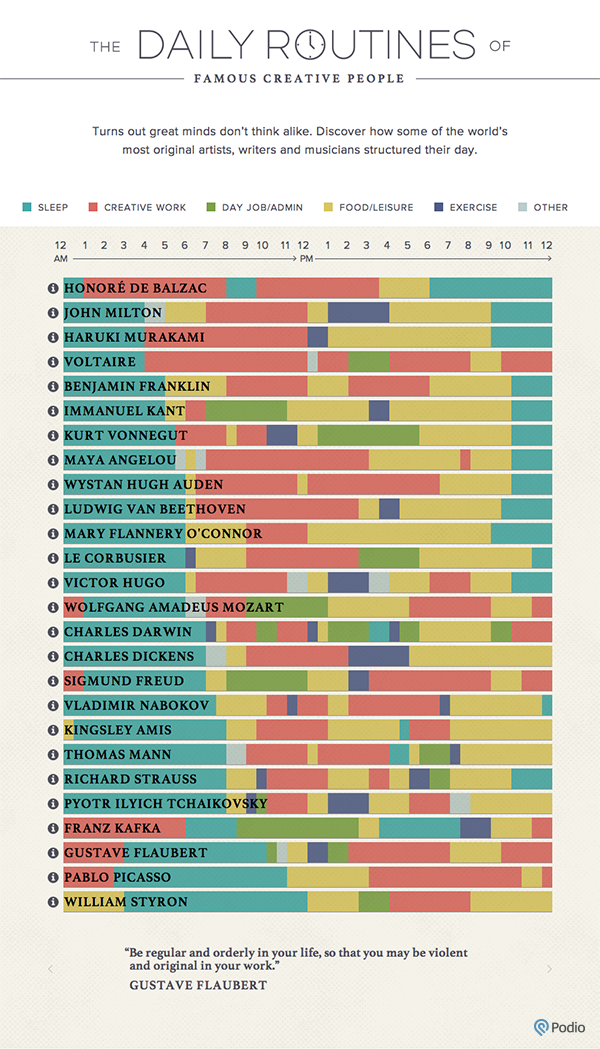
This year I'll use the graphic below to aid in that conversation. Of course, I may first need to introduce information about the famous people to my students. :-)


Want to develop a better work routine? Discover how some of the world's greatest minds organized their days.
Click image to see the interactive version (via Podio).


When you click on the chart, it will link you to Podio's website for an interactive chart!!!


Another use for this graphic is when you are discussing daily routines (reflexive verbs) with students.   

Graphic can be found at: https://podio.com/site/creative-routines


Sunday, July 27, 2014

10 First Day of School Ideas for the MFL Classroom

It's closing in on 2 months since I wrote my last post and now it's closing in on the beginning of school.  The opening day of school for me is less than a month away and thoughts of planning for a new group of students are more frequent. In particular, my thoughts are on the first day of school.  

The list below has some ideas I used in the past, some I found on Pinterest, and from blogs.  A few are ready to go as listed, and others will need changed depending on which level it is used.  The goal is to provide comprehensible input in the target language, even on, or better said, especially on, the first day of school!

Reminder: If the activity requires output in the target language, I suggest to dismiss it for beginning levels, or tweak it and/or provide the scaffolding needed to make it level appropriate.   

1.  Summer photos.
Last year before school started, I emailed my Spanish 4 students and asked them to send me a photo of something they did during the summer.  I put the photos in a powerpoint and our discussion was based on the photos.  It helped the students, and me, to learn about their classmates. This year I may create a Google presentation and share it with the students which will allow them to add their pictures on the presentation. (Work smarter, not harder, right?)

2. A Story!
I used this activity in the past for the first day of class (semester class that started in January) with students that had no exposure to the past tense before.  They had 70 minutes of comprehensible input of the past tense and left class feeling confident that learning does happen when the language is delivered in storytelling format.

3. Schools around the world.
Why not spend the first day of school talking about what your school has in common with other schools around the world?  Click here for a powerpoint of photos of schools around the world, or here is another option. The photos will help to keep the questions and discussion comprehensible.

4. Mafalda: Primer día de escuela
Dive right in and start the school year with a MovieTalk activity. Click HERE for the 45 second video about Mafalda's first day of school.  When I use this video I'll ask them about walking to school with their parents (more like did their parent drive them to school) and if the floors in the hallway were filled with charcos (puddles) from all the students crying. HaHa - this should be a fun discussion!

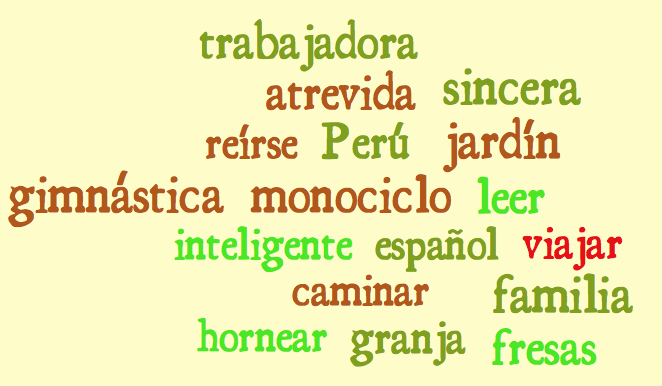
5. Personal word Clouds.
This isn't suitable for beginners, but is another type of get-to-know-your- classmates activity that is suitable for levels 2 or higher.  Choose your favorite word cloud site and fill it with words that describe you, activities you like, or places you have been.  After the students see the teacher's model word cloud, give them the assignment to make their own, but not to include their name.  (My suggestion is not to have the students make this in class, but rather give students 1-2 days to complete the activity.)  

After the students have submitted their word cloud, you can choose several (2-3) to show to the class each day.  Students will guess which of their classmates made the word cloud and then continue the discussion about the student.  This will provide you with more than a week of student-centered topics to set the foundation of a student-centered classroom.

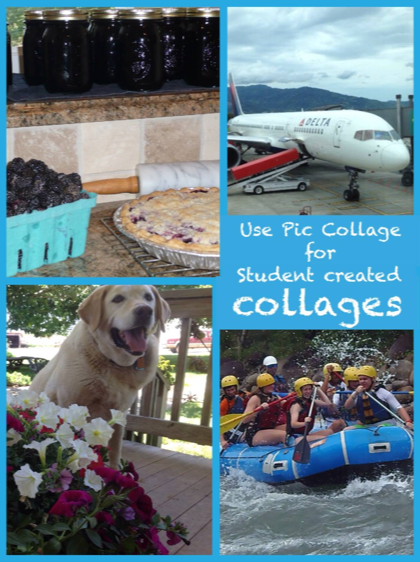
6. Student picture collages.
If you haven't added the Pic Collage app to your devices yet, then wait no longer! The app is user-friendly and I continue to find more classroom uses for it. 

This activity is similar to the Personal Word Clouds listed above, but instead of words, students will make a photo collage. Students can use photos from the app or their own photos, as long as it doesn't include people in the photos that will give away who made the collage.  These collages can be printed out to put around the room, or put on a powerpoint or Google presentation. Lead the discussion around the pic collages and the students' interests.

    (If you want to keep it uniform, set guidelines such as: include x no. of photos, 1 should be of an activity, 1 of your favorite food, etc.)

7. The TOP 10 List.
I did this activity several times in the past with my upper level classes.  I give them large sheets of paper and tell them to make a TOP 10 LIST of reasons to learn Spanish.  I encourage them to use their imagination and make them funny, and they have never failed to disappoint me.  

Below are more ideas that I found on Pinterest:

8. M&M game!
Most students are going to be excited about getting chocolate candies on the first day of school, or from my experience, getting chocolate on ANY school day is memorable for them.

The blog post found HERE, explains the M&M game.  It's not a beginning level activity for a second language class because it requires output, but higher levels will enjoy it.  

9. The Name Game 
The teachers from the Creative Language Class blog describe how to use the Name Game on the first day, even with level 1 students. 

10.  Memorias de un verano maravilloso
A Pinterest find. Click HERE for a free download that students can sketch or write their answers.  

Also check out:

- Show what you know (from the Creative Language Class) 

- What does this make you think about? (from Martina Bex)

- Cognate Practice (from the Creative Language Class) 
 
- Todo Sobre de Mí (from Carolina Gómez)

- Getting to know you grid (from Methods and Materials for WL Teachers)

Do you have a favorite activity for your first day of class or are you planning something new that you would like to share?  I'm sure there are other great ideas that I overlooked.

Sunday, June 1, 2014

Summertime Personalized PD at Home

If your schedule or finances don't permit you to attend the great summertime  conferences (such as iFLT and NTPRS) or the new workshop formats such as Camp Musicuentos, don't despair.  There is no reason to abandon hopes of summertime professional development because there are plenty of opportunities to learn from online resources!   Try thinking of it as a summer of PERSONALIZED professional development at home.
Teachers that are searching for training and resources on providing Comprehensible Input to their students are in luck because there are a growing number of teachers that are posting videos to YouTube in which they demonstrate techniques of using the TL language in a comprehensible way with their students.  As you view the videos below, take note on how each teacher connects with the students by keeping the language comprehensible and by interacting with their students. 

1. Leslie Davison's - ¿Quién llegó? lesson


Leslie used the target word, llegó, 76 times in 12 minutes!  She successfully kept it interesting and the students engaged with/by:
- Student actors
- Props
- Comprehension checks: either/or questions; "What does ___ mean?"
- Restating the students' answers to provide more repetition of the target word
- Comparisons and parallel examples/situations
- Her energy, constant movement throughout the classroom, matched the students' energy 
(WOW!)

My take-aways: Don't short-change students, even high school students, on the number of repetitions of new vocabulary and structures; involve students as much as possible throughout the lesson 
My summer task: Plan a trip to the dollar store or the local thrift store for props. 

Another video example of introducing vocabulary by Martina Bex can be found HERE.

2. Alina Filipescu's MovieTalk of Oktapodi   Click HERE to see the video.

Alina takes full advantage of the students' interest in the video to provide solid Comprehensible Input with the following techniques:
- Comprehension checks: What does ____ mean?  What did I just say? Who remembers (word)?  What did I just ask you?
- Grammar "pop-ups" (short explanations of grammar)  Examples: ser vs. estar; "What is the original verb before it is changed?"; lo que
- Restates students' answers to provide more repetitions in context
- Plays short clips of video and discuss the action
- Reviews past words with motions
- Refers to vocabulary words on the posted list

My take-aways: I don't need to narrate every single action in the video. Post the list of vocabulary to refer to when it appears in the video.
My summer task: Choose target structures from short films on my Pinterest board and add them to my lesson plans for the fall.

3. Michael Coxon's video of Blaine Ray's "la besadora" lesson


From what I've read, Blaine is a guest for the day and he dives right in with the "la besadora" lesson.  Blaine is THE master of TPRS and a master storyteller because he:
- is prepared with a skeleton story with target structures  
- engages students by asking them for details in the story
- asks "Why?" to develop background information; adds interest
- provides input on 1st, 2nd, and 3rd person singular (I, you, s/he) by turning to the actress and asking her to verify the details
- goes slowly, finds where students break down on understanding and works on that structure before moving on to the next detail in the story

An extra bonus to this video is that Michael added notes on the screen, detailing what skills Blaine uses in the lesson.

My take-aways: Verify details with the actors!  (I've read/heard of this technique but rarely use it. The day after I saw this video on YouTube last week I employed it in class and it worked remarkably well, even though my students were not accustomed to the technique.)
My summer task: Make a poster to hang in my room to remind me next year to verify details. 

4. 'Kindergarten Day' with Carrie Toth (click HERE for video)
This is another way to teach with comprehensible input.  Carrie describes it HERE and Crystal Barragan describes her experience with it HERE. 

In Carrie's Kindergarten Day video:
- It may seem very basic and not "rigorous" enough for a high school class, BUT I assure you the students' minds are constantly negotiating meaning as they hear the children's story told/"read" in another language.  
- She goes beyond the printed story, and engages the students by asking them to suggest names, state what the characters are doing, etc.
- She utilizes comprehension checks throughout the story.
- Carrie makes it an enjoyable experience for the students by permitting them to relax on the floor.

My take-aways: Include more Kindergarten Days in my lessons! I wrote a post mid-year stating that I wanted to include this every 2 or 3 weeks in my classes, but it didn't realize that goal. 
My summer task: Choose a minimum of 3 books per each Spanish level I teach and determine the best place in the curriculum to "read" them to my students. 


This is only the "tip of the iceberg"!  There are many, many videos available on YouTube.  I suggest that when you watch, you mentally take note of what the teacher is doing that makes the lesson successful; then make an action plan to implement those techniques and strategies in your classroom in the next school year.

Meanwhile, in July I'll be constantly checking my Twitter account to read the tweets from the lucky teachers attending the summer conferences.  If that's you, please tweet, tweet, and tweet some more. Note: tweets with photos will be especially appreciated.  Thanks. :-) 

Saturday, May 24, 2014

Post Cards for Seniors

Custom made post cards for my seniors
The school year is winding down and I have only a few days to spend with my seniors before they graduate.  This year I created post cards to give to my seniors. 

I'll hand them out to the seniors in my Spanish classes later this week with the instructions to put them in a safe place.  At some point in the future - a year, several years, after they graduate from college, or whenever they want to share some exciting news of what is happening in their lives - they can jot a few words on the back of the post card and drop it in the mail.  

Some students may stash the post cards in a drawer somewhere and completely forget about it until years later.  My hope is that when they rediscover the post card, they will take a few minutes to write a short message and send it on its way. Post cards may seem a bit old-fashioned to some, but in my opinion, getting correspondence through regular mail is extra special.  

Most likely, it will be several years before I open my mailbox and see one of these post cards mixed in with my regular mail, but what a fun day that will be!  

Coincidentally, I've noticed often when I receive notes from past students through Twitter, email, and Facebook, and it usually occurs right when I need a little pick-me-up.  Small things make great reminders of the blessings that are right in front of us. 

Wednesday, May 21, 2014

Today's 145 minute class!

 Can you imagine teaching a high school class for a 145 minute block?  In other words, a 2 hour and 25 minute class. Thanks to the schedule changes to accommodate the state's seemingly never-ending barrage of state testing requirements, today's adjusted 2 hour class period turned into an unimaginable 2 hour and 25 minute class period.

I was fortunate in that the students in my class were absolutely amazing and kept any complaining to themselves, but I felt for them.  For part of the time, I tried out a new activity that actually worked well and mixed things up in the long class period. We did the following activity for 30 minutes.

Materials for the activity:
- A subscription to A-Z Reading.  (If you don't have this, find a children's book with visuals for each book that students are very familiar with and cover the written words.  As long as the words are covered, you can use a book written in any language.)
- Mini-whiteboards for each student
- dry erase markers and erasers

1.  Put the students in groups of four (NOT less!).  Some groups may have 5 but only 4 sentences are required from the group even if there are 5 in the group.

2. Project the wordless book onto the whiteboard.  

3.  Each group must write 4 sentences that relate to the picture. Students couldn't repeat a verb in the 4 sentences.  They were encouraged to help their teammates in order not to have any mistakes in their sentences.

 I used this activity in Spanish 2, so their sentences had to be in the past tense.


4. Turn to the 1st group and tell them to hold up their sentences.  They received one point for each correct sentence.  If there was an error, I took the whiteboad and showed it to the class.  If the class could find the error, the team that wrote it did NOT get the point for the sentence.  If the class couldn't find the error, I explained the correction and the team that wrote the sentence got a point for it, even though it was originally incorrect.

5. Turn to the next group and go over their answers.

6.  Check each group's answers; write their points on the board; then start the process over again with the next photo from the story.

7. When finished, students work independently to write the story as I clicked through the wordless book the 2nd time.

The reasons I liked this activity:

1. All the students were engaged: during writing, reading the answers the other teams had written, and looking for mistakes.

2.  It promoted teamwork. Students helped their classmates as they were writing their sentences. If an answer was incorrect, I stressed that it wasn't the fault of the one person that had that board, but rather that it was the responsibility of the team to check each others' answers.

3.  They became very good at finding the mistakes and that carried over into their own writing.

4. Since they had to write 4 sentences, it pushed them past the basic sentences.  
5. When I saw a correct sentence that was rather complicated for Spanish 2 level, I held that up as an example of an outstanding sentence.

6.  The students were more at ease during the individual writing session that followed the activity.

This activity could also be completed after reading a chapter from a novel or a short story that has illustrations or photos.


Sunday, May 11, 2014

Review Chapters of Novels with PicCollage App

The goal for language teachers at my school is to read a minimum of 2 novels with the students per level.  I prefer to read a novel in 12-15 days instead of drawing it out to a month or longer.

A good way to review the events of the previous chapter before beginning a new chapter is to make a collage using the PicCollage app.  The app has images within the app that are copyright free, making it quick and easy for the teacher or students to create the collage in a short period of time.

This summer I'm going to shop around to check prices for making collages of El Nuevo Houdini into posters for the classroomAfter reading a chapter, I can then hang the posters around the room.  This will help students to remember the events of the previous chapters.  If a student is absent the day we read a chapter, the other students will have a handy visual to refer to when they explain the events to their classmate(s).

Or..display the poster photo collage before reading the chapter to predict events.  An variation of this is to create a collage with 1-2 photos not related to the chapter and ask students to guess which photo(s) are the imposters.

It also might be a nice way to have a verbal quiz at the end of the book.

Another bonus, hang the posters in the hall to help showcase what your students are learning in class.  Better yet, record a student telling a review of the chapter, connect a QR code to the recording, and post the QR code along with the poster in the hall!  

Friday, May 9, 2014

Active Reading Review - Marker Partner Game

My Spanish 4 class is currently reading the latest book by Carrie Toth called La Calaca Alegre.  We needed to take a break from reading the book to prepare lessons and then visit the elementary schools, so it had been several days since our last chapter.  I used the following activity which proved successful as a review AND as a way to keep everyone actively engaged in the review.

First, we arranged the desks in a circle in groups of two with a marker placed in the middle of the top of the desks.  (The sketch to the right shows seating for 16 students but I had 13 sets of desks to accommodate 26 students. The activity works with large or small numbers.)

Then I used used the activity El Tenedor (The Fork Game) found on Bryan Kandel's website, but made some small changes to the rules and added some (extra) movement by having the students rotate to other seats because I knew that would work well in my class. 

There were two teams: students on the inside were one team, and students on the outside of the circle were another team.

I had prepared 20+ true/false statements in the TL about facts from chapters 1-5.  Then I read a statement to the students.


·      Rules:
1.    True statement: students race to grab the marker and hold it up. The team with the most members holding the marker receives 1 point.
2.    False statement: students do NOT touch/pick up marker. If nobody on the team touches/picks up marker, the team earns 1 point.  (Both teams have the possibility of earning a point.)
3.    If it is a false statement and students on both teams hold up the markers, the team with the most number of students holding the marker loses 1 point.
4.    If it is a false statement and a student touches the marker and then throws it back, the person sitting opposite of them should stand up (without talking). The team with the student that threw the marker on the desk loses 2 points!
5.    After 3 statements, the students on the outside circle rotated clockwise one seat so students had a new person with whom to compete.
   
They loved this review game!  It was engaging, lively, and admittedly a little noisy at times, but sometimes learning is loud.  :-)

Monday, May 5, 2014

Writing with Spanish Hashtags #

The curriculum in my spring semester worked beautifully in that el Cinco de mayo happened in the midst of our cultural emphasis on Mexico.  I read the activities from The Creative Language Classroom and adjusted their suggestion for using hashtags with photos of Mexico. They have a few photos of Mexico on their website, but I searched for other photos and put them on a regular word document.  I searched for traditional photos (Mariachi groups, el día de los muertos, los mercados, etc) and added others photos to help show the diversity of Mexico such as snow (yes, they have it in northern Mexico at times), los clavadistas, Lucha Libre, ensalada de nopales, and others.  

The students worked in pairs to write a comment using a hashtag to describe the photo or simply react to the photo on the mini white boards.  For the first few photos many of the students had basic comments, but eventually they let their imaginations go and became very creative with their responses.  Once that happens, you can count on the competitive nature of some students and the desire to outdo the others, and then... the answers become even more creative.

We started this activity after 1/3 of the class left for an early dismissal for a track meet.  It kept everyone engaged and they enjoyed it.  

When I ran out of photos of Mexico on the document, I started searching in my files for photos that I use for a different activity in Spanish 4.  While I was searching, one student took advantage of the break and told the others that they had 1 minute to draw something that he described on their whiteboards.  (I continued searching on my computer.) After a minute, he told them to hold up their boards and to describe their sketches and THEN...he proceeded to ask them questions, in Spanish, about their sketches to which he insisted they respond in Spanish.  WHAT?  Did that really happen?  Yes, it did.  I paused from searching for my file and took in the moment, enjoying how the students were taking ownership of the class activity and cooperating with the student that suggested the activity.  What a perfect way to end the school day.

Saturday, April 26, 2014

Silent Photo Story: Digital Storytelling with a Twist

Last week my students created a Silent Photo Story project that was inspired by this pin on Pinterest.  (The two students that made the project, below left, gave me permission to post their project.  You can find it at the end of the post and HERE.)

Before assigning the project to my students, I did a trial run by texting photos of a story, with the sentences written on an app on my ipad, to my daughter that was at her college tennis match.  (See one of the photos from the story below on the right.)  I searched for a way to post the photos on an app that would automatically advance each page of the story instead of having the photos listed vertically as on the Pinterest example.  The easiest user-friendly method I found for students to use is the Educreations app.

The purpose of the project was for my students to write in the past tense, include sentences that describe how someone felt about the actions of another person (the imperfect subjunctive), and for the majority of the creative aspect of the project to be completed outside of class time.

The Silent Photo Story project:

A. Requirements
   - Write a story in the past with a minimum of 10 sentences.
   - A minimum of 2 of the sentences must describe how someone felt about
     the actions of another person or about a situation.
   - Write each sentence on a mini-whiteboard. (I gave each student 2 
     markers, an eraser, and a mini-whiteboard to take home.)
   - Take a photo of you holding the marker board with the sentence. Your
     actions should match the sentence on the board.
   - E-mail the photos to your school g-mail account.

B.  Students had 4 days to complete the assignment.  I offered to proofread their sentences before they took the photos, but none of the students took me up on this offer.  (Next time, I will require the students to have a mini-conference with me before they complete the project.)

C.  The day it was due, I signed out the department i-pads.  The students accessed their photos through their g-mail, copied the photos to the i-pad, and opened the Educreations app.

D.  On the Educreations app, they uploaded one photo per page/slide.  Then they made a silent recording, pausing 3-4 seconds on each page.  (If you save the project before making the silent recording of each page, the app will only save the initial page of the project.)

E.  After the recording, they saved the lesson and followed my detailed instructions on how to post their projects directly on our class Edmodo page.  Those directions can be downloaded HERE.

F.  The following day in class, we sat in a circle (conversation style which means without desks) and read the stories. 


Note:  This project can also be done completely in class if you do not want to send the supplies home with the students.  One of my students completed his project at home, but it was in one location instead of several locations as in the example above.  His expressions perfectly matched the action in his storyIf I he gives me his approval to post it, I'll add it later.