Tuesday, April 2, 2019

One Word Images in the World Language Classroom

PD in Philadelphia w/ Krista
In early March, the other 3 members of my World Language department and I traveled to Philadelphia for a 2-day workshop by Mike Peto. 

Krista and I have attended countless workshops, conferences, and TCI group meetings for years, but I was particularly looking forward to attending Peto's workshop since the two newest members of our department, ("new" as in they've been teaching at our school for 5 or 6 years), were also going to the workshop. Whenever Krista and/or I go to a conference, we share that information with our department when we return, but how fun and beneficial to grow professionally together as a department


PHS WL Dept driving to PD in Philly
I've been teaching with a focus on providing comprehensible input for years and I've read Mike's books, "My Perfect Year" and "Pleasure Reading", so much of what Mike talked about I had already implemented in my teaching, ie. SSR/FVR, interviewing students, writing, etc, but for me, the draw for the workshop was to see Mike demonstrate and talk about One Word Images (OWI), the Write and Discuss (W&D) aspect that follows it, and his Maravillas collection of videos and stories. I had created some OWIs in my classes this school year and last school year, but I was ready to improve my skills in that area and for my department to do the same (although I completely think Krista already has the OWI skill down to a science!). 


I chatted w Arianne Dowd!
Did you notice Mike
Peto in background?
Mike demonstrated how to create OWIs by creating one with the attendees as if we were students in his Portuguese class. Immediately after walking us through the steps for the OWI, he wrote about what we had just discussed, asking for answers from the class at our level. He "revealed" the sketch that two members had drawn while we were creating the image and reviewed the information using the sketch to point out different aspects of the story. More input, more repetitions of high frequency words, and more opportunities to process the input our brains had received.

Some of my take-aways from the workshop were:

1. Encourage students to "free their minds to imagine" before creating a OWI. Have students imagine with you as you move the image from the board to a stool or table in front of the room where all students can "see" the object. Set the students up for success by preparing them to be creative. Unfortunately, by the time our students are in high school, many of their required work and assignments for school do not allow them to utilize their imagination so we need to reawaken their minds to let the creativity flow.
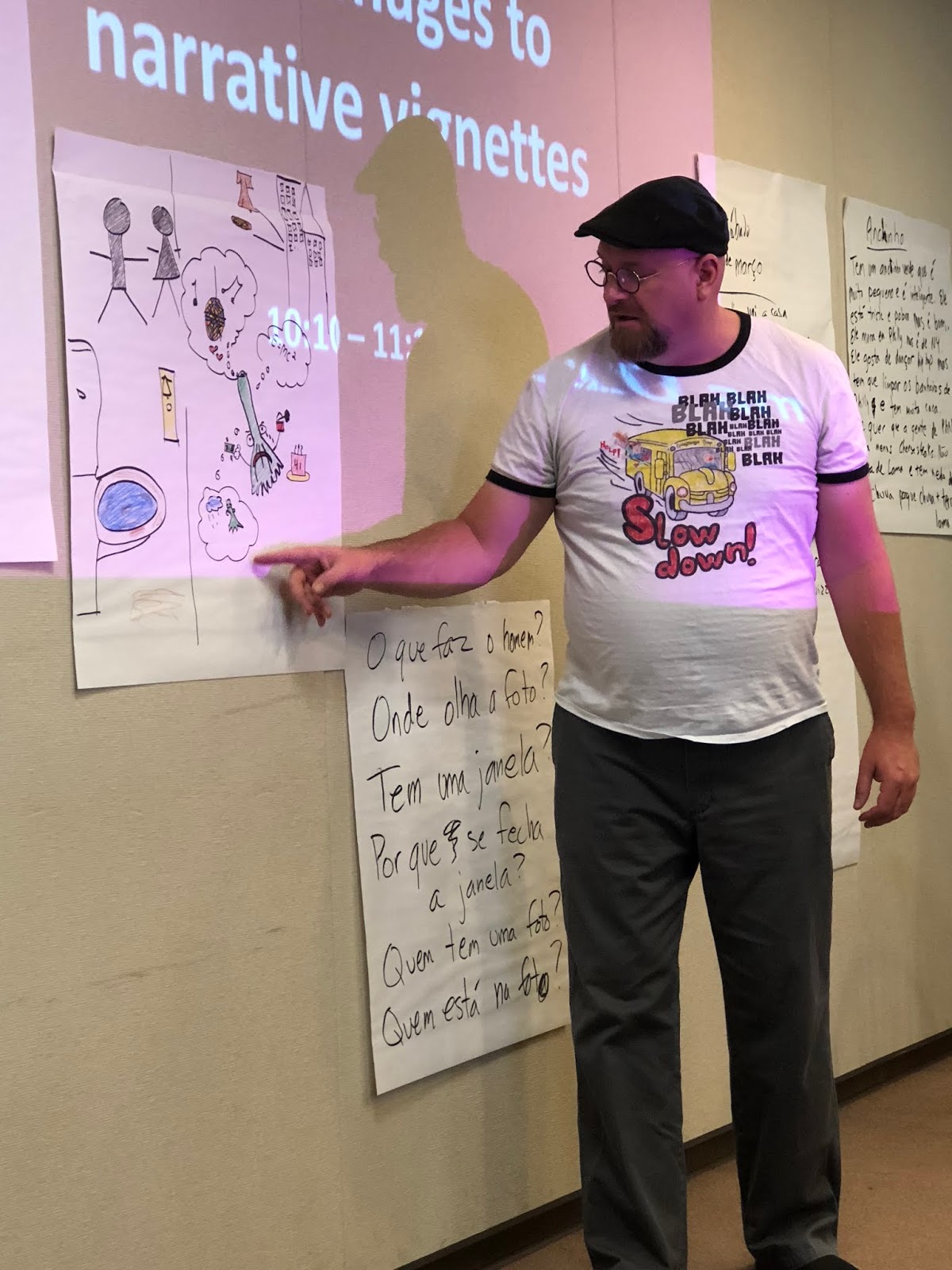

Discussing info from the OWI extension story.
2. Do a Write and Discuss about the OWI immediately after the students have helped you create an interesting object. The information that needs to be decided about the object are listed HERE. Limit the time spent on this stage and enlist the help of a student to keep track of the time for you. While you are creating the object, assign two artists (one student artist and one student to color the artwork). Have them draw in an area of the classroom that the other students do not see what they are drawing and are not distracted by the two artists.

Do the W&D before you share the artwork with the class. Writing about the object, before the class sees it, gives the student artists time to complete their sketch.

3.Students should NOT write during Write and Discuss. Ask students questions that will help guide them to retell the information. Write (not type) the information on a large sheet of paper or on the board. After the information is written, may instruction students to copy the W&D, but it is not necessary. The power of W&D for students is hearing the words as they are written and seeing the syntax of the language in a written story that they already know.

The W&D also gives the student artists time to complete their sketch.

4. After Write & Discuss, students should read what you have written with the class. Mike suggested several options on how to read, but most important is to READ it!


OWI created w/ class on 4/1/19
5. Create a OWI one day, write about it, read it and the following day create, with your students, a story about the OWI. (Ask the following questions to draw out more information: Who? Where? With whom?, What is problem? How does character fail to solve the problem? What is the solution?) As a ticket out the door, tell students to write a problem that the character has, or if you have already determined the problem, you can have students write or discuss in small groups HOW the character solved/tries to solve his problem. If students write an idea on a paper as a ticket out the door, look at the suggestions and choose the best one to use in class the following day.

Write the story that you created and READ again!

6. Give students a short quiz on the OWI and story they created. All students that were actively engaged in the creation of the story, the W&D, and the reading should be successful on the quiz. Students that do not do well is a result of them not tracking in class, which has nothing to do with their language ability.

7. After the story, highlight the good in the story and the positive actions of a character. Mikes says "I like my class to be a positive force for change."


OWI - 4/1/19
8. Post/project the AP themes and use them to inspire students when they think about how to create extension stories from the OWI. How cool of an idea is this?! AP themes should be part of your class from level 1.

9. Implement OWI into ALL levels. OWIs provide a perfect and natural way to provide rich language for your students in all levels.

The summary above only scratches the surface of the OWI and W&D portion of Mike's workshop, and there were many other aspects of the workshop, not just OWIs. The best way to get all the information is to attend one of his workshops first-hand!

A few other take-aways not directly related to OWIs.

Absent students represent students that have had less verbal input. Mike said, "It's hard to keep kids in my class" because the students are absent from school or pulled out to do work for other classes. It is better for us, as teachers, to require students to make up the missed input time and hours rather than excuse them from class with no expectations.

This was a complete shift in thinking for me. For several years I have been in the camp of thinking that if an A student misses class and there was a graded activity in class, I could excuse the student from the activity because if I required her to make it up, she would end up with a grade consistent to her previous work. More work for the student and for me to show that her grade will stay the same.

However, now I view it as Mike said, the student missed valuable input in the target language, something that is extremely difficult to find at the student's specific level outside of the classroom. Students will grow in their language abilities with additional input, not by excusing them from work they missed when absent. If I truly want my students to improve, I need to hold ALL my students accountable for material they missed when absent and be willing to possibly give up a lunch from time to time to retell a class story or create a new story with students that had been absent from class.

After a student interview, do a survey for the class about what was discussed. Limit it to 5 minutes max and then do a write-up about it, followed by reading what was written.

Calendar talk is NOT about the calendar; it's about the students' lives. I knew this but it seemed to sink in deeper hearing it again!
Also, Calendar talk becomes more impactful with each day new information is discussed/learned because you can refer back to the previous day(s)' information.

Changes made upon returning to PHS
Related OWIs created in separate
classes on the same day.
Both Krista and I were in our classrooms on the Sunday following the workshop. I moved my high-frequency verb posters to the front of the room, and moved some of the SSR books/bookshelves to the front and sides of the room. 

Our department is enjoying creating OWIs with our students and watching the students' vocabulary and understanding of the language develop naturally from the rich input provided by the OWIs. Imagine my surprise when I discovered that my Spanish 4 class and another teacher's Spanish 1 class had both created a wealthy, red avocado on the same day!

Krista and I bought jumbo crayons and other crayons to add to our student artists supplies. 

I am teaching levels 4 and 4+ this semester so my goal, for the remainder of this school year, is to create a OWI every other week with my students. Next year, I have asked to teach some Spanish 1 classes to be able to review the current curriculum by actually teaching it again (it's been y-e-a-r-s since I taught level 1), I know I will be implementing OWIs into my lessons from the very beginning of the semester!
   

Sunday, December 9, 2018

(Leave) Grammar at the Door

In May of 2017 I wrote a blog post about how I use passwords with my Spanish students when I greet them at the door. (To read more about passwords click HERE for the May 2017 post, and HERE for Alina Filipescu's explanation of how she uses passwords; I believe the idea for passwords was originally from Alina.) 

I teach three different levels of Spanish and usually I have two or three different passwords, depending on the level. To help ME to remember the passwords and questions, and to simplify things, I taped a mini-white board outside my room next to where I greet the students with the passwords written on the board. The first day of a new password, I have it written in Spanish and in English and the following days it is posted only in English. The white board is also handy because I can write an example response to a question on the whiteboard for additional support for the students.

An excellent benefit of using password questions, is that it is an indirect way of introducing a new sentence structure (grammar) without the focus on grammar. For example, my question this week for two of my classes were "¿Que nunca has hecho? (What have you never done?).  Below the question, I wrote "Nunca he viajado a Australia" and the following day I left only "Nunca he ..." as a hint for the students. 

I'm sure it is obvious to language teachers that I was "practicing" the present perfect form and past participles with the students. However, the focus is on their answers and what I learn about the STUDENTS from their answers. The grammar aspect is happening at the door, but the discussion and interest level continue inside the classroom after class starts.

Friday was a good example of class discussion happening after Grammar at the Door with the passwords. Students answered the question at the door followed by a comment or another question by me. A student said that she had never eaten octopus, so I asked her if she wanted to eat octopus. Another student said he had never eaten at Chick-Fil-A, to which I commented that I have never eaten their either. Another student said he had never traveled outside of the United States so I asked him where he had traveled in the United States. Someone even said she had never gone to Starbucks.

After class started, I shared with the students the answers of their classmates and wrote a few example sentences on the board. Then I asked each student to respond to the same question again, but with a different answer. Each new answer was a spark for a new conversation, some quite unexpected. Those that teach high school won't be surprised that one student said he had never drunk his own urine. Yes, he really said that. His answer is what I view as a teachable moment and a learning opportunity. My first thought was of are news reports of people that are trapped after an earthquake or a disaster and that is how they survived. Interestingly, none of the students were derailed by his answer and one girl said it's sterile, to which I agreed. From that conversation students heard in Spanish "estérile, sobrevivir (a recycled word from a newspaper article we discussed earlier in the semester), and terremoto". (sterile, to survive, & earthquake)

When the password question is one that interests the students, the follow-up classroom discussion flows easily, student engagement happens with ease, and the language is used in a natural way - to learn about others. Students want to hear what their classmates say and they want to respond to what their classmates share.  I actually ended the conversation with one of my classes because it was Friday and I wanted to wrap up an activity we had started the previous day. 

I am not against "grammar". Grammar has it's place and value in conversations.  Grammar naturally lives in conversations, but it doesn't live in worksheets and certainly not in conjugation charts. The more we communicate with each other, the more examples of grammar in context we hear and see. Remember, grammar isn't the star of the show, but rather plays a supportive role.  

Saturday, November 24, 2018

"Risky Business" - A Game for World Language Classrooms

I enjoy playing games in my Spanish class to provide additional comprehensible input, and so do my students, but did you ever play a game with your students and one team was so far ahead in points that the other teams wanted to give up? If so, considering trying a new game I created called:

Actually, it is the scoring that is new.

My students and I had read a chapter in Vidas Impactantes, written by Kristy Placido, on Azucena Villaflor. While reading it, I realized that the information could be subdivided into the following sections:

  A. Azucena Villafor. (6)
  B. El golpe de estado (6)
  C. Néstor (4)
  D. La búsqueda (3)
  E. La primera manifestación (7)
  F. Gustavo Niño (6)
  G. Arrestado (5)
  H. La desaparición de Azucena (4)
  I. Justicia (5)

After dividing the chapter into the above 9 categories, I wrote questions (the # of questions is in parenthesis above) from that section. When we played the game, I listed the categories on the board, but I did not write the # of questions in each category. The students did not know how many questions were in each category.

The class is a small class so I divided the students into three teams; I will call the team A, B, & C in this explanation. Students on a team were permitted to discuss the questions with their team members.  The goal of the game is to have the most points after all the questions are answered or after the allotted time the teacher set for the game has ended.

Answering questions in a category:
Team A chooses a category and they have to answer the first question from that category. If they answer correctly, they earn 10 points. EVERY TIME a team starts their turn, in each round, the answer is worth 10 points. If a team answers the first question of their turn incorrectly, they do not earn the 10 points, nor do they lose any points. Their turn is over after an incorrect answer.

After Team A answers the first question correctly, they can chose to end their turn or continue with the second question in the SAME category.  If they answer correctly, they DOUBLE their score, (in the example below, they answered the first question correctly and earned 10 points; they answered the second question correctly and doubled their score to 20 points). After each question they answer correctly, they can choose to continue with the next question in the SAME category, or they can choose to end their turn. If they answer the third question correctly, their score is doubled from 20 points to 40 points.

Ending a turn
A team will end their turn in one of the following three ways:
- the team answers incorrectly
- the team chooses to end their turn
- there are no remaining questions in the category they choose (This is why I DO NOT write how many questions are in each category. I don't want team members to choose a category based on how many questions and possible points they can earn. This add some unknowns to the game.)

Losing Points
When a team answers the first question incorrectly, there are no changes to any of the teams scores. However, a team will LOSE points if they incorrectly answer any question after their first question in each round.  


In the example on the left, ALL teams start with 0 points:

Team A earned the following points in a first round: 

 10 pts - answered 1st question of a category correctly

 20 pts - answered the 2nd question in the SAME category and doubled their score (10x2=20) 

40 pts - answered 3rd question correctly in the SAME category and doubled their score (20x2=40) 

80 pts - answered the 4th question correctly in the SAME category and doubled their score (40x2=80)

40 pts - The team INCORRECTLY answered the 5th question. They LOSE half of their current points, (80➗2=40) and the 40 points they lose are divided by the number of other teams playing and added to the scores of the other teams.  (40 pts divided by 2 teams = 20 pts for Team A & 20 pts for Team B.

Score: Team A - 40 points; Team B - 20 points; Team C - 20 points

Team A's turn ends because they answered incorrectly. Team B starts their turn in the first round and chooses a category. If Team B knows the answer to the question that Team A answered incorrectly, they can choose to stay in the same category and answer that question. But as a reminder, they do not know how many questions are in that category. It is possible that the category only has 5 questions and after Team B answers the question correctly that Team A missed, and earns 10 points because it is the first question they answer correctly in their turn for that round, it may be the last question of the category and their turn would end. Team B can choose a different category instead of continuing with a question in the category that Team A answered questions.

Points will accumulate quickly when teams answer correctly and when they earn points from teams that lose half of their points.

      -------------------------------------------------------------------------


Team B starts their turn. They choose a new category:

20 pts - (their beginning score) points were added to their score when Team A answered incorrectly

30 pts - Team B answered the 1st question correctly (20 + 10 = 30). Remember, the first question that a team answers is ALWAYS worth 10 points; points double starting with the 2nd question they answer correctly.

60 pts - Team B answered the 2nd question correctly and doubled their score (30x2=60)

120 pts - Team B answered the 3rd question correctly and doubled their score (60x2=120)

240 pts - Team B answered the 4th question correctly and doubled their score (120x2=240)

Team B decides to end their turn (indicated by the small "x"). Their ending score is 240 pts.

      -------------------------------------------------------------------------


Team C starts their turn. They choose a different category. 

20 pts - (their beginning score) points were added to their score when Team A answered incorrectly

30 pts Team C answered the 1st question correctly (20 + 10 = 30)

60 pts - Team C answered the 2nd question correctly and doubled their score (30x2=60

120 pts - Team C answered the 3rd question correctly and doubled their score (60x2=120)

240 pts - Team C answered the 4th question correctly and doubled their score (120x2=240)

480 pts - Team C answered the 5th question correctly and doubled their score (240x2=480)

240 pts - Team C incorrectly answered the 6th question. They lose half their points (480➗2=240)

The 240 points that Team C lost is divided by 2 (since there are 2 other teams playing) and Team A and Team B receive 120 points each.

 -------------------------------------------------------------------------

When my students were playing, there was one team that started to play cautiously because they had a large number of points and didn't want to RISK losing half of their points and having those points going to other teams. They chose to answer only 1 question per round. They were playing safe because the first question a team answers at the start of their turn in each round, is only valued at 10 points and if they answer incorrectly they don't lose points and the other teams do not receive any points for their incorrect answer.  

However, the one team was playing cautiously, but another team was answering several questions correctly each round before deciding to voluntarily end their turn, and the other team quickly caught up to the team playing cautiously.

Order of questions in each category
There are two ways you can order the questions in each category:

1. List them from easiest to most difficult. Teams will know that with each question, the difficulty increases so they can plan accordingly.

2. Order questions in each category in random order of difficulty. Teams will not know if the next question is easy-peasy or if it will be difficult and cause them to lose their points. If they proceed cautiously and end their turn, the next team may choose to continue in the category that the previous team answered one question correctly, and have several easy questions which will make the cautious team wish they had not ended their turn.

This game can be played with any written material/text or with text from a video or MovieTalk, as long as you are able to divide the information into many categories and there is enough material to write many questions.  I recommend a minimum of 6 categories and 20+ questions.  The advantage to having many categories is that if a team is on a roll, their turn will end as soon as they answer the last question in the category.

Whew! That was a long explanation. If there is something that is unclear, please ask me about it in the comments below and I will clarify it.  Thanks for reading!

Thanks to Carrie Toth - it wouldn't be Risky Business without you. 

Wednesday, November 21, 2018

Pleasure Reading in the World Language Classroom - a teacher's guide to reading by Mike Peto

Calling all world language teachers: 
What are your thoughts and understanding on the power of reading for vocabulary growth and to boost language acquisition? Do you have a current SSR (sustained silent reading) or FVR (free voluntary reading) program or are you ready to implement one? Do you have the key elements in place to move your students from reading in the target language to becoming lifelong readers that enjoy reading? Are you curious how other world language teachers are supporting students in their reading language journeys?

If you answered yes, or even maybe, to any of the above questions, then I'd like to recommend a book that will answer your questions and challenge you to rethink your reading program.    

I recently finished reading Mike Peto's newest book, Pleasure Reading in the World Language Classroom. This book is a must read for teachers that want to build a successful reading program, for those that want to improve their current reading program, and for those that want to increase the amount of reading their students do in the target language in every class period, every day. Who doesn't want that for their students? So, in other words, Pleasure Reading in the World Language Classroom is a must read for ALL world language teachers!

Mike shares his insight and personal experiences on how to create a reading program in the world language classroom that encourages students to become lifelong readers and eventually bring students to the realization that they ENJOY reading! This book is packed full of research on pleasure reading, steps to prepare students to read independently, how to select and display reading materials for a classroom library, assisting students and heritage learners in selecting reading materials, and perspectives on accountability and assessment.

Mike's style of writing is clear, straight-forward, and unapologetic. Mike is not content to continue teaching "status quo" when the results do not meet the mark that Mike expects. You will need to read the book with an open mind and a willingness to look at reading, and teaching a language in general, from different perspectives. However similar or different your teaching may be to Mike's, it will be evident that he is sincerely searching for what is best for his students in their language journey and wants to share his successes in the classroom with others in this book.

Mike begins his book describing how teachers can prepare students for a successful reading program through the creation and discussion of class-created stories or by the teacher telling the class about a remarkable person or cultural tidbit in the target language, (such as Mike Peto's Maravillas texts). These discussions and presentations are followed by reading. In this manner, Mike demonstrates how teachers can lay a foundation for student success in reading at the earliest levels before students open their first novel, and through all levels of language instruction.

In relation to reading novels, Mike makes a clear distinction between reading a class novel and independent reading of novels and other texts, a.k.a. pleasure reading. The pillars of pleasure reading are "student choice, little or no assessment, and giving students the ability to abandon the text."  Mike writes that there is a place for reading novels as a class, but he strongly places more importance on pleasure reading, (independent reading) and providing time for students to chose and read their own texts. He reminds teachers that read class novels with students to choose a book that doesn't require an extreme amount of scaffolding and support from the teacher to understand the text. Likewise, he cautions teachers to not commit "readicide" by requiring students to complete activities for each chapter of the novels.

Tina Hargaden weighs in on pleasure reading in several sections of the book that she wrote in which she shares her experience in areas such as "Differentiation and Equity", "Keeping Cool when Students aren't Reading", and "Reading Partnerships and Book Clubs Provide Structure for Independent Reading".  

I predict that Pleasure Reading in the World Language Classroom is a book that teachers will read many times as they continue to glean information on reading from Mike's suggestions and experiences. I downloaded my copy of the book and it is now marked with highlighting and underlines and notes in the margin to make it easier for me to refer to and reread in the future.  

Personally, reading this book has challenged me to reflect on my current reading program, and to remain committed to providing the best possible reading experience for my students, even when it may require some tweaking to my current reading program. 

You can download the ebook directly from the author at: https://mygenerationofpolyglots.com/product/pleasure-reading-in-the-world-language-classroom-ebook-download/

Wednesday, September 12, 2018

Leer es Poder

The World Language department at my school is making reading in the target language a priority this year. Below is the bulletin board outside of my Spanish classroom and Krista Kovalchick's French/Latin classroom. There are four 5x7 photos of the 4 WL teachers and the other photos are some of the students in Krista's and my classes. There are a few photos that we will add in the next few days to complete the bulletin board.

I have a rather extensive classroom library partially from buying books with our school budget, but the majority of the books I buy from amazon or the publishers with my personal money.  Krista does the same with buying books for her classroom, but it is a bit more difficult for her because there are not as many French and Latin books written specifically for second language learners are there are for Spanish language learners.

My plans are to write a grant and buy additional books to build up the classroom libraries so all the WL teachers have a nice selection in their classrooms from which the students can choose during SSR. 

I'm waiting for 4 new books from Fluency Matters as well as other books that I have heard about that will soon be published. You can never have too many books for your students, right?  :-)

We continue to read class novels together; 1 in level 1; 2 in levels 2 and 3; 3 (or more) in levels 4 and 5. Below are photos of my classroom library. One of the racks has children's books that I rotate after two or three weeks. I have a huge collection of children's books from an earlier grant and from a teacher that moved to the middle school and gave the books to me. I don't make those as accessible because the language and grammar is usually more difficult than the novels. 


Sunday, August 26, 2018

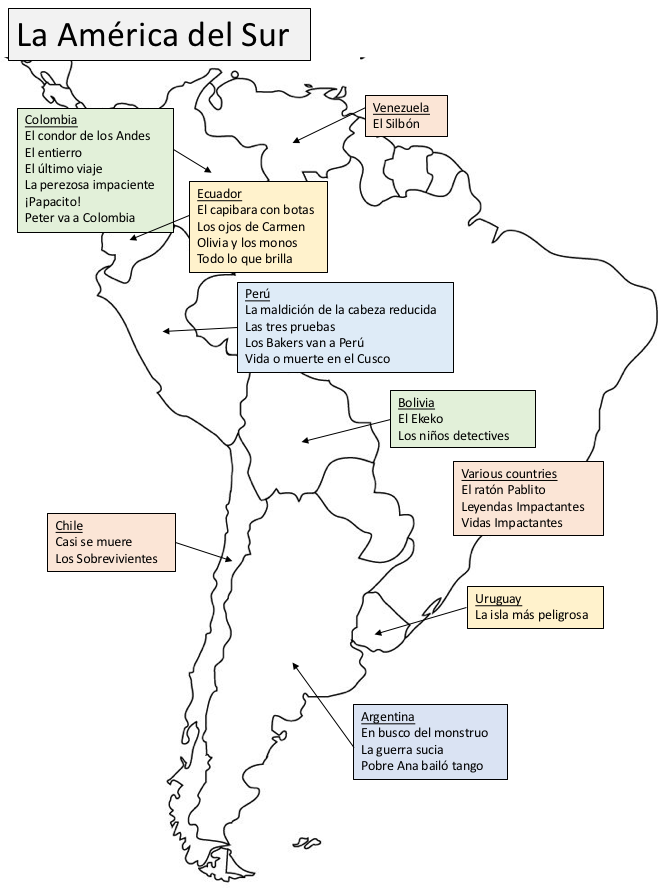
A Map of Spanish Readers

In 2004, when I left my middle school Spanish job and moved to another district to teach high school Spanish at Palmyra, there were very few Spanish readers/novels available to use in the classroom. The previous teacher left me with a class set of novels that was more suitable for an upper college level class, (and which were still shrink-wrapped so he must have had the same reaction to the books), and a splattering of other readers, such as El Cid, Don Quijote, Leyendas lationamericanas, Historias de la Artámila, and several others.  The ones that were most useful were 3 readers by Arturo de Rosa about the detective Pepino González. I used the Pepino readers with my Spanish 4 class although it took a lot of scaffolding to make it accessible, (especially since teaching with CI was not common practice at the high school when I started working at Palmyra so their reading in the language experience was very limited).  

However, in the last several years the number of Spanish readers available have exploded! Spanish teachers have a wide variety of readers to choose from to read with their students and to add to their class library for independent reading. If you're like me, and you want to keep the most recent Spanish books in your classroom to give your students a full range of books from which to choose, you are quite busy buying books throughout the year.

Not only are there loads of novels to choose from, and more added each year, but you can find a reader/novel that takes place in almost every single Spanish country, with only one exception - Paraguay.

I like visuals, so I created a map of the countries aligned with the readers that take place in each country. 


(I'll give the authors a week or so to email me any corrections and then I'll upload the maps to google docs so you can download them if needed.)

The danger to writing this post and making the visuals, is I may have unintentionally omitted a book. If that is the case, please let me know and I can add it although it may take a few days until I can update this post. The three main sites I cross-referenced for the list above was CI Reading (blog by Mike Peto), Fluency Matters, and TPRS Books

In addition, there are some readers that are listed in language catalogs that I have that I did not add because I do not recommend them for any level. 

There are only a few books in the lists above that I have not read; some I have not read because they are not available for purchase yet. Obviously, I have my favorites and there are some on the list that I was disappointed with, for various reasons. However, that is a personal preference and what I thought was not an interesting story, may be something that one of my students like, so I continue to make as many books available to my students as I can.  
I also add a few Spanish children's books in the selection and switch them out for different ones after a month or so. Since I liked the Pepino series, I make them available too.  :)  

Monday, August 20, 2018

The True Size of... Comparing Countries by Size

Pennsylvania, in pink, is small in comparison to Spain.
There is a gem of a website   to compare the size of one country to another country, or to compare a country to a one of the 50 states, or to compare two states. Not only is it a useful site for world language teachers, but also for geography teachers, social studies teachers, and teachers that reference other countries and wants to give students a solid visual of the size of the countries.

The website, "The True Size of" enables the user to type the name of a state or country, and to overlay that state or country onto another country (or state) on a map. This helps students to visualize the size of countries that are related to the Spanish novels that I read with my students each semester.   

Some of the novels connected to people from other countries that I read with my students are:

1. Felipe Alou, by Carol Gaab  - The Dominican Republic
The aqua-colored object is the state of Pennsylvania. This picture shows that Pennsylvania is much bigger than the Dominican Republic. 


2. Fiesta Fatal, by Mira Canion - México
Pennsylvania is dwarfed in size in comparison to Mexico.


You can overlay more than one country/state at the same time as shown below.

3. Vector, by Carrie Toth  - Panamá
Pennsylvania (shown in yellow), is larger than Panama

4. El Silbón, by Craig Klein Dexemple - Venezuela
    and
    Hasta la Sepultura, by Kristy Placido - Spain
Spain, the orange shape, is large compared to the countries in Central America, but there are several large countries in South America, such as Venezuela, that are larger than Spain.


This site can also be used for a Brain Break. Write several sentences on the board about one country compared to another country/state and students decide which sentences are true and which aren't.

Example: 
a. Spain is larger than Ecuador. (España es más grande que Ecuador)
b. Spain is large than Colombia.
c. Spain is larger than Uruguay.
d. Spain is larger than El Salvador.

or

a. (Your state) is larger than Honduras.
b. (Your state) is smaller than Guatemala.
etc.
  

Tuesday, August 7, 2018

More Work to be Done


Today, I saw a syllabus of a Spanish class in a school district within an hour drive of my school. On the syllabus it said,


What are the students going to do with that "verb tense knowledge"? When I saw that sentence, my first thought was 'Level IV students will be able to fill in verb conjugation charts'.

Another document for level 1 listed the grammar structures and vocabulary themes for each chapter. 


The syllabus makes it clear that the language classes will consist of vocabulary and grammar, grammar, grammar. 
   
This is what the traditional textbook publishers have convinced language teachers to believe - languages should be taught with a focus on vocabulary and grammar in the order the publishers have outlined in the textbooks. 

Often, when a teacher begins a teaching job at a school district, he is handed a textbook to use to teach the language. He follows the book that explains how to fill in conjugation charts made to look like boots and he distributes publisher worksheets to students so they can "practice" the verb tenses. When he wants to give his students a fun activity, he designs a Battleship Conjugation game, plays Swat with vocabulary words, or plays Number Bingo with the students on Fridays. The result is a huge exodus of language students after the required minimal levels leaving very few to continue to level 3 and beyond.

This troubles me... a lot. One of the reasons is I started my teaching career teaching in that manner. I thought I was doing my job well because that's what my experience in language classes had been, both as a student and as a student teacher. 

But two people, in particular, helped guide me away from grammar-based teaching to teaching for acquisition. The first person was Mara Anderson, the World Language department chair at the high school (I was in the middle school), who came to my classroom and demonstrated TPR. A few years later, after moving to another district, I attended a one-day workshop by Carol Gaab, in which I experienced, first-hand, the power of acquiring a language versus studying a language. The combination of those experiences started my CI journey and my interest in second language acquisition. 

But, what if Mara had not demonstrated TPR in my classroom? 
What if I had not attended the workshop with Carol Gaab? 
Would I still be teaching from the textbook and focusing on grammar rules? 
How would I know there is a more effective way to teach? 
Would I still be blaming the students for not studying?
Would I still hear comments such as "give me the quiz before I forget everything" before distributing a quiz?

This, dear friends, is where you are desperately needed. No more excuses. It is time for action. If you have abandoned grammar-based teaching and have witnessed your students' increased proficiency and language skills as a result of teaching with CI, then your task (not someone else's task) is to share your experiences and the teaching strategies you employ that make those successes possible. 

We have only scratched the surface of introducing and training teachers to teach with CI in order to enable their students to acquire the language. According to the Center for Education Reform, there are 129,189 schools in the U.S. If each school averages one teacher per building (middle schools and high schools average more than one WL teacher per building, but many school districts do not have WL teachers in the elementary buildings), that adds up to over 129,000 WL teachers in the US. How many of those teachers are blindly following a publisher's textbook and how many are teaching for acquisition?  

Below is a chart listing ways to introduce teachers to teaching with Comprehensible Input (CI) and help them on their language teaching journey.  Whether you are new to teaching with CI or whether you are starting your 20th year of teaching with CI, there are actions you can take to increase awareness of second language acquisition and how to teach for acquisition and share your teaching methods and strategies with others. 


A noteworthy reminder: ALL teachers, that are committed to continued professional development and growth, regardless of their experience and/or teaching methods, can learn from their colleagues, including those that do not teach exactly as they do.
     Be nice.
     Be open-minded. 
     Be gentle. 
     Be encouraging. 
     Be ready to learn from others.   

If you have more ideas to add to the chart, please share them in the blog comments below, on Twitter (@sonrisadelcampo), or in person. 

Comments related to chart above:
1. Submitting a proposal and presenting at a conference: If you have never done this before you may say you can't do it because you will be nervous. Welcome to the club! I have presented at national, state, and regional conferences, as well as at CI PLN groups and the only time I was NOT nervous was this July at iFLT18. Look at it as a way to grow.  :-)

2. Start a PLN in your area: I have wanted to do this for years. Maybe this will be the year I follow through.

3. Start a blog with the mindset of using it to reflect on your teaching and your lessons. People will eventually find you and share in your journey and then learn from you.

4. Offer free resources on your TPT store: Many of my teacher friends have TPT stores and it warms my heart that besides selling materials on their store, they are very generous in sharing great resources that they have made at no cost to others and in their time sharing their knowledge and expertise on live Facebook videos, on social media, and endless patience in answering questions about their classroom practices. 

5. Accept a student teacher and model how to teach using Comprehensible Input: Remember that the person may have come from training that did not acknowledge teaching with Comprehensible Input. Have patience and enjoy watching them grow in their teaching skills.

6. Create a substitute lesson bank: EVERYONE will love you if you freely share sub plans. This is your opportunity to share your BEST plans based on using comprehensible input. Others will be more open to leaving grammar-based teaching when they experience success with your substitute lesson plan. They may even use it on a day they are present!

7. Volunteer to mentor a teacher: Why do we not have a mentoring program in place?

8. Offer a free or low-cost training: When you train other teachers, there are usually costs involved for you, and I fully support that you should also be compensated for your time. If you have the opportunity to present that does not require travel or lodging on your part, consider offering that training at a bargain price to eliminate the financial strain that prevents some teachers from attending their first CI/TPRS training. 

9. Submit an article to ACTFL's publication The Language Educator: And/or submit an article to your state organization's newsletter or publication.

I have great colleagues (throughout the U.S.) that are doing amazing things. Their energy and expertise seem endless. I am grateful that they have done much in the past and continue to help their fellow teachers.  :-)

Sunday, July 15, 2018

Absolutely the Best Gift for a Teacher

Do you know what is the absolute best gift/thing that a world language teacher can receive? if you're a teacher you probably can guess. 

What it is NOT:

- an extra personal day
- a high rating on your yearly evaluation
- a raise (although, this definitely makes all teachers smile!)
- new classroom furniture (or in my case, getting permission to r-e-m-o-v-e some of the class furnishings)
- an increase in the amount of the department budget
- no extra duties throughout the school year

None of the above can hold a candle to the best gift EVER - a note from a 
student that says how he was able to use the target language in a purposeful way outside of the classroom.

Earlier today I received a Twitter message, as described above, from a student that graduated in June 2018. He talked in Spanish with a customer at his place of employment and he was (1) excited to experience being able to successfully use his skills in an authentic conversation, and (2) looking forward to continuing his exposure and acquisition of Spanish with a future study abroad program for his music major.

He gave me permission to share this on my blog. (I forgot to ask if I could use his name, thus, no name on the letter.) The success he experienced with the language is completely due to him receiving instruction that included tons of Comprehensible Input - movie talks, TPRS, stories and legends, reading (13 class novels from levels 1-5 and many book during SSR), weekend talk, jokes in Spanish, and even in games in the target language. CI is the powerhouse and the reason for his accelerated language skills. I was the fortunate one that was able to observe his progress on his language journey for 3 of the 5 semesters he had language classes.

This is a good reminder for me to never doubt the impact of providing a daily dose of comprehensible input to students. What remains is for ALL teachers to continue to invest their time and energy (and most likely money) into continual improvement of their teaching skills to benefit our students.  😊

When I received his message, I was on my way to iFLT, in Cincinnati, Ohio, a national conference for world language teachers. His message gave me a renewed energy to squeeze out every bit of knowledge, advice, collaboration, learning, observation, etc out of this conference. It pays off in huge dividends on the student end!!!