Thursday, July 28, 2016

14 Energizing Review Games

Why do I use review games in my classroom? Instead of using games to review before a quiz or an exam, I view games as an opportunity to provide additional input in the target language in a fun, energy-filled atmosphere for the students.    
The below compiled list of games are ones that I use when reading novels with my students. They are games that I use after reading the text and after discussing the chapter, several chapters, or an entire novel. (However, most of these games can be used in other contexts and subject matters.)  

The games are divided into 3 categories: no prep, low prep, and games with questions.   

No Prep Games 

1. The Copier  
Set-up: Divide students into 2 or 3 groups.  It is better to have groups of 6 or more than to have small groups.  Each student needs a white board and a marker.
Play: 
    Without using the novel, the group decides on a sentence to write about what happened in the chapter(s). I require that the sentences have a minimum of 6 words. All group members must write the EXACT same sentence.  They must work together to check the sentences that their teammates wrote to make sure it is an exact duplicate - spelling and accents should be identical. 
    When all students in the group have a sentence written, they raise their marker board and the teacher reads each marker board.  If all the boards are correct and identical, the group earns a point for their team. They then erase the boards and start working on another sentence.
If a member of the team has an error in the sentence, the teacher continues to look at the other boards (so the group doesn't know on which board the teacher saw the error), and tells the group there is a problem that needs corrected. Team members need to check their boards again in an effort to find the sentence that isn't identical.
    Students can search for the error(s) or they can erase the sentence and restart with a completely new sentence.
    If the group has a correct sentence, the teacher writes the sentence on the board for other groups to see it.  The groups are NOT permitted to use the same verb in subsequent sentences.
    The group with the most points at the end of the allotted time is the winner.
Note: 
    Promote teamwork by telling students that it is the group's responsibility to check ALL the sentences in their group. If someone's board is not identical, it is not the student's fault but the group's for not finding it together.

Low Prep Games

2. Find It!
Set-up: The teacher chooses several sentences from the chapter(s) that can be acted out or that can be drawn on the board and prepares a document with the sentences.
  Assign teams; 2 or 3 to a team is best. Each team will need a marker board and a marker. Choose a student or ask for a volunteer to be the all-time actor or all-time artist.
 Play:   
    The student volunteer reads the first sentence and then either acts out the sentence or sketches it on the board.  Students search for the sentence in the novel that is being depicted and write it on their group's marker board. Since the sentences tend to be long, I tell the students to write the first X number of words of the sentences. The team that is first to write the correct sentence earns a point.
Note: 
    This game requires the students to re-read sentences in the novel in order to find the sentence that the student volunteer drew or acted out. 
    Option: The teacher can call on groups to give the answer verbally instead of the students writing the sentence.

3. Scrambled Sentences
Set-up: The teacher pulls sentences directly from the chapter(s) and jumbles them. The jumbled sentences are put onto a powerpoint, 1 sentence per slide. Try the website Scramblinator to make this task easy; copy and paste sentences from the site onto Powerpoint. Cut typing paper lengthwise in several slips on which students will write sentences.
    Students work with a partner.  
Play: 
    Project the first scrambled sentence on the board. Students unscramble the sentence and earn a point for a correct sentence. As additional sentences are unscrambled, students should put their strips with the written sentences in the correct chronological order.
Note: 
    If you want the students to not rush when they are writing, give points for all the teams that correctly unscramble the sentence and not only to the first group to complete it.  
    For added review of the chapter(s), after all the sentences are ordered, ask students what event(s) happened in between the first and second sentence and discuss their answers.   

4. Salad Bowl
Set-up: The teacher selects words from the chapter(s) and writes them on index cards or slips of paper.  Students sit in a circle with the teams being every other person in the circle on one team and the others on the second team.
Play:
   This game is explained HERE, but it is labeled as "3 Rounds". Since writing the post, I discovered that many call this game "Salad Bowl". In the blog post, we played the game with Verba cards, but it can easily be adapted to be used with novels.

5. Marker Partner Game - The teacher will copy sentences from the chapter(s), but for half of the sentences, change one or two words to make the statement false. Find instructions HERE. 

Games with Teacher-prepared Questions
All of these games are based on questions that the teacher writes with information from the novels. 

6. Novel Bingo
Set-Up: The teacher prepares the questions and creates a document for the students with the answers ONLY.  Copy BINGO cards. The students write the answers on a BINGO card.  If the teacher posts the list of answers online or distributes copies of the document, the students can complete this for homework so as not to take class time for this.
Play: 
The teacher reads the questions/clues and the students put BINGO chips on their BINGO card for the answers to the questions. 

Below is the first page of a document for Novel BINGO for the TPRS Publishing novel, La guerra sucia. If you are interested in the full document, you can find it HERE.
Page 1 of 2 for Novel Bingo

7. Baseball
Set-Up: Divide students into two teams. Draw a baseball diamond on the board. Determine which questions are worth the value of "single", "double", and "triple". 
Play; Students answer questions correctly to advance around the bases and score "runs" for their team. Check THIS POST for details. 

8. Running Crossword Puzzle
Set-Up:  The teacher uses the prepared questions/clues to create a crossword puzzle. Make several copies of the crossword puzzle clues and place them around the room OR in the hall.  Students should work in groups of 2 or 3. Give each group the blank crossword puzzle without the clues.
Play: One student is named the Writer. S/he must stay at his/her seat or desk and is not permitted to read the clues. The other student (or other 2 student if playing on teams of 3) will walk (quickly) to the clues, read them, and return to the writer with the answer. If the student read the clue but doesn't know the answer, the student can tell the clue to the writer and together they can try to figure out the answer. 
Note: This is similar to running dictations described HERE. ESL teachers have used this activity for years!  I do not remember which teacher suggested to use a crossword puzzle instead of a dictation. If you know who it was, please let me know so I can credit him/her with the idea!
There can be multiple winners or the winning team can be the one that finishes first or correctly finishes the most clues in the allotted time. I like to stop the game before any of the groups finishes the crossword puzzle in order to not have students sitting around waiting for the others to finish.      

9. Bazinga! - described HERE. 

10. Grudgeball - described HERE. Since this game may rally the competitive spirit a little more than what you bargained for, I suggest that you read Martina Bex's suggestions on THIS BLOG POST to prepare students before they play this game.

11. Bluff 
Set-Up: Divide students into 2 or 3 teams. Place two chairs in the front of the room with a marker board, marker, and eraser.
Play: The teacher asks one of the prepared questions. Students that know the answer stand up, or students that don't know the answer but want to "bluff" and act as if they knew the answer and possibly earn more points for their team can also stand up.
   The teacher marks on the board how many from each team are standing.  That is the number of points each team will earn if the student chosen to answer can correctly answer the question, OR the number of points deducted from their score if the student answers incorrectly.  
   In this example, we will say that there are 2 teams playing - teams A and B.  The teacher chooses a student from Team A to choose a student from Team B to answer.  The student chosen from Team B is the one that selects a student from Team A to answer.  The two students go to the front of the classroom where there is a marker board for each of them and they write their answer, without any help from their team.
    The students reveal their answers when the teacher signals them to do so.  If the student answered correctly, the teacher adds the points to their score, or subtracts points if the student answered incorrectly. (The number of students that stood on their team indicating that they knew the answer is the number of points earned or deducted.)
   The winning team is the one that has the most points after all the questions are asked or after the pre-determined time.
Note: 
   After the question is read and students are standing up, I insist on complete silence so students do not share the answer with their team members.
   You may need to make a rule that keeps students from choosing the same person.
    Make sure to include some very simple questions so everyone has a chance to participate in the game.
    If you don't want negative points, you can make a rule that says "0" is the lowest score allowed.

12. Trashketball
Set-Up: Divide students in two teams. Put a small rubber ball on the middle of a student desk or table. Put an empty waste can, with a clean liner, in front of the room. Put tape on the floor to mark 3 lines with the closet line worth 1 point, the second closest line 3 points, and the last line 5 points (or whatever point values you want).
Play: 
    One student from each team stands at the table with their hands behind their back. The teacher reads a question. The first student to grab the ball is the one that answers the questions. If he answers correctly, he earns a point for his team and then chooses from which line he wants to attempt to throw the ball into the waste can to earn additional points for his team.
    If the student answers incorrectly, the other student has an opportunity to answer with the same options if he answers correctly.
   If both students do not know from the start, one of them can grab the ball and forfeit his chance to answer, passing to the other student to answer. If the 2nd student can't answer, the question goes back to the first team and this time the team can help him answer. This eliminates the problem is none of the students know the answer because they can still earn points for their team.
Note:
    This game is one of my students' favorites. Many times the students that are not on athletic teams score more points from throwing the ball than the athletes.


Good 'ol Standbys:

13. Jeopardy - Use an online template such as the one at JeopardyLabs.com to create your Jeopardy board.

14. Kahoot or Quizzizz.  When Kahoot first came out, I shared it with members of my department only because I knew that eventually other departments would learn about it and soon the students would be playing Kahoot in every class. That happened about 6 months after I started using it in class, and because of this, I am careful to limit it's use in my class even more than usual. Quizzizz is similar but the students work at their own pace.

If you have additional games to be added that you use with novels, feel free to email me or leave a comment below. 

Monday, May 23, 2016

How to make a Billy la Bufanda cake

Billy la Bufanda
Spanish students in our school district are introduced to Billy la Bufanda and Sr. Wooly in middle school.  In the high school, Billy la Bufanda and the two other songs about Billy are always a crowd favorite. 

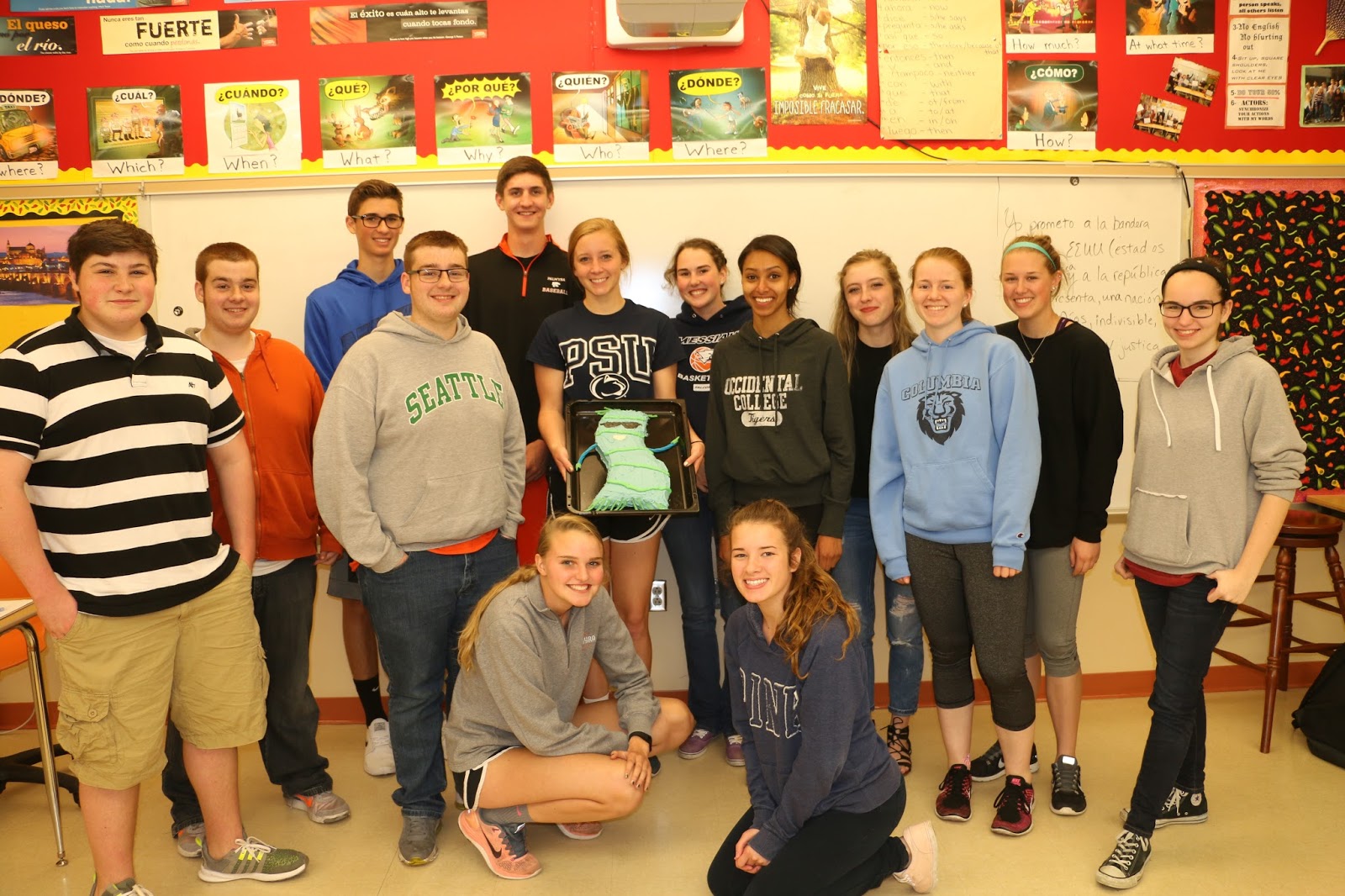
Therefore, when I wanted to surprise my Spanish 4+ class today with something special, Billy la Bufanda came to mind.  I know my students like food and they like Billy la Bufanda, so why not make an edible version of Billy?

I asked my daughter to help brainstorm how to make an edible Billy because she is the queen of creative desserts.  Then I searched on Pinterest (no edible Billy's to be found) and decided it was high time that Billy make an appearance in cake form.


Spanish 4+ students and Billy la Bufanda
Needless to say, the students were surprised and after one mandatory photo, they didn't hesitate to cut Billy (oh no) and enjoy the tasty treat.

Isaac is the brave soul that cut Billy.
If you, or your students, are interested in making a Billy la Bufanda cake for, follow the simple instructions below and you'll be ready to share the treat in no time.

Items needed:  heavy duty cardboard, pencil, scissors, hot glue gun, heavy duty aluminum foil, cake batter, icing, blue, green, and black food coloring, colored Twizzlers.


How to Make a Billy la Bufanda Cake

1. Watch the short video "How to Make a Custom Cake Pan". 

2.  Decide the size of the cake you want.  I wanted my cake pan to fit onto my oven's drip pan so I sketched Billy to fit within those restraints.  (My oven's drip pan measures 19" x 14".)  You also need to remember that the cake pan must fit into your oven.  If you want a really big cake than you can make two separate pans and join the parts of Billy together when you decorate the cake.

3.  Sketch the outline of Billy on a large piece of cardboard and cut out the outline.  I got heavy cardboard at the grocery store when the person stocking shelves was breaking down the cardboard boxes. (Note: I sketched Billy as he appears online, knowing that I was going to flip the cake two times, so I didn't need the inverse of Billy.)

4. Put the cardboard shape of Billy on a sheet of wax paper and trace the form onto the wax paper. Set aside until step #8. 

5.  Cut additional strips of cardboard, 2 inches wide.  Use a hot glue to glue the strips perpendicular to the outline.


6.  Put a large sheet of aluminum foil under the cardboard outline and fold the foil up and over the glued sides. Use additional sheets as needed to cover the outside bottom of the cut-out form and to fully cover the 2-inch sides.

7. Tear off a 2nd large sheet of aluminum foil and place it in the inside of the form and press it on the bottom and the sides of the cake form. 


8. Place the wax paper (from step #4) inside the cake pan form. Spray it with Pam. This will make it easier to remove the cake from the pan after baking. 


9. Place the cardboard/aluminum foil cake pan onto the drip pan.

10. Mix the cake ingredients, use a boxed cake mix or make it from scratch. Pour the batter into the cake pan, leveling the batter to fit in every corner of the pan. Bake according to directions. 
*Note: If using a boxed cake mix and your Billy cake form is similar to the size of mine, you will only need 1 cake mix.


11. Remove cake from oven and allow to cool on a wire rack.

12. Take a knife around the edges of the pan and gently push the cake edges toward the cake and the aluminum foil sides away from the cake. This is a big advantage to making your own cake pan with aluminum foil because you can bend the foil away from the cake making it easier to remove from the pan.

13. Place a wire cooling rack on the top of the cake and flip the cake upside down.

14. Ease the cake out of the cake pan.


15. Carefully lift off the wax paper from the cake.


16. Immediately, place the pan or sheet on which the cake will be decorated, on the bottom of the cake and flip the cake the second time.  Allow time for the cake to cool.


17.  Mix or buy icing.  Divide the icing and put it into 4 different bowls.  Use food coloring to dye the majority of the icing blow. Save a little icing to dye green (for the stripes on Billy) and a small amount to dye black (for Billy's sunglasses), and leave about 1-2 tablespoons white (for Billy's teeth). Put blue icing on the entire cake and sides.  Use a decorator's tip to pipe the green strips on Billy. 


18. Take a small knife and gently scrape off the blue icing where you want to add the black sunglasses and add the black icing there.  Do the same for where you want to add the icing for Billy's smile.

19. Use blue and green Twizzlers for Billy's arms and hands. Cut the blue Twizzler's the correct length for the arms. Cut 2 small pieces of a green Twizzlers to the shape of Billy's hands. Use a knife to cut strips of green Twizzler's for the fringes on the scarf.

20. Share Billy la Bufanda and ENJOY!

*Update: I forgot to add Billy's eyebrows!  To add them, use either green Twizzlers or the green icing.

Wednesday, May 18, 2016

Take Care of Yourself

Note: This blog post focuses directly on you, the teacher, and not on the students, the curriculum, teaching methods, etc. I feel I need to write this blog post before my mind will be freed up to return to writing other posts related to teaching. Please take this advice to heart and act upon it if you realize it pertains to you!

Have you ever postponed going to the doctor because you didn't want to take off a day of school? Teaching is a demanding job, but writing lesson plans, valid lesson plans and not just fluff, for a substitute teacher for your classes is, in my opinion, a more demanding job.

I have 3 different preps and I hate missing a day of school because:

1. I feel like we are crunched for time, as it is, with our schedule (we only have 100 hours with the students per language level)

2. Three different preps with 70 minute classes! That says it all. Preparing substitute lesson plans for 1 prep takes time; preparing sub plans for 2 preps is twice the work; and sub plans for 3 preps, well, I usually decide that it is easier for me NOT to miss school and throw out the idea of going to any appointments. Sure, I could have the students watch a movie, but....did you read #1?

3. When I make substitute lesson plans that are solid, it usually requires me to respond, in some format, to the work that students did after I return to school the next day. In other words, I have additional work waiting for me when I return. (I know, there are emergency and substitute lesson plans you can buy online, but they don't always match up for what I want for my students.)

However, I am here to tell you, maybe to admit to you is a better choice of words, that the above thinking is flawed. The best thing that teachers can do for their students is to take care of themselves. If it means making substitute lesson plans that may not be up to par to what you really want, then so be it. Cut yourself a break. Think of the many other professions in which employees are able to easily take a sick day and aren't required to make plans for others while they are absent from work. 

Do you get the picture? YOU need to take care of yourself, first! As teachers, there are many times that we put our jobs and our students first. That's noble and that's good, but when it comes to our health, we shouldn't be doing that.  

If, by chance, someone tells you that since as a teacher you "only" work 9 months, (gross misconception by those not in education; they also think we work 7 1/2 hr days; teachers know that is not true), you should wait until the summer to schedule all your doctor appointments, then simply smile and move on. If you're organized and plan ahead, scheduling those screenings for the summer is a good idea but, if you have postponed and delayed appointments already, don't fall into the trap of allowing someone trying to shame you into delaying appointments until the summer.  

I realize I am writing this in mid-May when there are only days, or weeks remaining in the school year.  However, it's possible that when you read this, it will be months after I wrote it.  In that case, summer may not be a few weeks away and in that case, don't delay. You need to come first.

If you're reading this and you are feeling a little bit of guilt - GOOD! That's what I'm aiming for because I want to push you, or guilt you, into action.

It is easy to find lists of preventive health care screenings on the internet.   
Follow this link: Preventive Health Screenings for a list of screenings, and then visit your primary care physician and seek her/his input and advice. 

And..I'm not an expert on insurances, but I think it is the norm for insurances to pay 100% for preventive health screenings. 

I'll step down off my soap box now.  I'm not sure what else I could say to make it more clear to you that it doesn't matter what your abilities are as a teacher, if you are sidelined by medical problems that could have been nipped in the bud if you had gone to the doctor for your preventive health screenings.

Take care of yourself. Your students, their parents, and your administration, need you to do that. No exceptions.  :-)

Tuesday, May 10, 2016

World Language Technology Institute

Leave it to Noemi Rodriguez to organize another grand event for World Language teachers, called World Language Technology Institute.  (She also was a key organizer and driving force behind last year's first ever @edcampWL.) The World Language Technology Institute is described as "A week dedicated to empowering World Language educators to create a variety of technology-based activities and assessments for immediate implementation." 

The World Language Technology Institute takes place on August 22 through August 25, 2016, at Pascack Hills High School in Montvale, NJ.  There is a long list of seasoned presenters that are excited to share their knowledge and success on what they are using with their students in their world language classroom. The sessions are divided into three levels of technology experience/comfort (beginners, intermediate, and advanced), for both elementary and secondary teachers, even beyond to college level.  Each day is assigned one of the 3 modes of communication, Interpretive, Interpersonal, & Presentational, with the last day's focus on IPAs.

Click HERE to take you directly to the session schedule and descriptions of the sessions.

Registration is open now.  If you have additional questions, you can contact Noemi on Twitter, @SrtaNRodriguez or @WLTechinstitute or by email at: info.wltechinstitute@gmail.com


Thursday, April 28, 2016

Sr. Wooly Skype - YES!!!

Yes - that's Sr. Wooly himself in a virtual visit to our classroom!
My students LOVE Sr. Wooly songs. They LOVE Sr. Wooly. In fact, at times I suspect they wish he were their Spanish teacher. So, I wanted to do something special for the students in relation to Sr. Wooly.

Last fall I contacted Sr. Wooly about the possibility of skyping with my Spanish 4+ class.  At the time he was busy working on upgrading his website and adding lots of cool features and in the following months, he was diligently working on filming and editing "Ya Está Muerto", which was released in January 2016. (Seriously, if you haven't seen it yet, you need to subscribe to his website and check it out, along with many other songs and activities available on his site, even a video game that I haven't tried out yet.) He is one busy man, but he told me to ask him again a few weeks into the new year.

Front row seat for asking questions to Sr. Wooly
After exchanging a few more emails and dealing with a little glitch of my school blocking Google Hangout, we agreed to have a Skype session on April 6. The students prepared for the Skype session by writing several questions in English and Spanish that they wanted to know about Sr. Wooly and his songs.

When the students arrived on April 6, I had the computer hooked up to the smart board and chairs placed in an arc so he could view the entire class.  At 11:10, on the dot, we received his Skype call and the fun started.

Students asked which was his favorite video, which was the hardest video to make, why he wanted to be a Spanish teacher, if he misses teaching, what
That's a BIG personality on a little screen.
inspires his songs, future plans, etc. One student even asked why I'm not in any of his videos and I promise you, I had nothing to do with that question.  


I wanted to make sure en ended our session at the agreed upon time. Sr. Wooly said later, in an email, that if we would have had more time he would have sung a song for the students. Wow, can you imagine how the students would have reacted to that!?!

There are two other Spanish teachers at my school and both were able to stop in for a little and listen to the conversation.

I owe a big THANK YOU to Sr. Wooly. That's one Spanish class my students will not forget.  
 

What's my problem? - A question game for MFL classrooms

Are your students creative? Can they think outside of the box?  I mean, r-e-a-l-l-y far outside of the box? If yes, the following activity will be fitting for them. If no, this activity may be what they need to help them tap into their creativity.

You could use these as a brain break for a week or use it when you have a few minutes at the end of the class.

 Step 1: The teacher writes a problem that an imaginary person has. Oh, did I forget to mention above that the teacher ALSO has to be creative to come up with a good "problem"? If you think you're not in that category, I'll share a few of the problems that I used with my students below:

examples:  
- I think I'm a bat.
- I only eat my cereal with mayonnaise on it.
- I think (choose a famous person) is my sister.
- My teeth are made of chalk.
- I'm afraid of shoes.
- A tiny person lives in my cookie jar.
- I can smell colors.

 Step 2: A student pulls one of the cards and takes on that problem.  I allowed the students to do this with a partner so they both are answering questions.

Step 3: The students ask Yes/No questions in the TL to attempt to find out the problem.

I did this activity with my Spanish 4+ this week as a trial run to see how well it would work. The longer they played, the better they were able to think outside of the box and ask some quite interesting questions.  In fact, some of the questions they asked when determining the problem, I will use the next time I use this with students.  

Update - 1 yr later: French teachers, check out Steve Smith's blog HERE post for his variation of this game, but using sticky notes. Also, he has some ideas in French ready to use!      
        

Thursday, April 21, 2016

Autorretratos inspired by Frida Kahlo novel

A few weeks ago my Spanish 4 class finished reading Kristy Placido's novel, "Frida Kahlo".  I'm a fan of fiction novels for my students, but when I heard Kristy had written a non-fiction novel on Frida Kahlo for Spanish students, I quickly started making plans to add the novel to our curriculum.  

The book is solid, packed with information about Frida Kahlo and her journey to become an artist and the challenges she faced throughout her life.  I was a fan of Frida Kahlo before we read the book, and I'm even more of a fan now.

Due to my schedule becoming busier than I had anticipated (as happens often), some of the extended activities for the novel that I had brainstormed didn't take form. However, the one activity that I was looking forward to doing was the autorretratos activity listed on Kristy's blog HERE. Check it out!!! I followed her instructions (how great is it when you find something useful for class that someone else has already designed and shared) for printing the pictures and the students spent part of a class period letting their inner artist soar.

After they were finished, I put their artwork in a sheet protector sleeve and displayed their autorretratos in the bulletin board in the hallway for other students to enjoy. 

Monday, March 28, 2016

Kindness costs nothing.

I will forever be grateful to those that blog, especially to World Language teachers that blog, and share activities they have created, resources they have found online, and their classroom experiences, both good and bad. I respect them because, as a blogger, I understand the time commitment involved in writing posts and in responding to readers' comments on the blog and through personal emails.

As a blogger, you are writing on a public space, and you are "putting yourself out there". There may be those that enjoy what you share and then...
there will be that small population, for reasons I don't understand, that write comments that are not helpful. After all, Kindness Costs Nothing (a sign which hangs in my room in English and in Spanish).

Yesterday, I received one such comment on my blog. At first, I was unsure how to handle it. My knee-jerk reaction is to throw my hands in the air and give up. After all, my blog is a labor of love - that's it, plain and simple. But that's not a logical reaction. Why is it that one negative comment can overshadow many positive comments?  

Last night, after two Easter meals with my family and my husband's family, in other words surrounded by positive energy, the solution on how to respond to the comment came to me. It's quite simple and it may just be the perfect solution. I decided to combat that one comment with twelve THANK YOU and encouraging comments on other blogs.

This morning my first business of the day was to catch up on my blog reading and leave encouraging words on blogs of other world language teachers. I searched out new blogs as well as blogs of those I've been following for years. In reading their blogs, I received valuable, personalized professional development. I read their insights on teaching and received ideas from the materials and resources they shared. What better way to show the blogger my appreciation for their work than by leaving a note of thanks in the comment section? 

My heart is singing again.

May I suggest that when you find something useful on someone's blog, take the time to let them know. Please don't misunderstand me - I'm not fishing for comments on my blog, but rather asking you to show your appreciation to bloggers in general for their energy and time in maintaining their blog and freely sharing with others. There is a list on the right side of my blog of amazing teachers with blogs.  

let's Celebrate the Many Hardworking Bloggers that enrich our teaching with our notes of thanks and encouragement.

Saturday, March 26, 2016

Los videos de Juan Fernandez

Are you acquainted with Juan Fernandez, @granainoinuk, on Twitter? 
If you teach Spanish, you may want to follow him on Twitter. 

Why? 
Because on a language forum that I follow, someone shared the link to his new YouTube channel with the videos he makes. The videos are perfect for second language learners because:
(1) he is a native speaker 
(2) he speaks clearly, 
(3) he speaks slow enough to give listeners time to process and understand what he is saying

Below is one of his videos:


I also like that the video DOES NOT have subtitles, but I noticed there is the option to add them if you wanted them on the screen.  Another one of his videos I watched had the subtitles, but since his speech is comprehensible to my students, I don't want the English on the screen.

In Juan's video "¡Dale la vuelta a la tortilla!", he begins with several written examples of the subjunctive used with CUANDO. After watching it, you can explain this food idiom. (The website Spanish Food Idioms has a nice explanation.)

Some of the videos are short enough that they would work nicely as Brain Breaks, such as the 2 minute video, "Cómo decir NO en español".

These videos led me to his website, 1001 Razones para aprender español with even MORE resources and the scripts of his podcasts.  Wow! I feel like I hit the jackpot this morning. 

I hope you didn't have anything too pressing today, because you may want to put your plans on hold to watch Juan's videos.  :-)  

THANK YOU Juan Fernandez for creating these videos!

Friday, March 25, 2016

Novels: Making Connections and 4-1-1 Comprehension Checks

Reading novels is a staple in every level in our World Language department. Below are two new approaches I used with reading a novel. 

1. Connecting to the character in the story. 
This year is the first time my students are reading the TPRS Publishing novel, Frida Kahlo, by Kristy Placido.  Before we started reading, I gave them the paper below.  They read the statements and responded to the scenarios on another paper that had 15 blank squares.  

The students did NOT know that these statements were events that happened in Frida Kahlo's life or were similar experiences (such as #9 & #10), that we were soon going to read in the novel. 

I created similar events (#9 & #10)
in order to provide examples that are plausible for my students.  (Ex: Frida called Diego out on his relationship with an art model when he was painting at her school. The possibility of our school commissioning an artist to paint a mural on our school wall is very unlikely so my example is the student's boss, who is married, has a romantic relationship with another person.)

After each chapter that mentioned one, or more, of the examples in the chart, we discussed the students' answers and compared them to Frida Kahlo's actions.  If what the student had written was similar to Frida's actions, they circled the square. If it was different than Frida's actions, they drew a bold "X" over the square.  After discussing all 15 examples, we were quickly able to identify which students could relate to events in Frida's life.  

2. Checking comprehension with Higher Order Thinking 
There are (a few) times that I assign homework for my students to read a chapter or two from the novel we are reading together in class.  A twist on checking their comprehension of the chapter (and also to see if they read the chapter), is to give them the 4-1-1 Comprehension Check.

To create a 4-1-1 Comprehension Check, you will need to choose 4 sentences from the chapter(s) that the students read for homework (or that they read in class). Then add a sentence of something that DIDN'T happen in the text, but is something that could have happened.  Write another sentence of something that DIDN'T happen and IS NOT a logical option of what could have happened in the chapter.  


4-1-1 Comprehension Check - ch6 of Frida Kahlo
Type the sentences in random order.  The students have to find the 4 sentences with information that occurred in the text they read. (If they are sentences with a clear chronological order, ask students to put them in order.)  For the remaining two sentences, students determine which one didn't happen but could have, and which sentence is not a logical choice of a possible event in the book and then they must DEFEND their reason for their choices with information in that particular chapter or previous chapters.  

The above example is from chapter 6 of "Frida Kahlo".  The two sentences that are NOT from the novel are B and E.  The book does not mention that Frida told her sister about the rats, but since Frida was closest to her younger sister and they spent a lot of time together, it would be a logical possibility that Frida would tell her sister about the rats.

The sentence that is not a logical possibility is E because if students read the chapter they know that Frida was hiding the rats from her mother. Frida would not want to give the rats to her mother as a gift because her mother would not agree to permit Frida to continue caring for them. 

Another chapter in Frida Kahlo that is perfect for a 4-1-1 Comprehension Check is chapter 7 that lists the mischievous acts of Frida and her friends at la Escuela Nacional Preparatoria.

This 4-1-1 Comprehension Check is beneficial in that students have to separate fact from fiction. If they read the chapter and understood what they were reading, it should be a fairly simple task for them to find the two sentences that are not from the text.  The higher order thinking skills are needed to determine which sentence is/is not a possibility, and then defend the answer using information already known about the character or the plot.

The 4-1-1 Comprehension Check can be used as a formative or summative assessment.

Thursday, March 17, 2016

Summer Professional Development on Teaching with Comprehensible Input

Annie Ewing, one of the organizers and geniuses behind the Tri-State TCI - Teaching World Languages with Comprehensible Input, has compiled a list of summer CI workshops and conferences on her blog, Profe Anny Cuenta.

Click HERE to see the list of 8 Professional Development opportunities, and possibly more to be added.