Monday, March 14, 2016

CSCTFL 2016 presentations

I presented two sessions at CSCTFL 2016.  The links to the powerpoints of those sessions are attached below.  

Presenter:  Cynthia Hitz
Integrating Apps and Tech Tools into a 90%+ TL Classroom

The emphasis in this presentation is scrutinizing the apps and websites that are used in the WL classroom to make sure they are giving you ADDED VALUE.


Presenters:  Cynthia Hitz & Krista Kovalchick
Breathe Life into Reading to Increase Student Engagement and Comprehension

 What reading activities help increase student engagement with the text? What activities can a teacher employ that demonstrates the students' comprehension? This powerpoint is packed with activities (more than a dozen), that you can use to liven up any text. 

If you have any questions about either powerpoint, please do not hesitate to contact me on Twitter @sonrisadelcampo. I uploaded the presentations minus the videos of students. During the presentation, the videos were useful in seeing the activity in action, so if something is unclear, send me a tweet or ask below and I will answer your quesitons.  


Sunday, March 13, 2016

Central States Conference on the Teaching of Foreign Languages 2016

Over the last few years I have attended numerous conferences for world language teachers (PSMLA, NECTFL, and ACTFL) and hands down this year's Central States Conference on the Teaching of Foreign Languages that was held in Columbus, Ohio, on March 10-12, was easily one of my favorites. 

Some of the highlights were:

1) GRANT BOULANGER received the CSCTFL Teacher of the Year Award! Congratulations GRANT!!! 
I am confident that everyone that knows Grant, will agree that he deserves to be recognized and celebrated for his passion for teaching Spanish with the belief that ALL students can be successful. It's exciting that this award will provide Grant with additional opportunities to share how he connects with his students and starts them on their way to proficiency in their second language. 

2. John De Mado was the Keynote Speaker. He didn't deliver the one-two punch. He delivered the one-two-three-four-five.....ninety-nine, one hundred, etc. punch. His straight talk about education, the illusion of education, the perceived literary problem, etc. left me wishing that ALL educators, not only world language teachers, could hear his message.

Several truths from John de Mado's Keynote were:
- Literacy begins with Comprehensible Input.
- Telling students what they need to know to say back to you on a test is NOT education.  It's an illusion of education.
- Computer programming is NOT a culture.
- Textbooks were NOT designed to be the curriculum!
- Where languages are celebrated, literacy thrives; where languages are atrophied, literacy declines.
- One cause of devolving language is high-stakes testing ill-conceived mandates.
- Standardized testing is killing us. It's killing our minds. It's killing our literacy.
  
3. The sessions and workshops! There were between 16-21 sessions happening at one time, not to mention the 3-hour workshops that were also offered in the mornings and afternoons.  

A common problem for me was which session to attend because there were usually several sessions that I wanted to attend scheduled for the same time. When there was a conflict, I decided to attend sessions of presenters that I had never heard present before and/or presenters that may not be presenting at the next conference I will be attending, IFLT16 in Chattanooga, TN.

Below are my notes & reflections and presenter comment's on the sessions that focused particularly on Comprehensible Input and Reading. (The reflections are listed in chronological order.)

Craig Klein @profeklein  aka Spanish Cuentos
Exhibitor All Star Session: The Power of Comprehensible Input and Storytelling
Craig started the session by sharing his journey from teaching college students to his move to teaching elementary students. He quickly came to the conclusion that he needed a different game plan. After observing another teacher whose students were comfortably speaking in their second language, he analyzed what words they were using and realized that they were using a core vocabulary which was sufficient for their communication needs at that level. This led him to search information from available online resources, such as blogs, videos, Twittter, etc. about teaching with stories and with comprehensible input. 

He apparently is a quick learner! He shared many videos of his students acting in class, retelling stories, and telling their own stories with props they created at home. I wish everyone at the conference could have viewed those student videos because there would be NO doubt that storytelling is powerful in second language acquisition. 
 
Additional comments by Craig and/or ideas from his classroom:
- Teaching with stories and CI works at any level.
- High amount of Input is needed before Output.
- Create finger puppets to introduce vocabulary (ex: Make a blue spoon finger puppet with eyes. Use inanimate objects instead of always using animals or people.)  
- Tell your students that you will publish their stories in a newsletter that you send to parents and then you will have a flood of stories from your students.
- Students prepare a story at home and come to school prepared to illustrate the story on the board and tell it to their classmates.

Check out his Spanish Cuentos blog HERE.
Check out the video El Ratón Pablito for an example of his online stories. 
Check out this video of his 4th grade students telling a story. They were NOT reading from a script when they recorded the video. 
Seriously, GO to his Spanish Cuentos blog and you'll find a boatload of ideas!
Genius!!!

Sara-Elizabeth Cottrell @SECottrell & Wendy Farabaugh @MmeFarab
Effective Storytelling with Consistency, Cartooning, and Cool Content
Sara-Elizabeth started the session with a story in Spanish and later Wendy demonstrated storytelling in French. (Wendy has some major acting skillz!)

My reflection/notes & comments by presenters:
- Introduce "dice" (s/he says) early in beginning levels so you can say "He says, I want to go to the party." which allows you to give repetitions of the first person plural form. 
- Use Goldilocks story to teach este, ese, aquel (this one, that one, and that one over there)
- Push for proficiency by asking students to add details.
- Use cartooning (simple shapes with obvious details) to help students visualize.
- Check YouTube on how to draw simple figures for storytelling.

As I say, less is more when it comes to sketching!

Teri Wiechart @TeriWiechart
Put TPR Back Into TPRS
Teri is the TPR pro! She demonstrated the power of TPR by giving commands to  5 non-speaking French attendees. The were quick learners with Teri as their teacher. 

My Reflections & notes and Teri's comments:
Teri & classroom mgmt

- Create 3x3 grids to track and recycle vocabulary taught to students and then add more grids of words to build vocabulary.
- Highly recommends Contee Seely's book "TPR is more than commands"
- Play with words used in commands - make odd combinations
- Chain commands - how many commands can students follow  correctly?  (Say 3 commands - students act them out; say 5 commands - students act them out; continue adding commands to find the highest number that can be completed)
- Teri allows students to give her commands as long as they are physically possible and not rude
- Student gives commands to teacher and she narrates the commands in first person singular as she performs them.
- Make mistakes when following commands to see if students recognize the error.
- Use numbers in commands so students start to learn them.

Grant Boulanger  @grantboulanger (2016 CSCTFL Teacher of the Year)
Best of Minnesota: The Art of Engaging Novice Learners
In true Grant Boulanger fashion, he started his session by getting to know the participants by asking them what level they taught, where they were from, etc. Grant shared examples of how he first makes students feel as part of a community and then how he engages the students in the classroom using the Target Language. Most helpful for me was watching a short video clip of Grant interacting with the students in his class.

My reflection/notes and comments by Grant:
- Personal stories and gossip make up 65% of our conversations ~Jeremy Hsu
- Be attentive to students and be in the moment with them
- Keep it Simple in the Classroom 
- For language to be acquired provide input that is: Understandable, Interesting, and Repetitive
- We acquire language when we understand messages.
- It doesn't matter is language is comprehensible if it hasn't been comprehended. (Grant quoted John De Mado's keynote speech)
- Interaction accelerates acquisition
- Teachers need to create a classroom environment that will allow language acquisition to occur
- Intentional planning must yield to flexibility 
- Students must make eye contact with teacher and respond to what the teacher says - facial expression, verbally, body posture
- Validate a student by asking him about his new hairdo, new shirt, and talk to other students about the student's response
- Create a space of JOY and SUCCESS in your classroom! (photo right: Grant shows student's weekly bathroom pass in which she signed out of every class except his. She didn't want to leave the class!)

Check out Grant's blog!

Mira Canion @MCanion
Reading is Thinking; Making True Learning Visible
When Mira Canion is the presenter, be assured that you will be an active participant in the session. (The downfall to this is that I did very little tweeting or taking written notes during the session.)

Mira started the session with a photo and then asked participants related to the photo. Some questions were easy to answer, while others required us to think about how we arrived at that answer. In some cases, our background knowledge and experiences influenced our answers. She pushed the participants to explain how they arrived at their answer, helping us to delve into the invisible thinking that steered us to the answer we gave. We then compared the first photo to another one that was similar but carried a much heavier meaning and impact on the people's lives in the photo.  

Mira had us break into groups of 4 and then each of us were assigned a number.  This helped to ensure that all group members were participating in the discussion questions.

Later, she demonstrated activities that can be used in connection with a text, such as Quiz, Quiz, Trade, (photo on left) in which the teacher writes questions about a text and gives the questions to the students. Students then pair up and ask each other their question, then trade their papers, and pair up with another student to repeat the process.

Check out Mira's blog!

The list of sessions above are a sampling of the sessions that I attended. I will definitely consider attending this conference again, although I REALLY wish presenters didn't need to bring their own LCD projector and speakers (which I forgot and Christy Miller kindly lent her speakers to Krista and me for our presentation.)

Next conference: IFLT!!!! And I know, without a doubt, that IFLT will provide powerful professional development!

Monday, March 7, 2016

CSCTFL 2016 - A few days away

Program cover - CSCTFL 2016
It is only a few days until CSCTFL16!  Last year during CSCTFL15, I read tweets from teachers at the sessions, saw photos of attendees as they strengthened friendships and met new colleagues for the first time, and read blog posts describing the huge benefits of attending this regional conference. With each tweet, photo, or blog post that I read, my disappointment and regret of not attending the conference in Minneapolis grew. 
 

Then I read that in 2016 CSCTFL was going to take place in Columbus, Ohio.  I immediately put it on my wish list of conferences to attend and I set to work to write two session proposals. Imagine how excited I was to receive a congratulatory email stating that my proposals were accepted!

So many (great) sessions, so little time
Click HERE to access the lengthy list of incredible sessions available for the 3-day conference. How can that many great sessions be offered over such a short period of time???

When the conference schedule was first published, (months ago), I read through the l-o-n-g list of sessions and made a schedule of priority sessions to attend. (Click here to see my tentative list of priority sessions. I'm sure I'll be adding a few more possibilities on the 6-hour drive to Columbus.)  

Click here for a list of sessions on Grant Boulanger's blog, offered by the #langchat moderators.

If there is a downfall to this year's conference, it is that there are several sessions that I REALLY would like to attend but they occur at the same time, or they occur when I am presenting. My game plan: Divide and conquer. Basically, I am hoping to find friends that are also torn about which sessions to attend, then we'll attend different sessions and regroup to share the insights from the sessions we attended. 

Two sessions I know for sure that I will attend:
As luck would have it, both times I am presenting there are other sessions I wish I could attend. Since I haven't figured out the whole cloning aspect, I going to have to rely on tweets and blogs to friends to share what is happening in those sessions.

A short description of the two sessions that I will be presenting are:

1. On Friday from 5:00-6:00, my colleague, Krista Kovalchick, a French and Latin teacher that teaches next door to be a Palmyra Area High School, and I will be presenting on "Breathe Life into Reading to Increase Student Engagement and Comprehension".  Reading is a powerful tool in the WL classroom and our presentation includes various examples on how to increase student engagement with fun and interactive reading activities. We included several videos from our classrooms so you can see the level of student engagement during those activties.

2. The following day, Saturday, from 9:30-10:30, I am flying solo on my second presentation entitled, "Integrating Apps and Tech Tools into a 90%+ TL Classroom". The emphasis is on using apps and websites that provide ADDED VALUE to a WL classroom. I enjoy experimenting with technology and new and improved apps, but the bottom line is if the app or tech steals time from the class instead of providing ADDED VALUE, it doesn't pass the test for my classroom.   

If you are planning to attend CSCTFL this week, Krista and I would be honored to share with you what is happening in our classrooms, as well as learn from YOU what is successful in your classroom.
 

I don't think it is too early to say THANK YOU to the organizers and those that are working behind the scenes to make this three-day professional development opportunity a reality. I repeat: I am looking forward to attending many informative sessions and learning from outstanding world language teachers in the Central State Conference area and beyond!

Friday, February 26, 2016

12 Ideas for Teaching Prepositions in the MFL Classroom

What is the best lesson to teach prepositions in a second language classroom?  The short answer is - there isn't one lesson. I have found the best way to teach prepositions is to introduce one or two at a time, then gradually add new prepositions to the ones students have acquired with a different activity. It's important to focus the students' attention AWAY from the vocabulary of prepositions to using the prepositions as part of a greater purpose.

Below are 12 activities that I've used throughout Spanish 2, rather than teaching a "unit" on prepositions.  Most students at the end of Spanish 1 are already able to use several prepositions of place such as debajo de, a la derecha de and a la izquierda de (under, to the right of, to the left of), so I recycle them throughout the semester and gradually add other prepositions.


1. Students' Photos of Pets. Personalize conversations using prepositions with student's photos of their pets. Ask your students to send you photos of their pets at different locations (on top of the sofa, inside the car, under the bed, etc.) and you will have instant engagement. Who doesn't like looking at adorable animals? If you're ambitious, make a list of the locations of the animals, type it and leave a space for students to match the animal photos on the powerpoint with the statements on their paper.   

Or...have the students use ipads to add captions to photos of dogs (their own or ones they find online) or other animals using prepositions. If you want to be really creative, make it a fun contest and students earn opportunities to vote for their favorite picture from participation points. Winner gets...I'll let that up to you.  :-)

2. Class Story:  The original purpose of this class story was to give the students a lot of examples of the Spanish structure estaba + -ando or estaba + -iendo. The story takes places in a movie theater which allows me to recycle to the left of, to the right of, and I add behind (detrás de) and in front of (delante de).  The plot of the story is that someone goes to the movie theater and the people surrounding that person are distracting and noisy because of what they are doing.  Click HERE for an in-depth description of the story.

3. Plaza Sesame: Arriba, Abajo, Alrededor y a Través. Looking for a fun Brain Break? Let your students watch this video of Grover as he adds rep after rep of arriba, abajo, alrededor, a través, and lejos & cerca.  Make it even more interesting by asking a student to be the mirror image of Grover - if you can find a student with that much energy!

4. Two puppets and a box.  I have several hand puppets, one of which is the lovely "Covadonga" cow puppet (pictured on the right) that I've used in my classroom since my first year of teaching. I place a cardbood box on a tall stool in the front of the classroom. Then I ask for 2 volunteers and they choose a puppet.  I say a sentence using the prepositions that students already know such as "los animales están detrás de la caja" (the animals are behind the box). The 2 students stand on either side of the stool with the box and put their puppet behind the box. I continue calling out places where the two animals are and students place their puppet at the appropriate location in relation to the box. After the first 2 students are placing the animals in the correct place without hesitation, the students choose someone to take their place and the new students repeat what I did previously and then I add more prepositions.

5. Here is another Brain Break with prepositions. I tell students to stand and to move their chair to a location in the room where they have more space on around their chair. I call out a preposition and students must put their body at that place in relation to the chair.  For prepositions such as "debajo de" (under) or "dentro de" the students and I decide ahead of time how we will demonstrate those prepepositions.

6. Hide and Seek. I have a colorful small plastic frog and an even tinier plastic cat the size of my thumbnail. One student is sent to the hall and the remaining students decide where in the room to hide the frog or the cat. The student in the hall enters the room and must ask questions to determine the location of the cat. The student may say, "¿Está el gato a la derecha de Nancy?" The students must respond using a preposition in their answer, i.e. "No. El gató está a la izquierda de Nancy." This continues until the student can tell us where the cat is.

7. Hide and Seek Photos. There are several websites with funny photos of children that failed miserably playing Hide and Seek. Project the photos and ask guiding questions to describe where the children are, i.e. ¿Está el niño debajo de la cama o debajo del perro?"
  a. 33 photos that show just how awesomely bad children are at playing Hide and Seek.  
  b. 20 kids who are totally winning at the game of Hide and Seek
  c. 37 photos that prove little kids suck at hide and seek 

8. Finding Mimo. Where's Waldo doesn't hold a candle to the adorable dog named Mimo. Project the photos in the links below and then let your students find Mimo, and then they can describe where the dog is located in relation to other objects in the photo. Or, ask yes/no and either/or questions in the target language about Mimo's location to scaffold the activity for beginning levels.     
  a.  Bored Panda - Finding Mimo
  b.  Bored Panda - Finding Mimo #2
  c.  Bored Panda - Finding Mimo #3

9. Felt Board App - 9 girls & 9 Cats. I use this when working with the vocabulary words: llevaba un vestido, tenía un gato, era, and estaba, but it also reinforces the prepositions to the left of, to the right off, and behind. An explanation of this activity can be found HERE.

10. Felt Board App - Students read a description and recreate the picture using the Felt Board App.  There are three separate scenes the students needs to recreate, and after each one, they bring their ipad to me to check it for accuracy and sign that I've seen it completed.  The document with the descriptions and photos of the screens is on my googledrive HERE.


bit.ly/1QCy3Ft
11. Cats, Cats, and more Cats. I found a picture on Pinterest with 20+ cats in a room. Follow this link to the pin on Pinterest. I uploaded the photo on my ipad on the Pic Collage app and added names for most of the cats.  See a sneak peak to the right.  In class, I describe the location of one of the cats and the students call out the name of the cat.

12. Vamos a cazar un oso. Take this well-known children's story and add your own actions to get the students up and moving around and to reinforce prepositions such as: por encima no podemos pasar, por abajo no podemos pasar, lo tendremos que atravesar.

Sunday, February 14, 2016

Education: Front Seat vs Back Seat - A Paradigm Change Needed

Can we change this?  Please?


Sir Ken Robinson talks about the desperate need for a paradigm shift in our educational system. Please watch this powerful video:

Sir Ken Robinson compares schools to "factories". It is time for a change in education and not one that is mandated by testing and uniformity. A paradigm change is needed. My hope is that it happens soon. We owe that to our students, to our communities, and to ourselves as educators. 

For additional reading from my personal experiences with our educational system, check out these two blog posts from 2014:
- "Divergent Thinking"  
- "Language Learning is not Linear; neither is riding a unicycle".

Wednesday, February 10, 2016

3-STEP No PREP Extended Reading Activity!

This has to be one of the easiest, no prep extended reading activities ever. You can use it with any text to which the students have access such as:
- a novel (after reading & discussing 1 chapter or several)
- a Movie Talk with an accompanying script 
- a class story with an accompanying script

Part 1
1. Students choose a partner. Students may use the text (book) or script (Movie Talk or class story) for the first part of the activity.

2.  Students write 3 sentences.  Two are TRUE and one is FALSE using the text.  They may copy the sentences directly from the text for the two true sentences.  For the false sentences, sometimes the only thing they will need to do is change a word or two in the text to make the statement false.

3. While students are writing their 3 sentences, the teacher uses a marker and writes a letter of the alphabet on each of their papers. (I had 14 groups so I wrote the letter A on one paper, B on another, etc.)

Students stay with their partners for Parts 2&3 of the activity.

Part 2
4. After students have written their 3 sentences, they tear off the bottom part of their paper and write the letters A-N (or however many groups you have). This paper will be their answer sheet.

5. The teacher directs students in which way they are going to pass the paper with the 3 sentences. They read the paper passed to them, decide which sentence is false, and write the # of the false sentence after the corresponding letter on their answer sheet.

When students have read all of the papers and decided which sentences were false, they hand the papers with the 3 sentences to the teacher.

Part 3
6. The teacher starts with paper A and the students call out which sentence was false. (I read the letter only and I did not read the three sentences. You could read the 3 sentences before asking students which was false, but the students had already read them one time and I wanted to keep the activity moving.)

7. The teacher reads the false sentence and then asks for a volunteer to change the sentence to make it true.

I told you it was an easy, no prep extended reading activity.  The best part is the students copied the sentences AND re-read a lot of the sentences from the text, which was my original goal.

Tuesday, February 9, 2016

Morir Soñando, Felipe Alou, & Béisbol - A Culture-packed Friday

Think back to your high school Spanish class and answer this question, "What were 3 of your best memories from that class?"

Are any of your answers related to food? 

Food would probably be part of my students' answers. I enjoy including teaching about the culinary aspect of Spanish countries, but it's not always possible (at least to the extent that I would like it to be) when I have classes of 30 students and no easy access to a refrigerator and other kitchen appliances. 

However, making drinks from a Spanish country is less of a challenge because ingredients can be kept chilled in coolers and the appliances needed are small and portable.

My students and I are reading Felipe Alou, a TPRS Publishing Inc. novel about a Major League Baseball player and manager, and his journey from a small town in the Dominican Republic to the United States, and the obstacles he overcame to achieve his dream.

The Teacher's Guide is packed with resources for discussions related to segregation and discrimination in the US in the 1950s and 60s, about the DR's past of discrimination towards the Haitians, about the homes in the DR, and other cultural topics related to the DR.

In addition to the sources in the Teacher's Guide, we read A-Z Reading's Spanish book on Rosa Parks and the article "Diez pruebas de la segregación racial en los Estados Unidos en los 50 y 60". After tackling these tough subjects, I was ready to change focus toward the food in the DR. 

My friend, Nelsi, is from the Dominican Republic and a few years ago she made the drink "Morir Soñando" for me when I was at her house. It's delicious and easy to make so I made a list and students signed up to bring the ingredients and the paper supplies to class. 

I used to tables for workstations for the students to extract the juice, measure the milk and sugar and ice, blend the ingredients, and serve it in cups. All of us enjoyed a refreshing cup of Morir Soñando and even had several cups extra that students asked to deliver to teachers in the building.


Our class is split by lunch, (35 minutes of class, then lunch, then 35 minutes of class).  In the second half of Friday's class, we played the Beísbol game (shown on the right). We used the questions that came with the game, but I think the next time we play, I'll use questions specific to the novel, Felipe Alou. (There were 3 different levels of questions: easy questions the person scored a Single; average questions the person scored a Double; and difficult questions the person scored a Triple.  If the previous player scored a Single and the following player scored a Double the first player will then be on 3rd and the second player will be on 2nd. Outs occur when the person asked the question does not know the answer.) It was the first time I've used this game even though it's been in my storage cabinet since my first day at this school.

Making the drinks and playing Béisbol was a relaxing, but cultural-filled class period and fun way to end the week. I'm adding the Morir Soñando and Beísbol activities to the curriculum for next year.

Now... if I could only figure out how to convince administration that I need (let's be clear, it's not a want IMO, it's a need) a classroom equipped with an oven, stove, refrigerator, microwave, and sink, I can e-x-p-a-n-d on this and immerse the students even deeper into the culture of different countries.    

Monday, February 8, 2016

TCI-Friendly Homework or Assessment

photo credit at end of blog post
When I assign homework, it is with the purpose to have the students interact with a written text in the target language or listening to a text in the TL. Examples of some homework that I have assigned in the past are:
- read a story, one created in class or a parallel story of the one created in class, and answer comprehension questions related to the text
- work with an online site to reorder the text in a story, or other activities related to the text, or
- read a script that is written in the TL, but read it to a parent in English, or 
- add sentences with details to an already established story, etc.

Below is a screenshot of the homework that I gave to my students last week. This type of activity could also serve as an in-class assessment.

I refer to this activity as an open-ended task because students are free to choose what information to add and where to add it in the story.  Some students will be very creative and take risks in their writing. Others will stick to basic, short sentences.


The story in the document pictured above, was created in class through "story-asking" in the following steps:
1 - Write the 3 structures on the board for students to copy and to write the English meanings
2 -  Assign actors for the story.
3 - "Ask" the story with circling techniques used in TPRS.
4 - Verify facts with the actors in the story.
5 - Pause for students to retell sections of the story.
6 - Use the student artist's sketches to retell the story.
7 - Ask the questions written by the student whose job it is to write questions.
8 - Project and read my previously typed version of the story.

Then I distributed the paper pictured above and we read the story together.  Students had the remaining 5 minutes of class to add 4 new facts to the story.  

At the start of class today, I projected the story from the document above on the board. Students shared (some of) the sentences they wrote and told me where they chose to insert the sentences. I typed the sentences into the story to expand it, and then we read it together. 

Instead of taking a text and paring it down to make an embedded reading, the students and I took a text and added to it to make an extended reading. (Basically, the opposite of an embedded reading.)


If you are interested in using the story with your students, the basic plot of the story is: someone went on vacation but didn't speak the language to the place he went.  When he leaves the hotel he wants to travel somewhere in the city but when he gets into the taxi, the person doesn't speak his language.  

This story took on a life of its own when I had the two foreign exchange students in the class (1 is from Germany and the other is from France) play the role of two of the taxi drivers that the main character couldn't understand because he didn't speak their language. The two foreign exchange students made the story more "novel" and there was obvious student engagement and buy-in from the other students.

The next challenge is to have the same engagement in subsequent stories.  

Note: Thank you to Melvin Cass for commenting below and sharing with me the correct Japanese.  Those changes are reflected in the document above.  :-)

Photo credit: <a href="http://www.flickr.com/photos/11434163@N02/5059351239">NyC TaXi</a> via <a href="http://photopin.com">photopin</a> <a href="https://creativecommons.org/licenses/by-nd/2.0/">

Sunday, February 7, 2016

Comics in the MFL Classroom

Comics are a fun way to provide compelling Comprehensible Input to your students. Click on the link below to go to Jeremy Jordan's blog, "Reflections of a Spanish Teacher" for his description and sample script of how he uses wordless comics with his students.

Foreign Language and Wordless Comics - by Jeremy Jordan 

After reading that post, I'm sure you'll want to continue reading his blog in which he shares lesson ideas and his reflections on teaching.  

Saturday, February 6, 2016

Tally Counters

Have you ever asked your students to tally how many times you saw a targeted word or structure during a class period? If you're like me, you overestimate (greatly), how many times you use a structure during the class period.

This semester I ordered three tally counters from Amazon and when they arrived last week, I put them to use immediately, and I LIKE THEM. 

Why? I like them because I can hear the click each time the student presses the clicker. When students used to keep tally marks with paper and pencil, I didn't know if they were recording all the times I said the word. Now I can hear it and so can the other students. Sometimes I've seen the person next to the tally counter nudge him (or her) and tell him that he missed clicking the button. 

The photo above shows the tally marks for today's story with the structures:
sube al taxi; contesta; baja del taxi. I was aiming for 50 or more for the class period and I fell short on all three structures.  :-)

The tally counters are an eye-opener. I always think I've said the words more times that what I actually do.  That's exactly why I suggest to those teaching with TPRS, or TCI, that are aiming for a high number of reps should assign a student to tally the # of repetitions of the target structures. 

Tally counter is one of the jobs for my students this semester and since I introduced the new tally counters, I have no problem finding volunteers for the job.

Friday, February 5, 2016

Semester Goals for Story-Asking

There are teachers that are incredibly talented at story-asking. Susie Gross, Jason Fritze, and Carol Gaab have mastered this art form. They make it look easy, which is a sure sign that they're extremely talented or they've been kissed by the storytelling gods. But, I imagine they have honed their skills and grew into the great storyteller or "story-asker" that they are over time, from practice, from observing others, and from reflecting on the successes and failures of their past lessons. 

I have come a long way from when I first started using stories in class, but I see the road ahead, and the final destination isn't even in sight yet.  

Therefore, this semester, more than ever before, I am working on improving my story-asking skills with TPRS in my Spanish 2 classes. Some of the specific goals I set for myself are: 

1. Golden rule: GO  S---L---O---W, including Point and Pause
This sounds like an easy rule to follow, but don't be deceived.  Students need time to process what is being said. Their minds are working on grasping how the words sound, what the words mean, and how they are used in sentences. That's a lot of processing going on! Don't bother trying to rush through, it will not end well if you do. Slow down, both your speech, and the progression of the story. The fun and excitement is IN the story, not at the end of the story.

Confession: Often, I make the mistake of moving the story along too quickly because I fear that the students will become bored. When I am tempted to move too quickly, I need to remind myself how I feel every time I observe Linda Li teach Chinese: I need a lot of processing time and I appreciate it when she goes slowly and points to the structures on the board.
 
2. Provide endless repetitions of the 3 (or less) structures during story-asking
If I want students to acquire the language, I need to provide a large number of repetitions of the structures and, the more compelling it is, the better the chances that students will be so focused on the story they forget it is in Spanish. 

At times, I have assigned students to keep a tally of the number of times I use the structures in a story because I wanted to know how many times I used the word/s. The tally marks help me realize that I repeated the structures far less times than what I thought I had. 


3. Limit the information in the basic storyline; add additional facts after the story is established for additional reps
This one is not easy for me. I am always tempted to add too many details to the story. I have to discipline myself to stick to the basic story, and provide the reps of the structures without providing too many details that end up distracting from the new structures. Keep it simple, and leave the option open to go back and add more details if the student interest is high. 
 
4. Interview characters during the story
This.Is.Powerful! When creating a story with students, make a statement about what the main character does, or where is he, or how he feels, and then...This.Is.Powerful...turn to the character and ask him information about the statement. For example: "Clase, Hayden está en el hotel en Las Vegas"; then turn to Hayden and ask "Hayden, ¿dónde estás?".  Hayden will then respond, "Estoy en el hotel en Las Vegas." In this way, students hear his response in 1st person singular, as well as 2nd personal singular in my question, and it gives the student actor, in this case, Hayden, a great deal of opportunities to use that form and become comfortable with it. If the student hesitates, I write the correct response on the board for him, so both he and class can easily see it and refer to it. I want the student actors to feel comfortable and it's perfectly acceptable to write the structures on the board to help keep them at ease. 
 
5. Hold students accountable for their "50%" by expecting verbal responses such as: oohhh, aahhh, Oh-No, etc, and answering questions throughout the story
This takes energy and discipline on my part. I need to be diligent about expecting students to be active participants in the story process. When students realize that this is an non-negotiable expectation, they understand that their 50% is just as important as my 50%. 

Confession: Sometimes, when students don't verbally respond to a statement or when I get minimal response from students to a question, I want to accept it and move on and conserve my energy for the rest of the story. However, when I insist on their response, and they verbally respond to a statement or question, those responses actually energize me and add energy to the room. 
    

6. Eliminate distractions for students
Cell phones are distractions. 
A student calling out in English is a distraction.
A student mouthing something to another student across the room is a distraction.
Anything that steals the attention of the student needs to be dealt with gently but swiftly so all students are in a position to receive the input and process it. 


7. Teach to the Eyes
In the last three weeks, I've made much needed progress on this one and I've seen the difference it makes during the story. Consistency - that's my goal for this one.  

There are more goals, but Rome wasn't conquered in one day, right? ;-)

Saturday, January 30, 2016

Scaffold Authentic Resources for Listening Comprehension Success

If I had my wish, I would insert another 50+ hours for each level of language at my school.  I don't foresee that happening (ever) in the future, which means I need to make every minute count in my classroom. This translates into scrutinizing my lessons and activities for what is best for the students in helping them increase their proficiency in the language in the limited time that I have with them. 

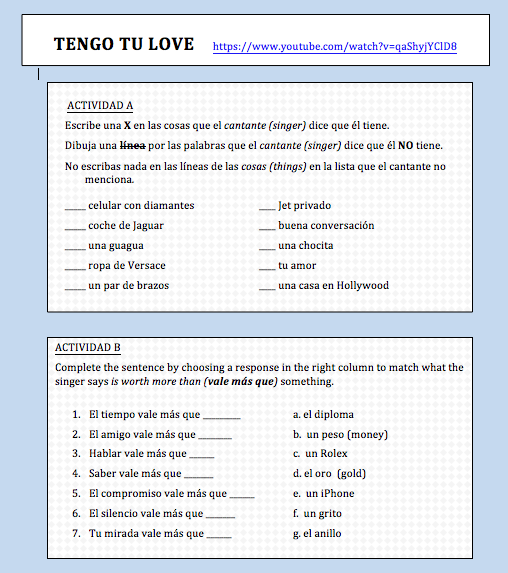
I've used the the group, Sie7e's song "Tengo tu love" in the past as a simple cloze activity with my Spanish 2 students. After preparing my lessons this week that included this song, I decided it was better to trim down the focus to a smaller portion of the song.  


With that in mind, I created two activities for students to complete while listening to this authentic resource.

First, we listened to the song and watched the video. I wanted them to enjoy the song, plus I suspected if students had to complete the activities the first time they heard the song, they would be more interested in watching the video than listening for specific information.

Activity A - The singer mentions things that he does and doesn't have.  The reason I chose the song was the high use of TENGO so I wanted to have the opportunity to use TENGO when going over the answers with the students. I listed the following for activity A:
- things the singer says he has
- things the singer says he doesn't have
- things that are not mentioned in the song

Students listen to the first portion of the song and check or cross out the items depending if the singer says he has or doesn't have the item.

When we went over this activity, I asked students, ¿El cantante dijo, "Tengo un celular con diamantes" o dijo "No tengo un celular con diamantes" o no lo mencionó?

Activity B - The expression VALE MÁS QUE is heavily used in the second half of the song. Finding a song that includes comparisons is a plus because I often forget to include comparisons in our class stories. I listed the comparisons that the singer makes and students match the answers from the list on the right that will complete the sentence.  The sentences are in order of the song to make it easier for students to follow.

I paused and replayed the above two sections of the song to give students additional opportunities to hear the lyrics. Thanks to the scaffolding, the students reported that the activity was at their level and they were successful in hearing specific words in the lyrics.   

If you are interested in the document, you can find the pdf HERE.