Showing posts with label subjunctive. Show all posts

Wednesday, February 15, 2017

Valentine's Day Idea in the MFL Classroom - Quick and Easy

Comprehensible Input & Food
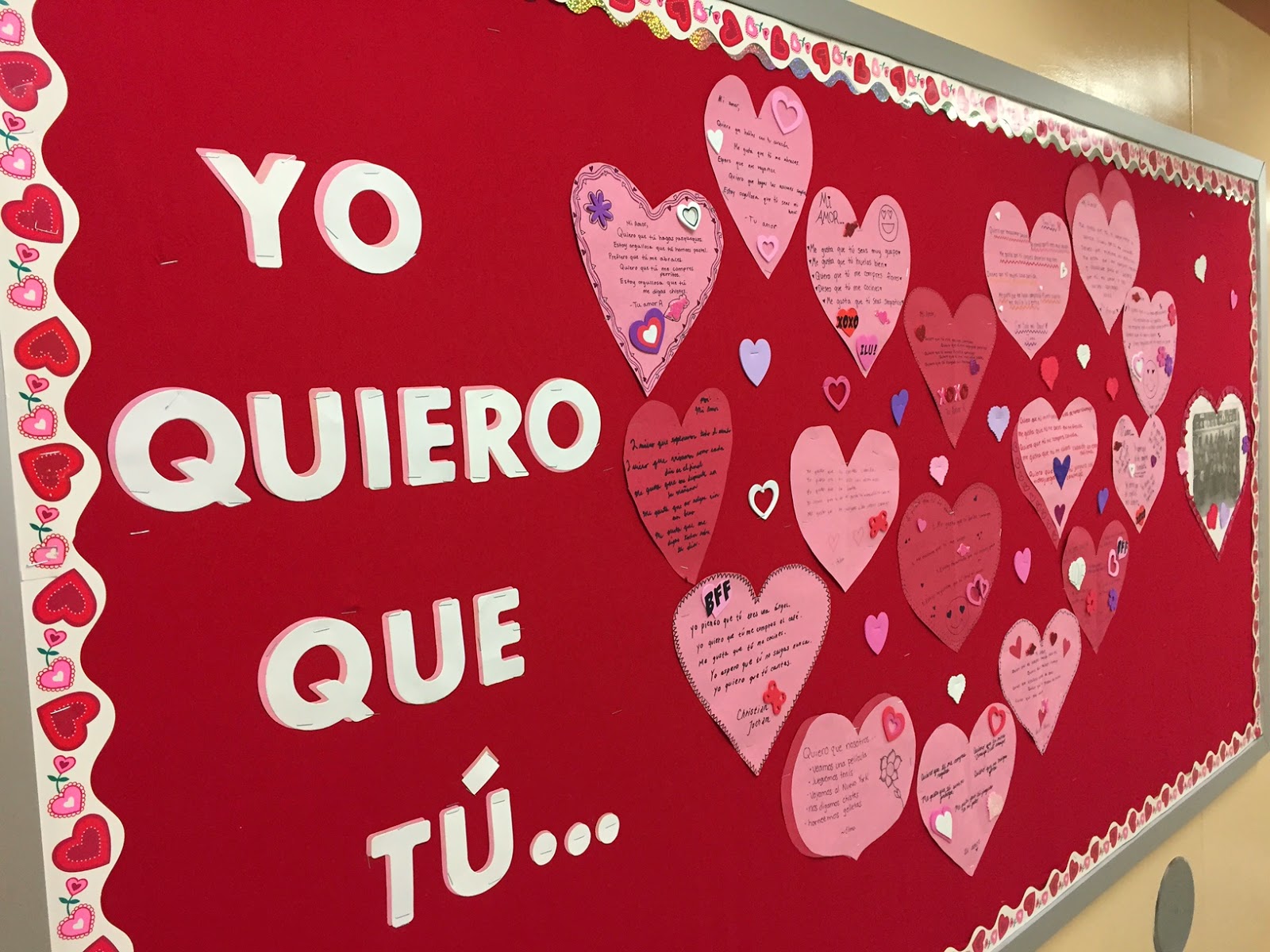
How is it possible that the date for Valentine's Day never changes but it still manages to sneak up on me and all of a sudden it's two days before February 14? That's what happened to me this year, but I didn't want to completely ignore Valentine's Day. Other years I had planned weeks ahead of time, especially the year I made a bulletin board in the hall from the hearts my students made (see this post), but when I put up a bulletin board in the hall, it stays like that for weeks, oh, what the heck, I'll be totally honest and admit it stays like that for months!

So what to do that isn't a waste of time and has a deeper purpose than simply decorating a card? I simplified my lesson from previous years to 15 minutes.

1. I asked the students to help me list people that are important in their life.  Then I used one as an example, such as "mother". Students gave me examples to write on the board of what they like that their mother does.  
 
Examples:  
Me gusta que tú me cuides.  
Me gusta que me ayudes con mi tarea. 
Me gusta que limpies mi dormitorio.

In one of my classes I explained that we were starting the Valentine message with a positive message, something I had learned over a decade ago when reading Stephen Covey's book, 7 Habits of Highly Effective People.

2. The second sentence was something that you hoped or wanted the person to do. The sentence started:  Quiero que tú... and students once again told me examples that I wrote on the board.

Quick and simple - two sentences!

3. I supplied red, white, pink, and lavender construction paper, markers, scissors, and several containers worth of heart shaped foam pieces to use to decorate the cards.  Students had 15 minutes max to write their sentences and ask me to check them, write them on the card, and decorate the card.

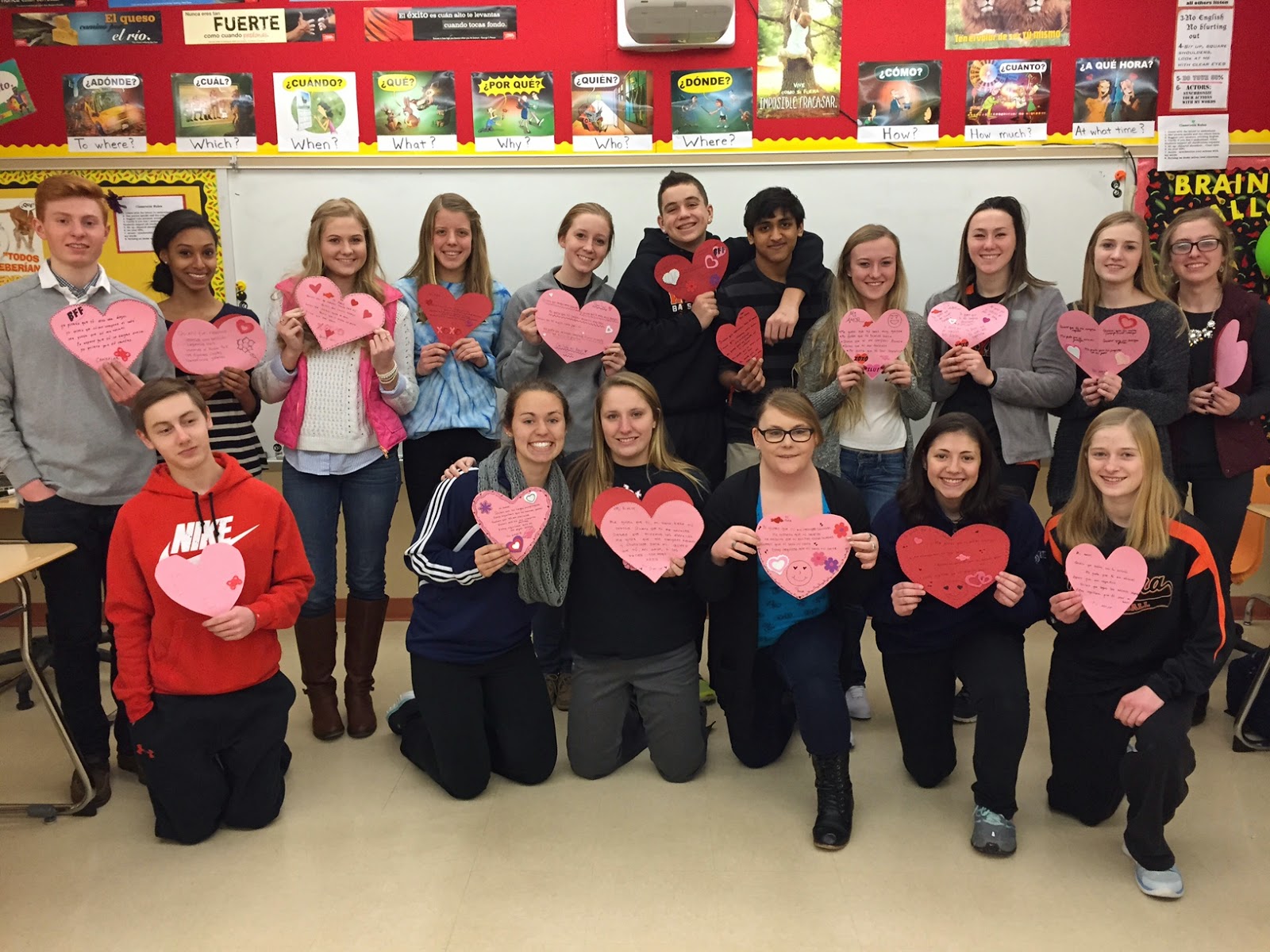
The last optional assignment, was to give the card to the intended recipient and take a photo of the card and the recipient. This had three purposes, 1) it would bring a smile to the recipient, and 2) if the recipient was a parent or family member, it was one way for the parent to see a small glimpse of what we are doing in Spanish class, and 3) fun publicity and "advertising" for the WL department.  Students that showed me the photo the next day in class, or they also had the option to email or tweet the photo, received +1 bonus point that will be added to their next assessment. Bonus points are rare in my classroom, so there was a fair amount of students that shared their photos, and videos, with me the next day. So, the fun lasted beyond the classroom walls and into the second day.

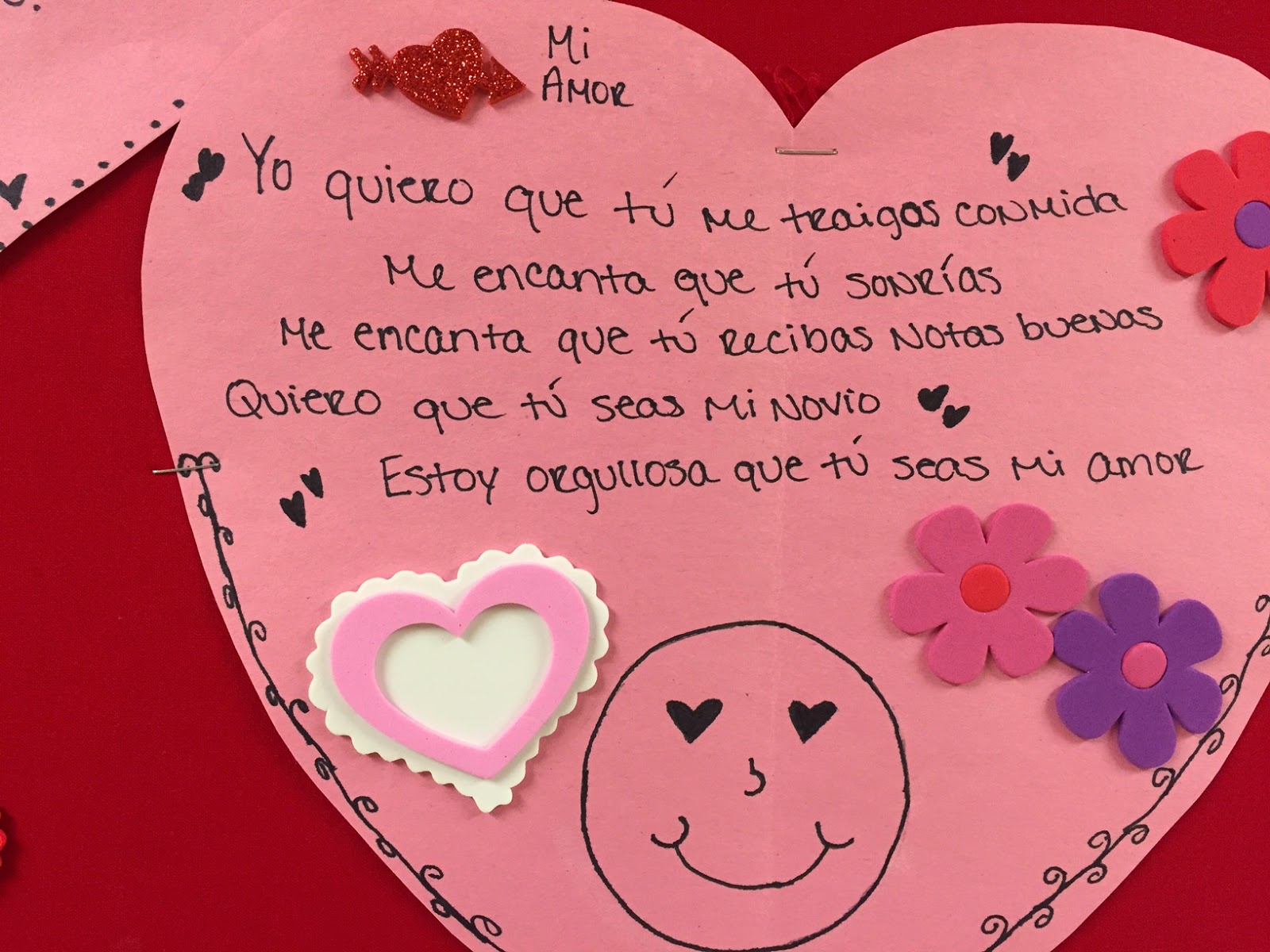
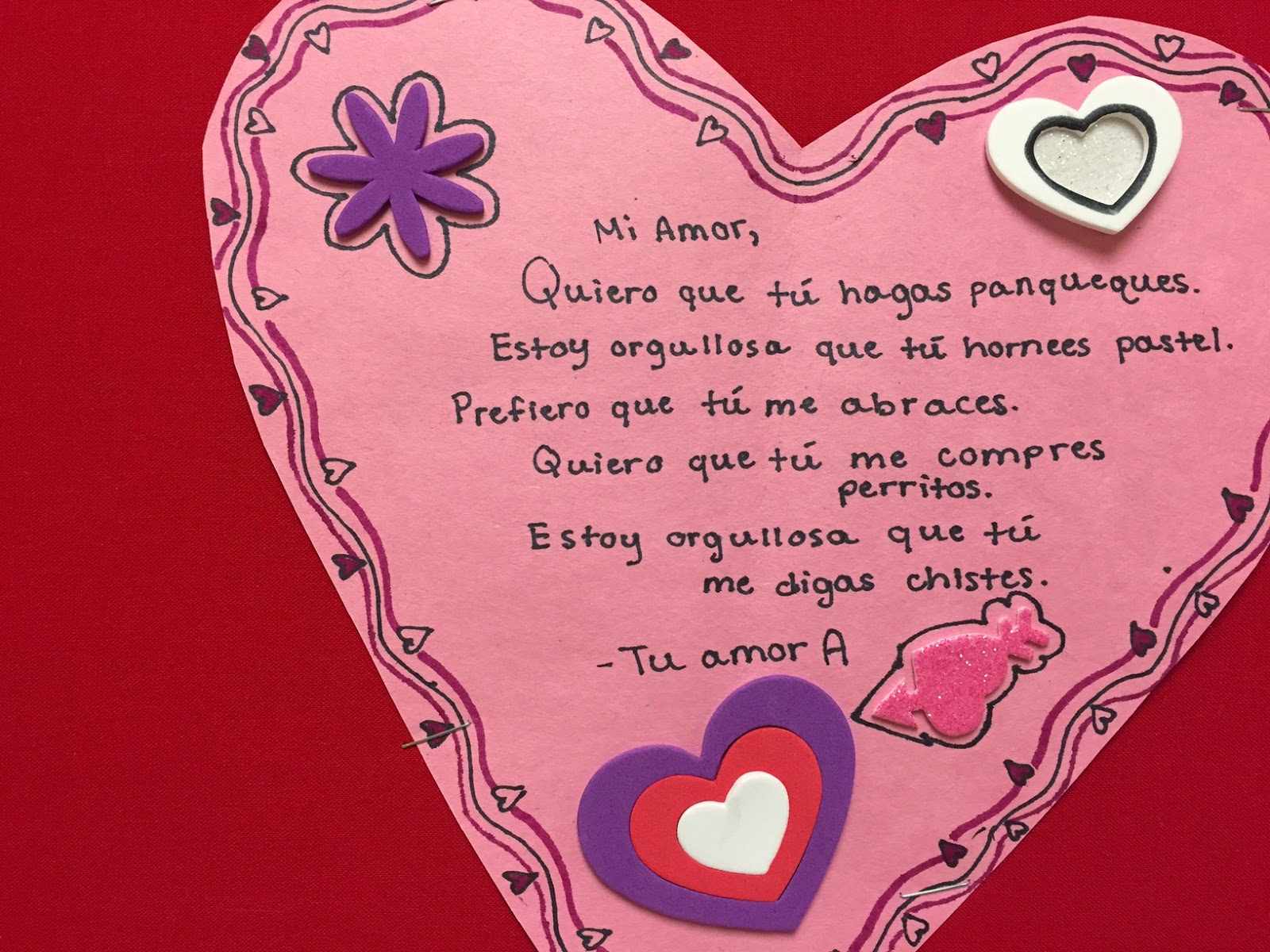
As an unexpected surprise, one of my students gave the Valentine's card to me at the beginning of the post. It says "Anon" but the student gave it to me in class after making it, so I know who made it. I love what it says:  I like that you teach me in different ways. That's lay terms for Teaching with Comprehensible Input.
The second sentence, has to do with food: I want you to make food for me. Short and sweet - CI and food.  That sums it up.

Thursday, December 29, 2016

Spanish Game for Navidad

In my previous post, I wrote about using The Match Game in a modern foreign language class.  (Click HERE for directions on how to play.) On December 22, our 2nd to last day of school before Christmas vacation, I used the Christmas edition of The Match Game for my Spanish 4 students.

If you teach beginning levels, you could easily change the statements so the ending does not require the subjunctive. My goal was for the students to concentrate on matching their team member and not on the grammar!
  

 If you would like the complete file in PowerPoint format, then contact me by email, Twitter @sonrisadelcampo or leave a message in the comment section and I'll forward the file to you. No cost to you.  :-)

FYI: The background format in the pdf copy above appears differently than it does on my PowerPoint file for whatever reason. It is less distracting on the PowerPoint file.

Wednesday, December 9, 2015

Spanish Stories with the Subjunctive


Story-asking with students is beneficial for students in ALL levels. When students help create the details in a story, they become invested in the story and are active listeners and participants.

Es probable que la Sra. Hitz hornee galletas para nosotros.
I wanted to involve my students in creating a story with me that pulled them into the story development and was packed with examples of the subjunctive. The steps for the storyline and following activity is described below.

1. I started with a story plot from *Bryce Hedstrom (see below for info): Person A has two friends; 1 friend wants Person A to go with her to one place and the 2nd friend wants Person A to go with him to a different place. This creates the subjunctive phrase:  "Ana quiere que Marcos vaya a la playa con ella" (Ana wants Marcos to go to the beach with her - Ana wants that Marcos goes to the beach with her).

2. For the story, I asked which student in the class had a problem (but didn't tell them the storyline yet). After we found the student for the "person A" role mentioned above, we decided which two students wanted Person A to go somewhere with him/her and to where s/he wanted to go with Person A.
(For this example, Person A will be Colin, and the two friends will be Isaac and Megan.)

3. Colin needed to decide if he wanted to go away with Isaac or with Megan.  In order to do that, Colin (the character in the story) needed to think of the pros and cons (ventajas=advantages, desventajas=disadvantages) to going away with each of the two friends.

4. The students gave me ideas and suggestions for the pros and cons of the student going with Isaac or with Megan. Each sentence started with "Es posible que" or "Es probable que", which requires the speaker to end the sentence with the subjunctive.
Ex:  
Las ventajas de ir a Disney World con Isaac:
(a) Es probable que ellos se diviertan mucho en los parques de atracciones.
(b) Es posible que Isaac tenga dos "quick passes" y no necesiten esperar en las lineas largas en los parques.

Las desventajas de ir a Disney World con Isaac:
(a) Es posible que haya muchas personas en el parque.
(b) Es probable que la comida en los parques cueste mucho.

5. Students then suggested ideas for the pros and cons for going away with Megan.

6. In our class story, the students voted with which person and to which destination Colin decided to go. 

7. That evening I typed the story and distributed it the next day in class. We read the story together. I, or a student, read a paragraph in Spanish, and then I chose another student to read the same paragraph in English. This helped to ensure that ALL students understood the story completely.

8. I randomly put the students in groups of 3. Each group had to create their own story, following the format from yesterday's story (which they had the copy).  They wrote the introduction and then the pros and cons.

9.Then each group had to illustrate the pros and cons by sketching a person thinking with two thought bubbles. (For each student story there would be 4 sketches with 2 thought bubbles each.)

10. I put the sketches on the board, or for the Spanish 4+ the students drew directly on the board. A student put a letter on each sketch. Then I read the introduction and the pros and cons and students wrote or said which picture matched the pros or cons.

This activity provided a great deal of repetitions of the subjunctive used in context: creating a class story, reading the class story; creating a group story; sketching the group story; listening to the group story and identifying which sketch belonged to the story.

 *The initial part of this storyline is from Bryce Hedstrom's ebook "Expressing Desire: Teaching the Subjunctive #1" in which Bryce explains how to teach the subjunctive with stories. You absolutely must check out Bryce Hedstrom's website for a long list of FREE Spanish stories and resources for language teachers, as well as resources that are reasonably priced.   


EJEMPLO: 

Las ventajas de ir al prom con (name)

  1. Es posible que la chica compre cosas en Gucci para llevar al prom.

2. Es posible que la chica lleva un vestido de muchos colores. 


Update on 1/11/16:  Arianne (@dowd124 on Twitter) shared the following photos that her students made when they used the above story format.  Thanks for sharing Arianne!!!


Friday, December 4, 2015

En 2016 espero que... A Bulletin Board for the New Year

Hall bulletin board display
If there is one thing I've learned when adding a display on a bulletin board, especially when it is original and requires creativity and making sketches, die-cut letters, etc, (more work than simply buying pre-made bulletin board sets from a catalog), it's to make sure what I put on the board is something that I can leave there for at least two months.

My plans were to make a bulletin board for the coming Christmas holidays, but with only 17 school days between Thanksgiving and Christmas, I ruled out a Christmas bulletin board for this year (at least for the large bulletin board in the hall). 

I had been waiting to be inspired and f-i-n-a-l-l-y it happened. (Which is a good thing because the bulletin board in the hall had only red fabric on it for several weeks!) I decided to have the students write what they wish for in the new year. 

Students' wishes/hopes for the new year.  (names of students covered)
Students started their sentences with: Espero que..; Deseo que..; or Quiero que...
 I shared my photos with Nelly Hughes (@nellyanhug), and she immediately replied that the sentences they wrote for the bulletin board provides me with even more information for PQA.  Killing two birds with one stone is always a good thing!
To the left is a collage of a few examples from the board.

 If you are interested in the pdf files of the people, please send me an email, leave a comment below, or contact me on Twitter (@sonrisadelcampo).       

Update:  Emily Long sent me a photo of the bulletin board that she made with her students (below).  Thanks for sharing the photo, Emily!


Monday, November 16, 2015

Flood of Subjunctive Input w/ Bianca Nieves y los 7 Toritos novel

As I mentioned in a previous post, my Spanish 4 students are reading the novel, Bianca Nieves y los 7 toritos written by Carrie Toth, (@senoraCMT on Twitter), and published by TPRS Publishing, Inc.  There is undeniable tension between two of the main characters with their true emotions spilling out in dialogue.  At times, Carrie gives the reader a glimpse into Bianca's thoughts when suspicions and distrust escalate and imminent conflict is on the horizon.

These strong emotions make it is easy to imagine what dialogues could have taken place among the characters that are not recorded in the book, and what characters may be thinking but strategically keeping to themselves. This is a perfect opportunity to "flood" the students with comprehensible input that is packed with examples of the subjunctive used in context!  

After students had read the first five chapters, I knew they had enough information on the characters in the novel to match possible dialogues and thoughts to the characters.  I wrote 25 sentences related to the events in the novel.  Students had to match the dialogues and thoughts with the characters that would have said or thought them. (If you would like a copy of the document to the right, you can find it HERE. 

Of, if you are a Kahoot fan, I uploaded the above sentences on Kahoot. Have the students choose which person said or thought the sentences by playing Kahoot with THIS GAME. (That saves paper and saves YOU time at the copier machine!)

You can find additional resources, in the Teacher's Guide for this book. It is packed with more activities than you need, which allows you to choose the ones that work best with your students. 
(To be clear, I mention books and materials I use in my class because I want to share what I have found to be useful in my classroom.  I do not receive compensation for mentioning products from companies on my blog.) 

Wednesday, November 11, 2015

Character Thoughts Graphic Organizer

I am excited about the increase in novels now available for students learning a second language.  In my opinion, novels can be a teacher's best friend in providing comprehensible, compelling input (but be sure to choose a book that is at the students' level). 

The novel Bianca Nieves is a great book to study relationships (as well as Spain's culture and bullfighting). My students are keeping notes on evidence of relationships throughout the novel that are strained or that are outright hostile!

I appreciate that Carrie Toth, the author, has not shied away from using the subjunctive throughout the book. At this level, (Spanish 4), I welcome every opportunity to model the use of subjunctive in daily conversations and discussions.  It is important that students understand how commonplace the subjunctive is from children's storybooks to novels.

One way to model the subjunctive in context, is to ask students to provide the thoughts of a character in a book, stating what she liked or didn't like about a situation or about what another character is/was doing. I used the graphic organizer pictured above, after reading chapter 5 of Bianca Nieves, for students to get creative with Bianca's true thoughts on what is happening in her life.  

Exploring a character's thoughts can also be accomplished by asking the students to write journal entries in the character's viewpoint.  However, the advantage to the thought bubbles, as shown in the picture above, over a journal entry is the limited space for each thought on the graphic organizer. (In my experience, students are more willing to write a few sentences in thought bubbles than having to organizer their thoughts in paragraph form.)

I'm also currently reading La Calaca Alegre, also written by Carrie Toth, with another class. I am making a similar graphic organizer for the thoughts of Carlos, "los pensamientos de Carlos".

Two copies of the pdf of the pictured document are available if you have use for them:
Click HERE for the pdf of Bianca in black and white, empty thought bubbles.

Click HERE for the color pdf of Bianca, empty thought bubbles.

      On the left is another organizer that I used with my students with the story "Jack y las habichuelas mágicas".  
1. I downloaded the story from THIS website.  
2. I read the story to my students.
3. We talked about Jack's thoughts using phrases:
-Me gusta que..
-No es justo que...
-Espero que...
-Es raro que...

4. We also talked about the giant's thoughts, fears, what angers him, etc.
No grade; a lot of input (plus the benefit of reading with the story about Jack)

The final piece is an assessment. Please note, however, that this is not the first time we have discussed how a character feels about the actions of another character in a book or story. Also, when students talk about their weekends, I sometimes tell them to add something that isn't the truth so we can DOUBT something that the person did or usually does on weekends.  The students have had a LOT of input on this!

5. I distributed the above sketch with thought bubbles and students wrote the mother's thoughts. I provided a few prompts (similar to what is listed in #3) that I wrote on the board for the students. 

Monday, January 12, 2015

Subjunctive Hearts - in time for Valentine's Day

Valentine's Day will be here in a little over a month. Even though the following activity would be a great one to complete in February, I did the activity with one of my classes on January 9, because the last day of the semester is this Friday, and the following week I'll get new rosters of students.

First, my students listened to Victor Muñoz's song, "Mi Princesa". They were familiar with it because I had played it during class changes earlier in the week. After listening to the song one time, I distributed Zachary Jones's cloze activity (found in his Cancionero 2012 book) for them to complete when we listened to the song again. We discussed the lyrics and the multiple examples of the singer wanting someone else to do something - Quiero que tú... (subjunctive indicator) . 

Then the students cut pink and red paper in the shape of hearts, wrote lyrics following the pattern of the song on their hearts, and embellished their hearts with Valentine's shapes.

As a last minute idea, I decided to post the hearts on the bulletin board outside my room. The students helped me to arrange their lyrics hearts in the shape of one big heart.  (My high school doesn't have an Ellison die-cut machine so when I have time to stop at the elementary school, I want to replace the temporary letters with some more polished looking ones.)


Spanish 4 students with their (Subjunctive) Hearts

Sunday, September 21, 2014

Subjunctive Review - The Fun Way!


How do you review the subjunctive at the beginning of the year without handing out worksheets with lists of verbs, conjugation charts, and rules?  Or better, how do you create a discussion or dialogue that requires the use of the subjunctive that shows how often it is used and how it naturally flows in conversations?

Last week I introduced an activity with my Spanish 5 student (in reality they're Spanish 4 students - see this explanation HERE) that met those requirements.  The activity eventually would lead students to a point to where they needed to respond with sentences that required the subjunctive.  They never saw my plan for the review until the subjunctive appeared. 

We started the activity with the premise of a lady that wanted to find a boyfriend, but was unsuccessful so she decided to go to an online dating service, in our case, a dating service for farmers.  We then listed what she wrote on the form to describe herself on one box on the board and next to that box, listed the true facts about the character.  (A side note: I love working with students that know how to "play the game" and are super creative, even if it means we end up with a character with a wooden leg due to the unfortunate accident she had with a cow, as in the case of Reina in the sketch above.)

Then we continued with an online bio of a man that saw Reina's profile. He filled out information about himself, so we once again made two charts, one of the lies he wrote and one with the truth.

The students were fully engaged in the activity. Don't let anyone convince you that students won't connect to characters that aren't real.  If they help create them and students have freedom to be creative, they will be engaged in the process.  

We continued with the story that these two people decided to meet at a coffee shop and when they saw each other, they immediately began making statements about what the other person had said.  Such as:

No es posible que tenga 22 años. (It's not possible that you're 22 yrs old.)
Dudo que haya vivido en París por dos años. (I doubt that you lived in Paris for 2 yrs.)
No creo que haya asistido Harvard. (I don't believe that you attended Harvard.)

It was interesting to watch the students during the activity.  When they were listing background information on the characters in Spanish they were calling out ideas, often several people talking at the same time. To an observer, it may have looked a bit chaotic, definitely non-linear.  But when I wrote the first sentence that one of the characters said after seeing the other to model what I was asking students to do in the next part of the activity, there was an obvious change. They didn't see the subjunctive coming their way, and boom, there it was. 

At first they were quiet, reaching back into what they had previously learned, and then, ever so slowly but surely, they "recovered" and continued the activity with sentences stating the reactions of the characters.  

Another step in acquisition.
Another example that showed students that they can handle any (grammatical) direction a conversation will take them.   

Saturday, April 26, 2014

Silent Photo Story: Digital Storytelling with a Twist

Last week my students created a Silent Photo Story project that was inspired by this pin on Pinterest.  (The two students that made the project, below left, gave me permission to post their project.  You can find it at the end of the post and HERE.)

Before assigning the project to my students, I did a trial run by texting photos of a story, with the sentences written on an app on my ipad, to my daughter that was at her college tennis match.  (See one of the photos from the story below on the right.)  I searched for a way to post the photos on an app that would automatically advance each page of the story instead of having the photos listed vertically as on the Pinterest example.  The easiest user-friendly method I found for students to use is the Educreations app.

The purpose of the project was for my students to write in the past tense, include sentences that describe how someone felt about the actions of another person (the imperfect subjunctive), and for the majority of the creative aspect of the project to be completed outside of class time.

The Silent Photo Story project:

A. Requirements
   - Write a story in the past with a minimum of 10 sentences.
   - A minimum of 2 of the sentences must describe how someone felt about
     the actions of another person or about a situation.
   - Write each sentence on a mini-whiteboard. (I gave each student 2 
     markers, an eraser, and a mini-whiteboard to take home.)
   - Take a photo of you holding the marker board with the sentence. Your
     actions should match the sentence on the board.
   - E-mail the photos to your school g-mail account.

B.  Students had 4 days to complete the assignment.  I offered to proofread their sentences before they took the photos, but none of the students took me up on this offer.  (Next time, I will require the students to have a mini-conference with me before they complete the project.)

C.  The day it was due, I signed out the department i-pads.  The students accessed their photos through their g-mail, copied the photos to the i-pad, and opened the Educreations app.

D.  On the Educreations app, they uploaded one photo per page/slide.  Then they made a silent recording, pausing 3-4 seconds on each page.  (If you save the project before making the silent recording of each page, the app will only save the initial page of the project.)

E.  After the recording, they saved the lesson and followed my detailed instructions on how to post their projects directly on our class Edmodo page.  Those directions can be downloaded HERE.

F.  The following day in class, we sat in a circle (conversation style which means without desks) and read the stories. 


Note:  This project can also be done completely in class if you do not want to send the supplies home with the students.  One of my students completed his project at home, but it was in one location instead of several locations as in the example above.  His expressions perfectly matched the action in his story.  If I he gives me his approval to post it, I'll add it later.

Friday, January 18, 2013

Finals to Assess Language Abilities (not memorized grammar rules and vocabulary lists)

Spanish 1 Final - Listening Comprehension - Part 1 of 3
Today was the last day of the semester and the last day of finals. I gave finals to Spanish 1, Spanish 2, and Spanish 4 students this semester.  My Spanish 1 final was the same as last January; the Spanish 2 final was completely new (I haven't taught Sp2 in years) and I eliminated the formal grammar section on the Spanish 4 final.  The driving force when writing the finals was to assess the students' language abilities rather than memorized grammar rules and vocabulary lists. (I have discussed, with all of my classes, how the "Cram and Drop" method of learning is outlawed in my classroom.)

Spanish 1
Listening Comprehension - 3 parts - I made QuickTime recordings and uploaded them to our class group on Edmodo.  The students tooks their final in the computer lab in the library to access the online files and work at their own pace, with the option to replay the audio files as often as necessary. 
  - Part A (12 pts) - (pictured above) Listen to 12 statements. Write the letter of the statement on the line. 
  - Part B (10 pts) - Similar activity as Part A but focusing on a different set of vocabulary.
  - Part C (8 pts) - Listen to a short story.  Answer several comprehension questions and write 3 additional facts about the story that are not mentioned in the comprehension questions.
Spanish 1 Final - Writing
Reading Comprehension (20 pts) - Read a typed page-long Spanish story and answer questions related to the story.
Writing (10 points) - Read a story in Spanish (different than the one mentioned above). Add 5 new Spanish sentences (anywhere) to the story.  No credit is given for sentences that are similar to the ones used in the story. Students need to write original, creative sentences.

There wasn't a verbal portion for the Sp1 final, but I may add it in the future.

Spanish 2
Listening Comprehension (10 pts) - I made a QuickTime recording of a story from a book published in 1942.  The students listened to the recording and answered comprehension questions, plus wrote one additional fact about the story. I replayed the story as many times as students wanted to hear it.
Writing (12 pts) - Part 1 - Students read two paragraphs in English about two sisters.  I underlined 23 of the (English) verbs in the story and students wrote sentences in Spanish choosing 12 of the 23 verbs that were underlined.
Writing (20 pts) - Part 2 - Using my subscription to Reading A-Z, I printed wordless copies of the story The Three Little Pigs. There were 13 illustrations and students wrote 10 sentences to match the illustrations.  They chose which illustrations to narrate. To receive full credit, students had to write fully developed sentences and use 10 different verbs, with only 1 of the verbs allowed to be in the present tense (if it was used in a dialogue).
Reading Comprehension (33 pts) - Read a story and answer comprehension questions.  (I will need to revamp this section. The students did well but I didn't like how the format of the questions.)
Verbal - I didn't have a verbal section, but I would like to add one in time for next semester's final.  

Spanish 4
Listening Comprehension - There wasn't any on the final.  I should add one for future Sp4 classes.  My Sp4 students have been listening to Spanish every day, 90% of more of the class time and I have been informally accessing their listening comprehension throughout the semester (which is very good!).

Writing/Subjunctive (18 pts) - I wrote the first clause of 9 sentences followed by "que", related to the collage on the left. (The collage is currently only available by e-mailing me.) Most of the expressions required the subjunctive in the second clause and most of the first clauses were written in the past - meaning they had to use the imperfect or pluperfect subjunctive in the 2nd clause.  The students finished the sentences. They had to use different verbs for each sentence and write well developed sentences. Even with students having the option which verbs to choose, many of them used a lot of irregular verbs such as "cayera", "hubiera muerto", and "sonrieran".  This is the closest I came to a grammar section, but because they were trying to explain why someone felt the way they did (doubted, demanded, were surprised, was irritated, etc.), it was more communicative and contextual.
Writing (10 pts) - Write a short essay describing a situation in modern times that is similar to the situation in the reading comprehension section of the test.
Reading Comprehension (16 pts) - Read a story (which they later informed me was difficult for them) and choose 16 of the 18 comprehension questions to answer.   
Verbal (30 pts) I typed 4 sets of 5 questions (all different) in Spanish.  While the students were working on the written final, I handed the 5 questions to a student and gave them 2 minutes to look at the questions and think about them. Then they went to the hall with my iPad or my iPhone (I trusted them with the iPhone - for the most part) with typed instructions on how to make the recording on QuickVoice, title it, and save it.  I allowed them 5 minutes to complete the task. If they hadn't returned in 5 minutes, I went out to the hall and ended the recording, which only happened with 1 student.
 
There are some sections of the final on which I want to make adjustments, but for the most part I was pleased with the format. I like to offer them choices throughout their exams because, as I see it, that is how real communication works.  I have a dear friend named Nelsi from the Dominican Republic.  We get together on a somewhat regular basis so I can practice speaking with a native speaker.  If, during our conversation, I don't know a certain word, I either use another word that will express the same thing or ask Nelsi. We make those choices in every real word conversation, why not let students choose how to express themselves on exams?

This leads to the question: Why are we forcing our students to use certain words on the finals? (i.e. sentences in the TL with the verb listed as an infinitive in parenthesis and students have to conjugate the verb in the tense indicated on the test.) I gave assessments like that in the past and now, looking back, I can't think of a strong argument in favor of that type of assessment.  As I mentioned above, students don't necessarily choose simple, regular -ar verbs when given open-ended sentences and assessments.  They want to express their thoughts and opinions and they don't limit themselves to simple verbs.  In the story about the 3 Little Pigs for Spanish 2, many students used irregular verbs like oyó, destruyó, vieron, se cayó, and fueron, along with regular verbs like bebieron  and tocó a la puerta.  They knew the words from previous stories and they felt comfortable with them.  In fact, students may not even view them as irregular verbs because they weren't presented to them in that way. In the writing section of the Spanish 1 final (photo above),  the student used as many irregular verbs as regular verbs.  When the students have a huge amount of input of hearing and reading the verbs, they're not "irregular" verbs - they're just words that express meaning. 

  • Again, for emphasis, they're just words, not irregular, not -ar, not -er, not stem-changing, not -ir, not "go" verbs, not participles, not object pronouns,  just words that express meaning.