Showing posts with label photos. Show all posts

Saturday, June 30, 2018

Brain Break - Photo Roulette

Photo Roulette - photo from Library of Congress
 It's June 30 today and I doubt there are many teachers looking for ideas for Brain Breaks but, when the school year starts again in August, this may come in handy. Also, I saw this today and I'm likely to forget about it, so this blog post serves as a reminder to me. 😃

For the brain break you will need to go to the website Photo Roulette, which has photos from the Library of Congress. The website will show you a photo from the Library of Congress and then you guess in what year the photo was taken. You have 10 guesses and after each guess it will tell you whether you should guess an early year or one that is more recent. 

You can play Photo Roulette as a whole class effort, let students work in groups of 4, or whatever works best that doesn't take time to arrange groups. If using it with the whole class, especially a beginning class, the teacher could have a student write a year on the board, and the teacher would then turn to the class and say in the target language, "Class, do you think it is before (year written on board) or after?"; maybe have the students that think it is before stand up and those that think it is a later date remain seated.  The teacher, or her helper, will type in the suggested date, and if the website says it was before, any of the students standing can write a number on the board for the next suggestion. For more repetition the teacher can say, in the TL, "It wasn't before 1955, it was after 1955." The teacher looks at those students that are seated and says, "Who wants to guess a date, an write it on the board, after 1955?" Doing the brain break in this manner allows the students to hear the year, repeated several times as the teacher asks about it, and not have to produce it.

A suggestion for doing the brain break with several groups: Divide the class in 4 groups and let the first group guess a year. Type the answer in and check if the group is correct. The next group reads the hint provided by the Photo Roulette website and guesses accordingly. The group that guesses correctly is awarded the number of points of the remaining guesses. After 3 or 4 photos, the group with the highest number of points is the winner.

If your school is 1:1, students can play Photo Roulette with a partner, which translates into ALL students being actively engaged!

Whether you use this website as a brain break or for a fun Friday activity, I think the students will enjoy it and not realize they're getting a little "practice" on how to say years in the TL. If the teacher wants to really dig in, she can compare the photo to today and point out things that are different, or simply talk about the photo after the year was guessed. 

If you have fun way to use this with your language class, please share in the comments below. HAVE FUN!!!!

Sunday, July 27, 2014

10 First Day of School Ideas for the MFL Classroom

It's closing in on 2 months since I wrote my last post and now it's closing in on the beginning of school.  The opening day of school for me is less than a month away and thoughts of planning for a new group of students are more frequent. In particular, my thoughts are on the first day of school.  

The list below has some ideas I used in the past, some I found on Pinterest, and from blogs.  A few are ready to go as listed, and others will need changed depending on which level it is used.  The goal is to provide comprehensible input in the target language, even on, or better said, especially on, the first day of school!

Reminder: If the activity requires output in the target language, I suggest to dismiss it for beginning levels, or tweak it and/or provide the scaffolding needed to make it level appropriate.   

1.  Summer photos.
Last year before school started, I emailed my Spanish 4 students and asked them to send me a photo of something they did during the summer.  I put the photos in a powerpoint and our discussion was based on the photos.  It helped the students, and me, to learn about their classmates. This year I may create a Google presentation and share it with the students which will allow them to add their pictures on the presentation. (Work smarter, not harder, right?)

2. A Story!
I used this activity in the past for the first day of class (semester class that started in January) with students that had no exposure to the past tense before.  They had 70 minutes of comprehensible input of the past tense and left class feeling confident that learning does happen when the language is delivered in storytelling format.

3. Schools around the world.
Why not spend the first day of school talking about what your school has in common with other schools around the world?  Click here for a powerpoint of photos of schools around the world, or here is another option. The photos will help to keep the questions and discussion comprehensible.

4. Mafalda: Primer día de escuela
Dive right in and start the school year with a MovieTalk activity. Click HERE for the 45 second video about Mafalda's first day of school.  When I use this video I'll ask them about walking to school with their parents (more like did their parent drive them to school) and if the floors in the hallway were filled with charcos (puddles) from all the students crying. HaHa - this should be a fun discussion!

5. Personal word Clouds.
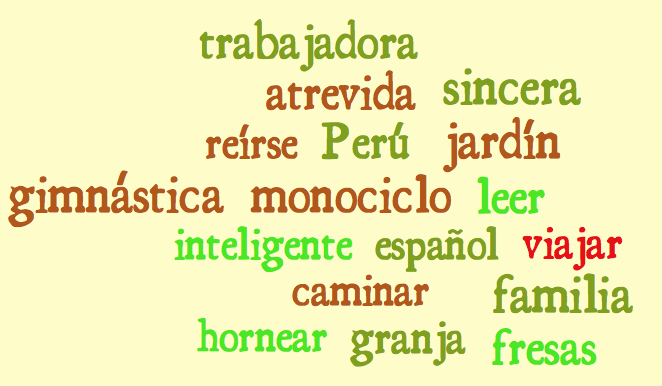
This isn't suitable for beginners, but is another type of get-to-know-your- classmates activity that is suitable for levels 2 or higher.  Choose your favorite word cloud site and fill it with words that describe you, activities you like, or places you have been.  After the students see the teacher's model word cloud, give them the assignment to make their own, but not to include their name.  (My suggestion is not to have the students make this in class, but rather give students 1-2 days to complete the activity.)  

After the students have submitted their word cloud, you can choose several (2-3) to show to the class each day.  Students will guess which of their classmates made the word cloud and then continue the discussion about the student.  This will provide you with more than a week of student-centered topics to set the foundation of a student-centered classroom.

6. Student picture collages.
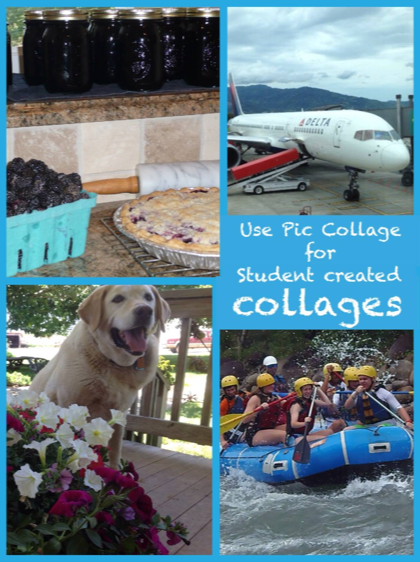
If you haven't added the Pic Collage app to your devices yet, then wait no longer! The app is user-friendly and I continue to find more classroom uses for it. 

This activity is similar to the Personal Word Clouds listed above, but instead of words, students will make a photo collage. Students can use photos from the app or their own photos, as long as it doesn't include people in the photos that will give away who made the collage.  These collages can be printed out to put around the room, or put on a powerpoint or Google presentation. Lead the discussion around the pic collages and the students' interests.

    (If you want to keep it uniform, set guidelines such as: include x no. of photos, 1 should be of an activity, 1 of your favorite food, etc.)

7. The TOP 10 List.
I did this activity several times in the past with my upper level classes.  I give them large sheets of paper and tell them to make a TOP 10 LIST of reasons to learn Spanish.  I encourage them to use their imagination and make them funny, and they have never failed to disappoint me.  

Below are more ideas that I found on Pinterest:

8. M&M game!
Most students are going to be excited about getting chocolate candies on the first day of school, or from my experience, getting chocolate on ANY school day is memorable for them.

The blog post found HERE, explains the M&M game.  It's not a beginning level activity for a second language class because it requires output, but higher levels will enjoy it.  

9. The Name Game 
The teachers from the Creative Language Class blog describe how to use the Name Game on the first day, even with level 1 students. 

10.  Memorias de un verano maravilloso
A Pinterest find. Click HERE for a free download that students can sketch or write their answers.  

Also check out:

- Show what you know (from the Creative Language Class) 

- What does this make you think about? (from Martina Bex)

- Cognate Practice (from the Creative Language Class) 
 
- Todo Sobre de Mí (from Carolina Gómez)

- Getting to know you grid (from Methods and Materials for WL Teachers)

Do you have a favorite activity for your first day of class or are you planning something new that you would like to share?  I'm sure there are other great ideas that I overlooked.

Thursday, February 27, 2014

Linoit in the MFL

Linoit is a nice platform to post photos to use in discussions instead of putting the photos on a powerpoint or word document. Linoit has many more features, such as the ability to upload files or videos, share boards, etc.,  that I didn't use in this particular activity, but it's definitely worth checking out.

Today my Spanish 2 classes were working with the structure: s/he saw - VIO in conjunction with reviewing s/he went - FUE, and then what s/he did (verb in the preterit form).  I found photos on the web to post to the Linoit board.  I sketched a person on the board, the students named him, and then we talked about the places that he traveled, what he saw there, and what he did.


For some of the places, I did not list the country, which added interest to see which students knew the famous landmarks; PLUS, I had several places from Spanish speaking countries to introduce places that students may not have known.

Using Linoit is a interesting and sure way to get MANY repetitions of target structures and include culture in the discussion.


Tuesday, February 4, 2014

Snowmen and CI

This winter is not fooling around. When it snows, it usually is enough to delay or cancel school. We've missed more school days this winter due to snow and ice than we have for the last 3-5 years combined, AND it's only February 4th.  

What do you do when students return from a day off of school due to snow to get them back in the swing of listening to and speaking in Spanish?  You talk about what they're already talking about - SNOW - in the Target Language. 

Below is the collage I had waiting for my students this morning.


There is a lot of Comprehensible Input to generate when talking about the snowmen in the collage.  Use CI to talk about:
what the snowmen are wearing;  the size of the snowmen; boca abajo (position - upside down); decorations used for eyes and nose;ask who in the class made a snowman; other activities in the snow; winter; best activities for snow days; which students made which snowmen, etc.

We spent 10 minutes  talking about the snowman.   It was a short, CI-based activity to ease students back into Spanish class.  

You can search online to find photos of snowmen OR take the more enjoyable option...snap a photo of one or two that you've made and ask your students to send photos of snowmen that they've made.  I made two of the snowmen in the collage above , and then sent tweets to a few students currently in my class, students from last semester, and to students from previous years that have  graduated. Making the snowmen was fun, and watching the photos roll of snowmen that my students made was also enjoyable.


Work with what you have - if it's lots of snow, talk about it.  That discussion will naturally bring up words in Spanish that your students will need for future discussions on what they did on their days off.

Sunday, March 31, 2013

Photos to Elicit Discussion in the MFL

http://www.buzzfeed.com/daves4/people-you-wish-you-knew-in-real-life
Following the success of "March is Children's Story Month" in my upper level Spanish class (see post HERE), I am declaring "April is Photo Month".  This means I will start each class with a photo and a short discussion.  

I'm banking on the saying "a picture is worth a thousand words" to capture the students attention and elicit their thoughts and opinions in the TL. Starting class with photos and a 7-10 minute discussion will keep the students guessing as to what I have in store for them each day, but won't steal away too much time from the scheduled lesson plans.

I suggest that you vary the goal of the target such as one day students say what will happen next, or what happened previous to the photo being taken, or creating a personal profile for the person, etc.

Below is a list of a mixture of serious photos from news sites, beautiful photos from National Geographic, and funny photos. As always, you will need to preview the photos for school appropriateness! 

1. BBC News in Pictures

2. Toxel.com "World's Best Father" photos

3. National Geographic Photo of the Day

4. Lens, New York Times Photos

5. Awkward Family Photos

6. BuzzFeed, People you wish you knew in real life

7. NYTimes, What's going on in this picture?
   (Click HERE for a previous post in Feburary regarding this website.) 

Here is an idea to get students involved in finding the photos for discussion:  Choose 3 students at the end of each class and give them the assignment to find and email a photo to you that evening, along with an explanation (in the TL of course) why they think it is a good photo to use in class.  The next day in class, show the 3 photos but DO NOT tell the students who sent the photos to you.  The class will then vote on which photo they want to discuss and the student that sent the photo to you can win a small prize. (Even something as small as a "fireworks" clap. Anything to give them recognition for having their photo chosen by the class!)

Please feel free to share other websites with collections of interesting photos.

Monday, January 14, 2013

"What's going on in this picture?"


Today I found a new resource of photos to use in my Spanish classes. It is a weekly feature of The New York Times website in the education section.

I plan to use these photos as a variation of my Character Sketch activity.  For the Character Sketch activity, I project a photo of a person.  Then I guide the students in developing information about the person: where they live (lived); where they work (worked); describe their personality; are they married or single; and other information.  Keep in mind that you, as the teacher, are in charge of making sure the character sketch uses the structures and vocabulary that you want to stress and that the students stay within bounds in their descriptions.  

The new resource, "What's going on in this picture?", can be used in a similar way.  An advantage is that the photos capture your attention immediately.  If you have a class that doesn't compete to give their suggestions for a character sketch, the intriguing photos on this website should make it easier for them to think of possibilities for what is happening in the photo.  

For lower levels you can begin by describing who/what is in the photo and what they are doing.  For upper levels, you can slip in questions and descriptions using the subjunctive, the conditional tense, and a wider range of vocabulary.

I enjoy these type of activities because many times one student has an idea and the others "run with it", building on the information a piece at a time.  It provides ample opportunity for PQA and for circling.  It's like a ready-made lesson plan that can easily last for 30 minutes or more and that's 30 minutes of compelling input (because the students are the ones helping to create it) in the Target Language.  

So many choices for different types of input activities - so little time.

Thursday, September 13, 2012

Ser vs. Estar

I wanted to review Ser and Estar with my students this week, but I didn't want them to focus on grammar.  I wanted the focus to be on having the students work together on a goal to communicate something that, coincidentally, called for sentences that used Ser and Estar. After a little thought, I came up with the following activity. 


When a major bookstore closed in my area, I bought these state books for $1 or less, packed with large photos of people and places.   

I found a photograph of a man at a flea market and tore it out of the book.  On Day 1 of the activity I posted the photo on the board next to several questions that the class needed to answer about the man.  The rule was they had to speak only in Spanish (that's a standard rule) and their answers had to be creative.  
Some of the questions they had to answer were:
- ¿Qué está haciendo el hombre?
- ¿De dónde es?
- ¿Dónde está? ¿Por qué está alli?
- ¿Cómo es el hombre?(características; cualidades inherentes)
- ¿Cuál es su nacionalidad?
- ¿Qué hora es?  ¿Qué día es?
- ¿Por quién fue sacada la foto?
- ¿Cuál es su profesión?
- ¿Es miembro de qué organizaciones?
- etc

The students were focused on creating an identify for the man that they didn't realize that all the sentences they were using had either Ser or Estar. It the students 30+ minutes to come up with an identity that they agreed on.  That's 30 minutes of discussion in the TL, concentrating on a communicative task and not listing rules.  At the end of the class I asked them if they knew why I had them to the activity.  They gave answers such as: "you wanted us to use our imaginations", "you wanted us to work together", "it required us to talk through our suggestions in Spanish", etc.  I told them that they were good reasons but not the underlying reason for the activity.

The next day we continued the activity, but this time students worked in groups of 2, I gave each group a new photo, and they worked to create an identity for the person.  I told them they would have to share with the class about their person so it was totally up to them if they wanted to write notes or not.  For today, I put the questions/facts that they needed to address in English.  We only had time for 2 groups to present and those two groups did not have many errors on their descriptions. I asked them again if they knew why we were doing the activity.  I got the same type of answer as yesterday.

On the 3rd day, the remaining groups talked about their photos and I needed to make some restatements when they used the wrong verb in their answers. Finally, a student turned to me and said, "Señora, I think I know why we're doing this."  After some prodding by me about the activity, several more students figured out why were did the activity.  One girl answered, "so we know the difference between Ser and Estar.  

I'm convinced that by using the language to create an identity, the students made more progress than by memorizing a list of reasons to use Ser and Estar. How much better for them to focus on communication than on grammar.  The assessment today was similar, with students writing about a person in a photo, in full sentences.   

Tuesday, August 21, 2012

Inspirational sayings and Photos

http://www.desmotivar.com/
Desmotivar.com is a website where you can find inspirational sayings matched with photos.  The one on the left is one of my favorites.  I may share it with my students when we are talking about El Camino in Spain.

Just a fair warning that not all the photos are ones that are appropriate for school, but if you bypass those, you'll find plenty that will make nice additions to units or used alone for conversational starters.

I found this website when browsing Pinterest.  As I said in a previous post, I'veo only recently started learning how resourceful Pinterest is for teachers. The Pinterest board that I found Desmotivar.com on, is titled "Soy maestra de español :)" by Jenny Burkholder.

Saturday, August 18, 2012

Photos - Un Cuento en 6 Palabras

This activity was inspired by the blog, SWSED - Six Word Story Every Day. As the website states, the challenge is to write a story in only six words. When I use the activity in class, I  ask my students to write a title/story in 6 words.  The trick is that it has to be EXACTLY 6 words or their answer is disqualified. My students love this activity and it is a nice way to add variety to the class.  I use the activity two times per school year (level) in Spanish 4 and/or 5, but it can easily be used in lower levels.


First, you will need a collection of photos, or you can use my PowerPoint below:


The students work in groups of 3 and, of course, they have to communicate in the target language during the entire activity.  I tell them to discuss their answers quietly so other groups don't copy their ideas and so I cannot hear their idea.  Then they write their title/story on a paper and hand it in to me.  I mix the papers so I don't know which group wrote each title, and then I read them to the class.  I choose the one I like the most and that group gets a point,  or another option is to give two points for the top title and one point to second place.  We continue with 6 or 7 more photos.  At the end, the group with the most points gets an extra credit point, or whatever prize I may have available.

I enjoy using photos in class because my students react well to visuals.  It seems easier for me to engage them in conversation when they have an interesting photo to grab their attention.

Do you use photos in to teach your language?  Would you be willing to share how you use then in class for interactive and communicative activities.