Showing posts with label songs. Show all posts

Wednesday, October 2, 2019

Charlala + Sr. Wooly Resources = Happy Students & Teachers

Ever since I stumbled across Charlala.com, thanks to a post on Twitter, my mind has been bombarding me with ideas of how to use it in class. If you don't know about Charlala.com yet, go to the website and explore (you will love it, I promise) and check out these explanations of how I've used it in the past. 


My Spanish 1 students have watched Sr. Wooly's GUAPO video and completed a few of the extra activities that he provides on his website. One of those activities was the cloze activity. I printed the "fácil" version on one side of a paper and the "difícil" version of the cloze activity on the other side. (This is perfect for differentiating instruction in the classroom!)
After we went over the lyrics, students got an iPad and I instructed them to chose one of the lines in the story and to sketch it on the charlala.com webpage.  If you know the GUAPO song, you know that the lyrics are repeated many times, which means there weren't many things for the students to draw. (But, this can be a good thing! Read on.)

After the students submitted their sketches, I projected many of them onto the board. First, students had to identify which line of the song the sketch represented and then we described more details about the sketches. It didn't matter that there were five sketches of a man with green eyes and brown hair. The students heard a huge amount of comprehensible input on high frequency structures (tiene, es, soy) plus useful adjectives, nouns, and expressions (guapo, feo, mujeres, alto, no es necesario).

If you use songs with your students and want a new way to re-use the song for more comprehensible input, give this a try! If your song is a story, after viewing the sketches, you could ask students to put the song in order using the sketches.

 ENOY!

Tuesday, March 15, 2016

Creating a mini-unit from El Banco

Sr. Wooly's song, El Banco, has been one of the songs that I share with my Spanish 2 students for several years.  When I first started using it, it was basically to show the students the video for them to enjoy the song and hear the Spanish.

Now, however, since it is part of the Spanish 2 curriculum (that means I'll be subscribing to his website for years to come), there are readings and activities in place to introduce structures and vocabulary BEFORE watching the video, AND, activities that we do directly related to the video. It's not haphazard as it was in the past (which by no means took away from the enjoyment of the video), but rather a meaningful, well-planned component of the curriculum.

I added a two new activities this year (see #4 & #6) 

1. Rumors activity by Martina Bex
    Introduces structures: ¿Quién dijo?, no lo creo 

2.  A variation of the Thief Activity by Martina Bex. 
    Target structures: soy inocente, no hice nada, no lo creo.  Student A takes 10 things out of their bookbag and puts them on a chair; then leaves the room.  One student is chosen to take and hide one of the items.  Student A returns and has to guess who took the item. 

Student A: ¿Quién robó mi ____?  Daniel, ¿robaste mi ___? 
Daniel: No. Soy inocente. No hice nada. 
Student A: No lo creo.

3.  Movie Talk of Mercedes commercial of blonde lady in library

      Target Structures:  se acercó, miró
This short video helps me to introduce se acercó, which is a structure students will hear again in El Banco. It is also a good way to recycle previous vocabulary and pull in more examples of verbs in the past such as miró, vio, pensó, etc.)

4. Draw diagram on the board of the police station and interrogation rooms. Explain the main characters in the story and their actions, (in the TL of course!) referring to the diagram on the board.


5a. Distribute and read EL BANCO script
Note: I used to have Sr. Wooly's name at the top of the script but then the students knew that there was a video to accompany it.  I like to surprise them with the video, so you will notice that the paper below does not mention his name in order to keep the video a secret.


5b. Listen to recording of native speaker. My friend Nelsi, is from the Dominican Republic. I recorded her reading the story so my students can hear the beautiful Dominican Republic accent. 

6.  Act out the story.  (A day with acting in class is always a good day!)
You will need the following:
Actors:
   - Margarita
   - Federico
   - el detective
   - a 2nd detective
   - two students to be the doors  (hold arm against your body, bend the arm at elbow, and extend the forearm).  The detective must pass through the door to go from one room to another.

El detective interroga a Federico.
Props:  tie for el detective; two desks and four chairs (each interrogation room had two chairs and a table); folder; two pieces of white typing paper - one with a sketch of Margarita and one with a sketch of Federico and scribble lines to look like information about the two suspects; a plastic cup (can be water in it); a styrofoam cup, pen,

The teacher should be the director while the students act. Insist that the students are dramatic. Insist that the detective walks through the "doors" to enter the interrogation rooms. When you say, "Había una mujer que se llamaba Margarita", pause and allow time for Margarita to look at the "audience" and acknowledge them.

7. Watch "El Banco", MovieTalk the events in the story. This video is always one of the students' favorites.

8.  Describe El Banco characters on the board. (A double T-chart) List the 3 characters:  Margarita, Federico, and el detective.   I ask the students to tell me the actions that the person did or describe the person (what s/he was wearing, physical characteristics, his/her feelings, etc).  Teacher writes on board:  Margarita, Federico, & el detective.  Students tell teachers sentences to describe the person or to tell what actions s/he did.  Students write sentences as teacher writes them on the board. Students form inside/outside circles. Student A reads a statement to Student B and Student B says which person it describes. Continue with 2 more statements then switch or Student B is reading from the list of statements and Student A responds.

9a.  El Banco script on Textivate - This is a public link
Variations: create a sequence for homework; or create a Challenge activity with the script instead of a sequence.

9b. Order the dialogue. I projected a scrambled dialogue that used the same structures and vocabulary but not related to El Banco video, on the board. Students worked with a partner to put the dialogue in a logical order.

10. Comprehension questions. I have some questions that I verbally ask the students about El Banco.  (Ex: ¿Dónde estaban las personas? ¿Qué bebió el detective/Margarita?) The purpose of the questions is to give students more input so they hear the vocabulary and structures in a different format. 
During these questions, I insist that students have two choices on how to respond: 

    (a) they raise their hand - they know the answer;
or 
    (b) they place their first in the palm of their other hand - this indicates they don't understand the question, and/or they don't know the answer after they have referenced the El Banco story script and cannot find the answer

Passively sitting in the class and not choosing one of the above actions is NOT an option.

After the flood of input on these song and text activities, I give students a quiz which is a short story to read (it is NOT El Banco story), but it contains the same major grammar structures and vocabulary words.

Sr. Wooly has expanded his website immensely... so if you haven't checked it out lately, you will be in for a pleasant surprise. It is teacher-friendly and packed full of readings and online activities for teachers to assign online for students to complete. 

Saturday, January 30, 2016

Scaffold Authentic Resources for Listening Comprehension Success

If I had my wish, I would insert another 50+ hours for each level of language at my school.  I don't foresee that happening (ever) in the future, which means I need to make every minute count in my classroom. This translates into scrutinizing my lessons and activities for what is best for the students in helping them increase their proficiency in the language in the limited time that I have with them. 

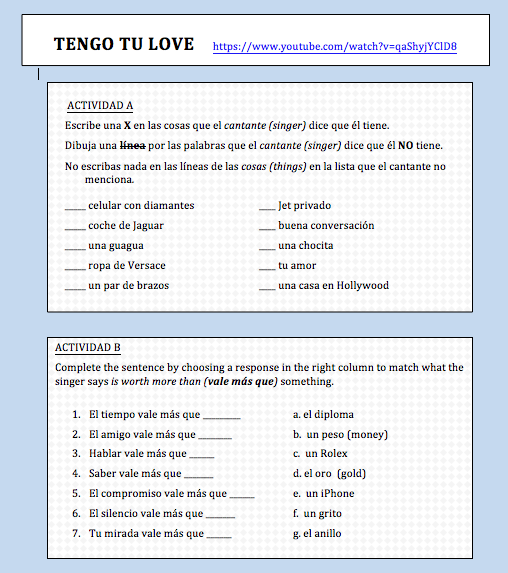
I've used the the group, Sie7e's song "Tengo tu love" in the past as a simple cloze activity with my Spanish 2 students. After preparing my lessons this week that included this song, I decided it was better to trim down the focus to a smaller portion of the song.  


With that in mind, I created two activities for students to complete while listening to this authentic resource.

First, we listened to the song and watched the video. I wanted them to enjoy the song, plus I suspected if students had to complete the activities the first time they heard the song, they would be more interested in watching the video than listening for specific information.

Activity A - The singer mentions things that he does and doesn't have.  The reason I chose the song was the high use of TENGO so I wanted to have the opportunity to use TENGO when going over the answers with the students. I listed the following for activity A:
- things the singer says he has
- things the singer says he doesn't have
- things that are not mentioned in the song

Students listen to the first portion of the song and check or cross out the items depending if the singer says he has or doesn't have the item.

When we went over this activity, I asked students, ¿El cantante dijo, "Tengo un celular con diamantes" o dijo "No tengo un celular con diamantes" o no lo mencionó?

Activity B - The expression VALE MÁS QUE is heavily used in the second half of the song. Finding a song that includes comparisons is a plus because I often forget to include comparisons in our class stories. I listed the comparisons that the singer makes and students match the answers from the list on the right that will complete the sentence.  The sentences are in order of the song to make it easier for students to follow.

I paused and replayed the above two sections of the song to give students additional opportunities to hear the lyrics. Thanks to the scaffolding, the students reported that the activity was at their level and they were successful in hearing specific words in the lyrics.   

If you are interested in the document, you can find the pdf HERE

Thursday, September 10, 2015

La Dentista script from Sr. Wooly's song

Who doesn't love the wonderful Sr. Wooly and his creative videos and ever-increasing teacher materials?  I'm positive if I had my students list their top five activities of the semester, Sr. Wooly's videos would, without fail, be top contenders.  

In 2013, I added Sr. Wooly's La Dentista video as part of our (official) curriclum for Spanish 2.  Before any of the activities below, the students and I read a children's book about going to the dentist, (Max va al dentista), read a story on A-Z reading about a vampire that goes to the dentist, complete the MovieTalk of La Dentista y el Vampiro and related activities (click HERE for those activities), create class stories using high frequency words and structures, and complete several other components in this "unit" of the curriculum. 

To prepare my students for the vocabulary in the video La Dentista, we do the following activities:

1) An activity with the phrases:  Creo que sí and Creo que no/no creo que.  Students wrote 1 sentence about themselves that was true (verdadero) and 1  that was not true but could be possible.  I read one of their sentences to the class and their classmates said Creo que sí if they thought the sentence was true, or no creo que sí, or creo que no if they didn't think it was true.


2) To pre-teach the structure, se quejó de, I created a TPRS storyline. Students contribute the following information about a fictitious character:
 - name
 - lived with mother, father, or both
 - number of siblings
 - class in school 
 - sport person played
 - instrument the person played  

Then I use the students' suggestions in a story about someone that complained throughout the day about each of the above items.  After our class story, students read a story, from a previous school year, about "Dante". 

3) I turn the volume off when we watch La Dentista the first time and I narrate the action and descriptions using vocabulary that the students know and introduce a few others. During this narration I also ask questions throughout to check for students' comprehension.  

The second time we watch the video with sound and subtitles.  We may watch it a few more times, and I pause it to ask students to describe what is happening.  The last time we watch is with the grammar pop-ups.

*4) I distribute the story script for La Dentista and I read it to the students. 
Partial script for La Dentista
When I read a word they are not sure about, they tap their foot on the floor and I translate the word to English and continue with the reading in Spanish. 

Sometimes I assign the script for homework.  Students have to read the story to their parent in English.  The purpose is for students to read the story again in the evening and if they're reading and don't know a word, I tell them to circle it and tell me the next day so I know which words are causing problems.

  Recently, Carrie Toth (@senoraCMT) posted materials on her blog (HERE) that she uses with La Dentista.  Her materials have a powerpoint with screenshots of Sr. Wooly's video and text.  I'll add that to my materials to provide more repetitions of high frequency structures. (Plus check out her materials on Billy la Bufanda, and Runaway on the same blog post!)

Because Sr. Wooly's videos easily captivate the students' attention, we use many of the videos as part of our curriculum and others for a brain break or end of class video if there are a few minutes remaining.

If you have heard about his videos but haven't subscribed yet, I strongly recommend that you do so now.  Plus, according to his recent email to current subscribers, his new and improved site will be revealed within weeks. 

*Since Carrie has a transcript available for the La Dentista story, I did not link my version on this post.  If you would like a copy of my transcript, indicate that in the comment section below (and also indicate if you prefer not to have your comment with your email published and I will send you the document without posting your comment) or contact me on twitter @sonrisadelcampo and I can send the document to you as a link from Google Drive.
  

Wednesday, October 30, 2013

Mi novio es un zombi - by Alaska y Dinarama

In the spirit of sharing, my dear friend Nelly Hughes (follow her on Twitter @nellyanhug), sent me a song activity she made for "Mi novio es un zombi" by Alaska y Dinarama. Click THIS LINK to download it, or download it directly from the embedded image below:


To find a video of the song, Google the title and there are several from which to choose.

The lyrics and activity are similar to one made by Martina Bex for the song "La Llamada" by Selena found HERE. If you're searching for additional songs to use in class with ready to go activity sheets, go to Martina's blog and in the search box type "songs".  There are loads to choose from - 32 according to the list on the left side of the blog. This is a perfect example to "work smarter, not harder".

There is no excuse for not including songs in your teaching. ("Physician, heal thyself" - I admit, I should add more songs on my lesson plans.)

Friday, October 19, 2012

Cloze exercises w/ Songs

I'm feeling a little frustrated with the results I'm getting when my students take their song quizzes on Fridays.  The grades are lower than I expect and I haven't quite figured out what the problem is.  

Here is my routine for songs:
1. Monday: I introduce a new song in Spanish.  Students listen to it without seeing any lyrics and list words they hear in the song.
2. Tuesday: We listen to the song again but this time with the lyrics, some of them missing for students to fill in. Go over and explain any new phrases/words.
3. Wednesday: Listen to the song, pausing the video at times to ask the students comprehension questions.
4. Thursday: Listen to the song.
5. Friday: Quiz - for some of the points I replace words with a line and students listen to the song and fill in the blanks; for some points I put some words in bold print and students write what it means.

I suspect that I'm not getting super results from this because I'm not taking the time to preteach the unknown grammar and vocabulary.  If that is the case, then I need to weigh whether testing students on the song is worth the time that I will need to spend to preteach the necessary vocabulary.  I feel like my classroom instruction time is very limited as it is.   
 
Would it be better to listen to the song once or twice, maybe with a cloze activity, and then NOT test the students on the song?  The students enjoy listening to the songs, and I like that I can introduce another aspect of the culture to the students through music. 

Maybe I should simply let them enjoy the music and the cultural experience and save the testing for other areas.   Time to check with my PLN to hear their experiences with music and assessments and their suggestions.

Monday, August 20, 2012

Pinterest as a Useful Resource

Pinterest is a resource that I have only begun to explore.  Today I found a board named "Spanish" by Spanish Plans.  The title of one of the Pins on the board is "Over 90 Websites with Ideas, Resources,...".  One of those resources is a collection of Plaza Sésamo videos posted on YouTube, like this little gem "Arriba, Abajo, Alrededor y a Través":

 
You can find other Plaza Sésamo videos on MarshalArchibaldo's channel on YouTube at this link.

The channel for Plaza Sésamo can be found here.

Here is the link to Spanish Plans Pinterest board "Spanish" that is loaded with other useful resources.  Enjoy! 

Wednesday, April 11, 2012

Los Pompillos (un programa de Perú)

Today (Tuesday) was the first day back from Easter break and the first day that I took back 25-35 minutes at the end of my two Spanish 4 classes. (I have a student teacher and I am gradually taking back classes to allow her time to finish a project for her college, but more so because I WANT to teach my students. This is definitely the hardest part of having a student teacher - handing over my students and not being able to interact with them throughout the class period.)

I had originally planned a TPRS story for today, but then I saw the lyrics paper for this song sitting on the corner of my desk. I found this song two weeks ago and when I saw it used the subjunctive, which is what Spanish 4 is studying now, mixed with a catchy tune, I was hooked. I enjoy using songs in class, but I am not disciplined at regularly adding them into my classes.

The music video can be found HERE and the lyrics are HERE:

The steps I followed are basic:
1. Give examples of how you can use "que" with the subjunctive (I compared it with "ojalá que...")
2. Students listen to the song one time through to enjoy it - no filling in the blanks.
3. Students fill in the blanks as they listen to the song.
4. Go over the answers together - pop-up grammar as needed
5. Divide class into 4 groups. Make sure the students in each group are seated in close proximity. Give each group a letter "A, B, C, & D". Group A is assigned the first line in each stanza. Group B the second line in each stanza, etc.
6. Allow a few minutes for the groups to practice their lines.
7. Tell the students the 3rd time you play the song, they should practice saying the lyrics in their heads, silently. Play the song the 3rd time.
AND FINALLY, you're ready for some entertainment...
8. Play the song the 4th time. When it is Group A's turn to sing the lst line in the first stanza, they stand up and sing it, along with the music video, and then they sit down. Group B stands up as they sing the 2nd line in the first stanza, and then they sit down. Group C stands up as they sing the 3rd line in the first stanza and then they sit down. Group D stands and sings the 4th line in the first stanza and then they sit down.
Since each stanza is repeated, the groups get a second chance to sing the same line.
7. Continue this for the remaining stanzas. Everyone can sing the last 3 lines "La lluvia bendita, La lluvia bendita, ¡LA LLUVIA!"

I confess the student's favorite part was the break in the middle of the song when the little blue puppet sings "eh, eh, eh", but their participation in singing was more than acceptable and full of energy. Not bad for high schoolers, not bad at all!

This was incentive to remember to add a new song at LEAST every other week.

Monday, December 26, 2011

StudyStre.am - New Resource

What a perfect time of the year (between Christmas and New Year's when I have free time) to find a new resource to use in Spanish class! As I was browsing the FreeTech4Teachers website, I found a post on StudyStre.am. StudyStre.am has a selection of music videos and other types of videos accompanied by the transcript. When you mouse over the words in the transcript, there is a box that pops up on the right with the English translation. If you actually click on the word in the transcript, the box on the right will list conjugations for verbs, definitions, and examples of the word used in a sentence. By clicking on the tab "Practice Words" at the top of the video screen, you can listen to the song and complete an online Cloze activity.

If you prefer to read, on the Home page there is a tab for Articles that works similar to the videos. The languages available to practice are English, Spanish, Japanese, Italian, and Portuguese. I was hoping it had German and French so I could share it with the other language teachers at my school, but no such luck.

There is also a tab on the Home page for Exercises, and other areas which I haven't explored yet.
Sometimes I am so focused on my goal of teaching three new words/structures through storytelling, as per the TPRS method, that I forget to include music and lyrics taught via TPRS as an option to bring variety to the lesson. Hopefully, as StudyStre.am increases its inventory of songs, I'll find more opportunities to include music in my classroom or for independent practice for the students.