Saturday, October 22, 2016

Written Story Retells Made EASY with Powerpoint

Below are simple instructions to get some extra mileage of students' sketches of class stories.  I acknowledge that this easy method using Powerpoint may be old news for many, . . . but, in case you didn't consider this option, I'm going to pass along this cool little feature of Powerpoint. 

1. Take a photo of your class artist's sketches from one of your class stories. (added bonus - your student artist(s) get positive recognition for their work!)
2. Email it to yourself (or create the powerpoint directly on your smart phone)
3. Insert the sketches onto a powerpoint slide or slides.
4. Insert Text Boxes to number the sketches.
5. In the notes section (the white section below the powerpoint slide), write instructions and add numbers. Be sure to return after each number to allow sufficient space to write sentences. Don't forget to include a space for students to write their names.


6.  Go to the Print function to print the slides. Powerpoint has 8 printing choices in the drop down menu.  They are:
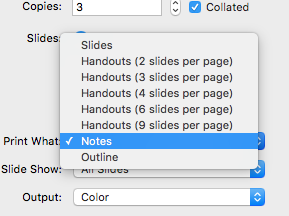
- Slides 
- Handouts (2 slides per pg) 
- Handouts (3 slides per pg) 
- Handouts (4 slides per pg)
- Handouts (6 slides per pg)
- Handouts (9 slides per pg)
- Notes
- Outline    

Choose the Notes option.

You will be able to see a preview of the document on the left (as seen below).  If you see that you didn't provide enough space between the numbers, make the adjustments on the powerpoint slide notes section before printing.
 
Check preview before printing your document

7. Print!
With very little time invested, you will have a document with the sketches, a place for students to write their names, instructions, and numbered spaces for students to write sentences. PLUS, since the sketches are on a powerpoint, you can easily project the sketches to talk about them before writing the story.

The teacher can write the sentences on the board and the students can copy the sentences OR the students can work alone or with a partner to write the sentences. It's also a quick informal or formal assessment if you use sketches that you have not used in class. 

Below are two powerpoint slides made into a Written Story Retell paper that I distributed to the students.
Sketches by the amazing artist T.F.
 
Sketches by the amazing artist T.F.

  Another option is for the teacher to type the story sentences directly on the powerpoint notes section as shown in the example below:

 
Type story directly in the Presenter Notes section on the ppt slide

Here is a summary of my plans for the structures SAW, GAVE TO HIM/HER, WAS DISAPPOINTED (which are targeted in the story above). For a more thorough explanation, visit THIS POST from 2014.

1. The class & I created a story with the basic plot that someone wanted to give another person a gift so the character when 3 places, lists what the person saw, that he bought a gift and then gave it to another person, and the person was disappointed with the gift. 

I projected the document "Graphic Organizer for Guided Storytelling" and as I told the story, the students provided the names of the characters, where they went, what they saw, to whom the character gave the gift.  
Graphic Organizer for Guided Storytelling

2. As were were creating the story, another student was drawing the story. We use the sketched story during our class review of the story because it doesn't have any words and the students are able to hear the target structures again - repetition in context!  The illustrations on the right are by the one and only amazing Ava K.   
3.  We reviewed and retold the story using the sketches above and answered the questions written by the student question writer. 

4. I distributed a blank Graphic Organizer for Guided Storytelling to students (pictured below). Students worked in pairs to create details of a different story and then they sketched the story. They rotated around the room and shared their stories with other groups of students.

5. One of the groups created the story with the illustrations shown in the first half of this post. I decided to put those sketches on a powerpoint point slide to get additional reps on the focus structures. 
6. The following day I told the story with Scott and Bill as I projected the sketches from the powerpoint on the board.

7. I distributed the document (it was front and back) of the powerpoint slides that had instructions for the students to write sentences about the story.

8.  The homework that evening was for students to show their written story to their parents and to read it to them in Spanish.  
 

Wednesday, October 19, 2016

Haste makes waste: The multi-dimentions of "SLOW"

In the book "Stepping Stones to Stories" by Ben Slavic, he lists SLOW as one of the five important skills needed in delivering comprehensible input to our students.  If I understand him correctly, the SLOW he refers to is the speed in which teachers talk to their students in the target language.  He writes, "Speaking to your students slowly indicates respect.  When you speak slowly you acknowledge that you appreciate how hard it is for your students to understand the new and foreign language."

SLOW is a difficult CI skill for teachers because it feels unnatural. It feels unnatural if you teach in your 2nd language and, even more so, if you teach in your native language! It requires a conscious effort and strict self-discipline, but it is necessary to (1) put our students at ease and (2) allow their brains the needed time to absorb the meaning of the message in the TL language at their own individual rate. 

Without question, speaking SLOWLY to our students is crucial. But, SLOW is more than one dimensional.  The SLOW in the title refers to the pace in which we move through our lessons or our "curriculum". 

Many of us introduce new structures and vocabulary to our students with PQA (Personalized Questions and Answers), followed by stories (TPRS) using the target words in context, and then reinforce it with reading and possibly a MovieTalk, or some other type of comprehensible input, to give additional repetitions of those structures. When we see evidence that the students "get it", we move on to new structures.  

Wait. 
Are you thinking, "isn't that what we're supposed to do?" 
Well... yes, but.. I think there's an overlooked element to our teaching pattern and rhythm: We don't allow (sufficient) time for students to play with the newly-acquired language, if indeed it has truly been acquired.  

Students need time to enjoy the feeling of success, of being able to respond to and use the new vocabulary and structures in a new context withOUT the pressure of new words added to the mix.  Allowing playing time with the newly-acquired structures sends the message: this material is important and I (the teacher) am going to allow you (the students) time to celebrate your growth and success and show off what you can do with it. Today we are going to take time to explore exactly how useful are those new structures/vocabulary.     

In addition, by forging on too quickly with new content, we miss the opportunity to show the students the power of High Frequency Words (HFW) on which we base our lessons. If the words are HFW, there are a mountain of contexts in which we can provide additional exposure and reps of those HFW. Students may be amazed at how many conversations use words such as wanted, had, there was, was (location & emotion), etc. There's a reason they're called HFW! 

Allowing extra class time to play with the language validates our choice of the HFW (found in the structures and vocabulary) on which we plan our lessons.  The extra time and CI will pay dividends, both now and later in the students' language journey, because they will have a more solid grasp of the words and structures they will encounter 75%, or more, of the time when communicating (listening, speaking, reading & writing) in the language.  

Just as important, if the words we are teaching are High Frequency Words, by pausing a day, or two, or three, before adding new material, it makes it clear to all involved that acquiring those HFW is not only a good idea, but crucial in order to make steady progress toward the goal of fluency. It sends the message that NOW is the time to really make those structures part of each student, to make them really stick, for both the fast processors and the slower processors in the group. It shows our commitment to student success right now, in this lesson, in this moment, in the present, and... in the future when they move on to the next lesson, the next unit, or to the next language level the following semester or year. 

If we allow that additional processing time and exposure through play time with the language, we help to discourage the yo-yo pattern of 2 steps forward, 1 step back (or worse, 1 step forward, 2 steps back) that can occur when too much is thrown too quickly at language students. The words that aren't fully acquired start to become jumbled with the newly introduced words, and before you know it, there's a cyclone of words and structures swirling in the students' heads and when that happens, trying to put things in any time of order becomes a huge challenge. 

Please understand that "playtime with the language" is NOT wasted time. It's NOT "fluff". Putting on the brakes and choosing to go SLOW AFTER you feel comfortable with the students' ability with a particular set of structures allows the students to relax within the learning process, which lowers the affective filter, which in turn opens the door for students to make (even) deeper connections with the newly acquired structures. 

Have you heard the wise old saying, "Haste makes waste"? It mean acting too quickly on something will actually slow things down.  There's a lot of wisdom in those three words. Heed the advice or be prepared for the consequences, which will cause frustration on both the teacher and the students' part, (at least that has been my experience, whether I was the one at fault or the "haste" happened before students arrived in my classroom.

This year I'm stepping up my efforts to be more attuned to my students' language abilities and needs. In other words, I'm striving to be honest with myself about what my students can and can't do in the language in relation to the comprehensible input they have been received, in my class and previously. I fully believe in recycling language - it's necessary and with HFW it's natural.  What I don't believe in is the need to "re-teach". If that need exists, I suspect it is due, in part or in whole, to the lack of the needed amount of comprehensible input and time to acquire the language at a previous time in the language experience.   

Saturday, August 13, 2016

CI Sessions at ACTFL16

ACTFL16 in Boston, MA, is close to 3 months away.  The 3-hour, half day workshops begin on Thursday, November 17. The opening session is on Friday, from 8:30-10:00, where the new ACTFL TOY will be named. Three of the five regional TOYS in the running for ACTFL TOY are Grant Boulanger, Darcy Pippins, and Michele Whaley, all of which teach with CI. There's no denying the power of teaching with comprehensible input!

Three days of hour-long sessions, on anything and everything language related, follows the opening session.

For attendees searching out sessions based on teaching with comprehensible input, you will be glad to hear that there is a long list of presenters from which to choose.  

I compiled the list of sessions on comprehensible input below to help to help you to start planning your schedule at ACTFL. If there are other sessions that fall into this category that are not mentioned (or other errors), please let me know and I will update the documents. A link to the document is HERE.


What a line-up! And don't forget about the professional development that awaits everyong in the exhibitor hall and in the evening conversations with other teachers.  If you are still on the fence on whether or not you will go to ACTFL in Boston this November, click HERE to access ACTFL'S online program to see what else ACTFL16 has to offer!

 I hope to see you there.  :-)
  

Saturday, August 6, 2016

An Explosion of Spanish Readers this Summer!

It wasn't that many years ago when it was the norm for two, possibly three, Spanish readers to be published each year. Well, times are a changing, my friends, because in the last year there has been an EXPLOSION of books, hot off the press, written for language students. I expect that trend will continue, due in part to:
   (1) Dr. Krashen's call for more books written for language learners and his advocacy for reading, citing studies that reading is a powerful method to increase proficiency in a language
   (2) Karen Rowan's urging to budding writers to publish their works. She is promoting "How to Write a Novel" through webinars, sessions at iFLT and NTPRS conferences, Facebook pages and other online social media. Her sincere encouragement to teachers to write a novel is incomparable!
   (3) Mike Peto's and Meg Villanueva's examples of how to publish your own novel. After publishing his first novel, Mike Peto wrote "While I am enormously proud of this novel, I hope it is obvious that the main thrust of my work is to encourage more TPRS teachers to dream, write, edit, practice with their classes, edit further simplifying the text as much as possible and eventually publish their own class novels. ...do not let anyone intimidate you into thinking that a mere classroom teacher cannot publish a TPRS novel."
     Mike Peto also has created a new website to track books written specifically by independent publishers to use in language classes called, CI Reading.  The website includes readers available in Arabic, French, German, Latin, Mandarin, Spanish, and books for Spanish heritage readers.  After checking the website, I found books that I want to buy to add to my ever-growing class library.

As proof of the recent book explosion, look at photos below of the books I have bought since summer vacation began, and there are (at least) two other novels that will be available this fall. The direct links to the novels are in blue and the webpages/blogs are in red.


Andrew Snider, @Reading633 on Twitter, announced to the iFLT/NTPRS/CI Teachers Facebook group last month that the above two Spanish novels, "Las tres pruebas" and "La vida loca de Marta" were available.  I believe these are his first two novels. You can find them on his webpage, Reading 633, on the Spanish novels tab.  While there, check out his blog on which he shares FREE stories, videos, and other materials for teachers to use with their students. 


 "Peter va a Colombia" is written by Craig Klein Dexemple, @profeklein on Twitter. It is his second novel, (the first is "El silbón"). You can find his books on the "books" tab of his webpage Spanish Cuentos. While there, check out his blog where he explains in detail some of the lessons he uses in his elementary Spanish classes, and check out the cool resources such as finger puppets and a poster of storytelling characters in his online store. 

"Ataques de hambre" is written by Eric Herman.  The book is a "Colección de los Cuentos Clásicos con Confesiones & Continuaciones" of the stories:
- Three Billy Goats Gruff
- Goldilocks
- Little Red Riding Hood
- The Three Little Pigs
- Jack and the Beanstalk
He retells these well-known bedtime stories in simplified Spanish and then branches out and writes the story from the perspective of the characters in the stories. If you like the story, "The True Story of the Three Little Pigs" (one of my favorite versions of the Three Little Pigs story - find it HERE on YouTube), then you, and your students, will enjoy Eric's book of stories of the characters' perspectives and confessions in the above listed classics. I bought "Ataques de Hambre" from Amazon HERE. He may have it listed on his webpage but I did not see it.  Check his school webpage, The Edgartown School, for a multitude (I'm not kidding) of resources such as videos of Eric teaching his students, embedded readings, online resources, etc. etc. etc.


Meg Villanueva, @meggiev777 on Twitter, has published two books and you can find the one shown above at Amazon here. I was late to the party on this one because "El gato misterioso y otros cuentos", as shown above, is her first book which was published last year (?) and I only bought my copy this summer. On the back cover of the book, Meg writes "El Gato Misterioso is a book that can be easily read by Spanish 2, successfully read by Spanish 1 after second semester, and read with assistance from the first week of Spanish 1." It is a collection of stories written in the present tense and then repeated in the past tense.  I need to buy her second book, "El cochino blanco y otros cuentos", to add to my class library. Check out Meg's blog, Let's Make a story!!  ¡¡Vamos a hacer un cuento!! and her Facebook group, La Sirena Baila.

Katie Baker's second published novel, "El Ekeko: Un misterio boliviano",  became available this spring (?). It is published and distributed through TPRS Publishing, Inc., which is also where you can find her first book, "La llorona".  "El Ekeko: Un misterio boliviano" is "based on fewer than 200 high-frequency words in Spanish...making it an ideal read for beginning language students."


The last two books that I purchased this summer are written by two outstanding authors whose names ALL Spanish teachers should be familiar with because they have written and published MANY novels. They are also skilled and engaging presenters at state, regional, and national conferences such as CSCTFL, ACTFL, iFLT, and NTPRS.

Mira Canion, @MCanion on Twitter, published "El capibara con botas". She describes it as "An easy Spanish reader containing just 55 new vocabulary words and English-Spanish cognates", which makes it a perfect reader for elementary students and beyond. You can find "El capibara con botas" HERE, along with numerous other fantastic novels written by Mira, at her website Mira Canion.  Note: She sells the books in packs of 5 on her website, so if you want one copy you can find it at Amazon, HERE, or you can always ask, (it never hurts to ask, right?) Mira if she is willing to sell it to you in less than multiples of five.  

Carol Gaab, @CarolGaab on Twitter, has written and published a fourth book in the Brandon Brown series.  It is "Brandon Brown dice la verdad" which is available, along with a seemingly endless choice of other Spanish readers, by Carol Gaab, Kristy Placido, Carrie Toth, and others, at TPRS Publishing, Inc. (There is also a collection of readers for French teachers and teacher of other languages.)


Finally, I need to include Mike Peto's book, "Superburguesas" which is available at Amazon here. It was published last year, but as I mentioned above, I believe Mike Peto helped bring about the "explosion of Spanish readers" by:
- self-publishing his novel, 
- sharing with others how to do this, and 
- encouraging others to do the same.
Mike has not mentioned this, as far as I know, but I wouldn't be surprised if he is working on writing another book. At least that is what we hope is awaiting us in the near future.

Mike shares his lessons, experiences, and thoughts on teaching on his blog, My Generation of Polyglots.  

I'll mention it again, because it's an invaluable resource, check Mike's newest website CI Reading,  to find books by independent publishers in several languages.

FYI - To be clear: I purchased these books with my own money and I did not receive any monies from the authors to mention the books on this blog. I am sharing the information and blog pages about the books and other materials because I know how beneficial it is for our students to have access to books written for beginning and intermediate language learners.