Thursday, November 15, 2012

Engaging lesson plan for Imperfect Tense

Goals for today's lesson:
1 - Provide a lot of repetitions of various verbs in the imperfect tense 
2 - Provide input that will engage the student
3 - Don't specifically tell the students that my focus for the lesson is the imperfect tense 

I started the lesson with the picture of an elderly couple (find it HERE) projected on the board.  I mentioned a few comparisons using young and old and then moved right into the goal of building a story around the two people.  We first established the basic details such as their names, their age, and where they live now.  Then I asked my students about details of their life in the past using the following questions as a guide:   

- Where did they used to live when they were young?
- What were they like?
- Where did they work?  What was their job?
- To where did they always on vacation?
- With whom did they talk every day/week?
- What did they believe?
- What did they want?

My students are getting better at "playing the game" and with a little help from me, we ended up with an interesting profile for these two people.  Throughout the profile building exercise, I continued to review the previous information to increase the number of repetitions.  Goal #1 ✔

After we had talked about "Dan" and "Beyonce" for awhile, I told the students to stand up and their ticket to sit down was to repeat one of the established facts about the couple.  If they couldn't remember any, they had to give a new fact about their past.  At first students took turns repeating the facts, but as the number of facts available yet to repeat dwindled, students started raising their hands to give new interesting facts; even several that were already seated wanted me to call on them because they had a good fact to add!  #Goal 2: ✔

Photo by Martin Smith, Flickr
For the last activity of the class, I counted off the students and put them in groups of 3. Then I projected another photo on the board, (right) and they had 10 minutes to write a profile on the two new people.  I instructed them not to write their names on their papers because I wanted to award points to the group with the best background information and I wanted to decide without being influenced by seeing their names. I chose the background information that explained how the couple was connected to the characters in The Hunger Games.  (I may have been slightly biased toward that since last night I just finished reading the second book in the series in Spanish.)

The next time I meet with the class, I'll ask some Verdadero/Falso or short answer questions to review the material yet one more time.  That will be on Monday, so if I have time Sunday evening (not tomorrow or Saturday due to ACTFL12), I may type a list of background information and the students will have to read it and find the sentences that describe "Dan" and "Beyonce".

As for Goal 3, well, I confess I mentioned that I put a graphic organizer on their Edmodo group a month ago and it was still there if anyone wanted notes.  (For what it's worth, I predict very few, if any, will bother to view the graphic organizer that I provided.) 

FYI - here is the profile for the first couple pictured above:

- Dan, is 82 yrs. old, from India, played cricket when young; 
- Beyonce, is 80 yrs old, from Alaska, played football when young;
- they're retired and now live in San Diego; they used to live in Portland, Maine;
- they're friends of the pope; actually Dan is his cousin
- they used to go to Vatican City every year for vacations
- they worked as spies for Canada
- they were athletic, hard-working, and funny
- Dan had 2 legs, but lost one in an accident in Serbia; now has one leg
- they had 2 sons 

Friday, November 9, 2012

130+ repetitions of a new word + review

Student sketches as per my descriptions
 Q: How do you get a lot of repetitions from one word?  
A: Tell the students to draw it.

My Spanish 1 class is currently working on the 2nd chapter of stories in the Cuéntame Más series.  We did a story earlier this week with the words el cuervo, tiene miedo, and se esconde debajo de la cama (the crow, s/he is afraid, s/he hides under the bed). Yesterday I did PQA with the words detrás del cacto, sales de, and deja (behind the cactus, you leave, and s/he leaves...something/somewhere), but we never got to a story the kids gave me great feedback during the PQA session.  Many of the other words in chapter 2 the students already knew due to the previous 2 months of TPRS. However, they didn't know pájaro (bird).  I didn't really want to do another story since we got a lot of mileage out of the one earlier this week, and I didn't want another full class period of PQA. 

C - El pájaro negro corre tras el pájaro verde.

I realize that pájaro is not a high frequency word. Because of that, my goal was to be able to give a high number of repetitions of the word, but to have the students focus on more than that particular word (which is what TPRS usually does in storytelling). 

At the beginning of class, I gave each student a half sheet of paper, and a small paper with a description of a bird or what it was doing.  The students sketched the description. Then I put 3 or 4 sketches at a time under the document camera and started asking questions about them.  This turned out to be an unbelievably easy way to provide a high number of repetitions and it kept the students' attention because they were interested in seeing what their classmates drew. By the end of the activity I had 130+ reps, plus we had reviewed a lot of the vocabulary from previous stories.

Here are a few of the descriptions I gave to the students:
- a big bird talking to a wolf
- a little black bird running after a big green bird
- a bird wearing blue jeans
- a sad bird listening to music in his bed
- a yellow bird drinking Coca-Cola in a canoe
- a bird with big eyes
- two birds telling a "knock knock" joke to a big, angry snake
- two yellow birds, one big and one small, eating spaghetti
- a bird behind a cactus that is smiling
- 2 red birds hiding under a big bed         

Learning from Great Storytellers

What can storytelling offer?
Children have an innate love of stories. Stories create magic and a sense of wonder at the world. Stories teach us about life, about ourselves and about others. Storytelling is a unique way for students to develop an understanding, respect and appreciation for other cultures, and can promote a positive attitude to people from different lands, races and religions.  -
British Council BBC

 
(click HERE to go to the British Council BBC website that outlines the benefits and techniques of storytelling.)

How true! Stories draw us in and captivate our attention, especially if told by someone that has a talent for sharing stories.  As an example, think of Morgan Freeman, when he narrates a story at the beginning of a movie. I find myself wanting to listen to Morgan and at times disappointed when he stops narrating and the movie begins.  That's how quickly he has captivated my attention.
 
Storytelling is a gift but there are techniques we can learn from great storytellers. I found a website by the Resident Storytelling Company called Story Circle at Proctors. The website was created to share information about "Tellabration 2012" an event in which great storytellers gather together and share their talents.  The first story I clicked on was called "The Edge of the World" a folktale told by Betty Cassidy.  Even though it is entirely different than creating a story with a group of students, a la TPRS, I was intrigued with how she told the story, her pacing, her expressions, tone of voice, everything...that made me want to keep listening to see what happens at the end.   

Here is a video of Betty telling the folktale "The Edge of the World" (in English):


What a great new resource for stories to use in class.  As I listen to the stories, I can find structures that students need more repetition on or look for new structures that are common that I can introduce before telling this story.  This story could be used as part of a listening comprehension activity after the vocabulary and structures are taught in previous mini-stories. 

Thursday, November 8, 2012

Impromptu Stories: Making the Most of Every Minute

In my Spanish 4 class today, we finished one activity with 8 minutes remaining in class.  I didn't want to start the next activity in my plans because 8 minutes was nowhere enough time for what I wanted to do.  Not wanting to waste a single minute of class time, I decided to do an impromptu story.

I asked the students to stand up.  We were already in a circle because unless the students are working in groups, our chairs are always in a circle (no desks - I'll post about that later).  The directions for the activity: one person starts the story with 1 sentence; the person to their right adds the next sentence; followed by a sentence from the person to their right, etc.

Things off the top of my head tend to be, ah.....unpredictable.  That explains why when I started, "Había un chico que se llamaba...."  the first thing that popped in my head was "LowlowdoedoeBoy" for his name.  The first student added that "LowlowdoedoeBoy" had 2 dogs and 3 cats. The next student wanted to say he lived in a boat in the sea, but instead of saying "vivía en un bote en el mar" she said "vivía en una bota (boot) en el mar".  No problem - we made it work - AFTER laughing together about it. (LAUGHTER - good for your health and good way to lower the affective filter)  Living in a boot on the sea made for a much more interesting story than someone that lived in a boat on the sea. 

Those last eight minutes flew by, thanks to "LowlowdoedoeBoy" and his adventures on the sea in his boot.  Yes, this is output, but it is output with a level 4 class.  I just can't afford to lose minutes at the end of class so creating an impromptu story is a great fit and an enjoyable way to end the class. 

Wednesday, November 7, 2012

Adding Details to a Story

This fall is the first time I've taught Spanish 2 for at least five years and I am thoroughly enjoying it.  First of all, it is a great group of students.  They are the first class of the day and I look forward to starting my day with them.   

Secondly, I'm enjoying teaching them how to talk about things that happened in the past WITHOUT handing them endless piles of worksheets and conjugation charts.  Forty-seven days into the semester and I haven't once mentioned "preterite" or "imperfect".  Instead of telling them that the verb needs to be in the imperfect, I tell them I want them to describe what someone looked like, or was wearing, or how the person felt, or how old the person was, or what time it was.  Many times I prompt them with a choice, "era alto o era bajo, estaba triste o estaba contento", etc. Because they've heard me give suggestions for possible answers many, many, many (x an enormous # of ) times, the problem of knowing when to use imperfect or preterit has diminished greatly.

I've been concentrating mainly on the él/ella form (3rd person singular) of the past tenses.  In the last week or so, I have slipped in several examples in the ellos/ellas form (3rd person plural) in stories.   Today I wanted to see what they could do with those forms.  Yesterday we created a story and it had several examples of both of the forms mentioned above.  I typed the story for them, and added space throughout the story for them to add more details.  Then the students worked alone or with a partner to write the additional sentences.  As they wrote I moved throughout the room, helping students and giving grammar pop-ups as necessary to individuals.

The students enjoyed the opportunity to add their own details to the story.  How do I know this?  They asked to share their new versions of the story with the class. I collected the papers of the groups that wanted to share, but unfortunately there was only time to read two of the stories and they asked if I could read them tomorrow.  

If you want to see the format in which I provided space in the middle of the story for their input, click on the link below.  I also added an activity in which I read the original story to them but this time I also was included in the story which meant they were hearing the nosotros (1st person plural) form of the verbs.  

11.6.12 Story - Sp2 - focus words: fueron, hablaron con, vieron, respondieron, dijo, preguntó  


Sunday, November 4, 2012

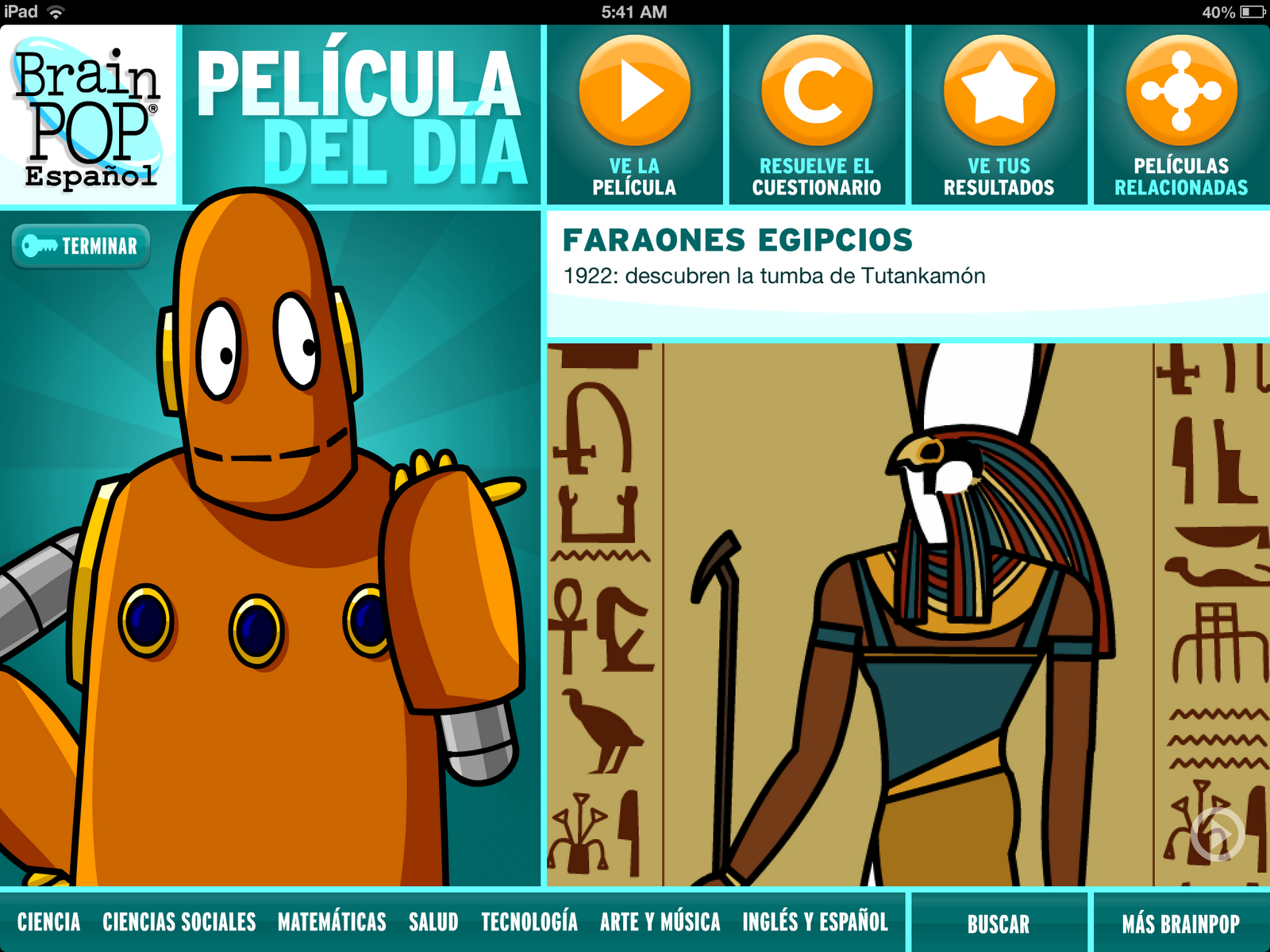
BrainPOP Español - App for Spanish Class

App - Brain POP Español
One of my goals this year is to increase the amount of exposure my students have to listening to native Spanish speakers in order to better prepare them to understand native speakers in the future whether it is in their college Spanish classes, in the community, listening to Spanish programs on TV, or in future travels.

In March of this year, I found the app BrainPOP Español.  There is a free version and a paid version. Most of the recordings are around 5 minutes in length.  The categories are Ciencia, Ciencias Sociales, Matemáticas, Salud, Technología, Arte y Música, and Inglés y Español.  Some videos in the free version specific to Spanish themes are "Revolución Mexicana I", "Simón Bolivar", and "Frida Kahlo".  Using the videos from other categories is a way to incorporate the 'Connections' component of the Standards for Foreign Language Learning if you are doing a unit such a health and fitness.  (The paid version has a much larger selection of videos but it is expensive.  There is an English version of this app that some schools are using in the elementary schools so ask your tech support department what is involved in adding you to the subscription.)

After watching the video, click on a tab that takes you to a 10 point quiz of the material. There are ten questions and four multiple-choice options for answers.

This is how I use the BrainPOP Español app with my upper level classes
:

1. I put the students in groups of 3.
2. I project the video onto the whiteboard and students watch the video 2 times.  The first time they watch the video most of them are busy reading the Spanish script written at the bottom of the screen. 
3.  The second time they watch it, I encourage them to not look at the words, but rather to LISTEN for comprehension and only use the script as a backup if they start feeling lost because there are several words they didn't understand.
4.  After the video, we go through the questions on the quiz.  Each group has a mini-whiteboard.  They read the options and discuss them with their group member.  At times I have to clarify the question or possible answers because I don't want them answering incorrectly because they don't understand the meaning.  Then they write their answer and wait until I tell them to hold up their whiteboards at the same time.  
5.  I use different strategies as we go over the answers.  If everyone answers correctly, we may go through the wrong possibilities in the quiz and explain why they are incorrect.  Other times, I ask groups why they chose their answer.  
6.  I keep track of their points for the 10 questions and the team with the most points after 10 questions is the winner.  Sometimes winners receive the standby "fireworks clap". Other times, if the team answered all of the 10 questions correctly, I may add a point to their next assessment.

On average, I use BrainPOP Español every 2 or 3 weeks.  I'm also including more podcasts and other news sites that include audio to incorporate even more listening activities.

Thursday, November 1, 2012

Resource for Discussion Questions, Jokes, Games

This is a short post to share a site that I had bookmarked at one point, but had not returned to the site since I bookmarked it.  The page on the site that will be useful in my upper level classes for discussions in the target language is called "Conversation Questions for the ESL/EFL Classroom" (a project of the Internet TESL Journal).  This page has a long list of discussion topics. When you click on a topic, you'll be directed to another page with possible questions concerning that particular topic.  The questions are written in English (since it is meant to be used with English learners), which means any MFL teacher will be able to use the questions when they translate them to the language they are teaching.  

This website includes other resources too.  Under the title there are tabs to click on such as: Games and JOKES! (I enjoy using jokes in the TL). 

In regards to the Games Tab, I'm very particular in any games I play during class time because they need to pass my test on whether they are helping to acquire the language rather than simply a fun activity.  There are some good ideas in the Games Tab, but I may need to alter them as necessary.  An example of a popular game that is altered to improve it is Martina Bex's version of BINGO.  
 
Hopefully, this resource will prove useful for you.
  
Happy discussions!

Tuesday, October 30, 2012

Pictograms of Well-Known Stories

If you are looking for ready-made materials to use in your language class, the website Orientación Andujár has familiar children's stories en pictograms available to download.  It is a website for Spanish teachers, but even if you teach another language, you will still be able to use the pictograms because there are not many words in the pictograms.  Some of the stories also have additional activities that you can download to use with the stories.  

Ideally, the majority of the fables and legends that I teach in class are authentic stories from countries where the target language is spoken, such as stories about Juan Bobo.  But, occasionally it is fun for the students to hear a familiar story from their childhood told in the target language.  The advantage is that the students already know the plot and the characters in the story, so they can concentrate on learning the words they don't know in order to retell the story.  A variation I employ when using familiar children's stories, is to ask questions for information not given in the original story so the students can use their imaginations instead of sticking with the regular story.    

There are pictograms of the following stories:
- Los 3 Cerditos                         - La Ratita Presumida
- El Asno y el Cochino                - El Rancito Pérez
- La Princesa y el Guisante         - El Flautista de Hamelin
- Cenicienta                              - Los Músicos de Bremen
- Blancanieves                          - La Cigarra y la Hormiga
- Caperucita Roja                      - La Casita de Chocolate
- Ricitos de Oro                         - El Patito Feo

Since I mentioned authentic stories, I just found this book, Tales our Abuelitas Told, (Cuentas que contaban nuestras abuelitas) on the web this morning.  If you have the book, please e-mail me directly or leave a reply on the blog if you have used the stories in class or if you recommend it.  Thanks!  

Saturday, October 27, 2012

The iPad & Educreations App in the MFL Classroom

If you have an iPad or have one available to use at your school, consider using it to make mini-lessons with the free Educreations App.

This school year, I have been experimenting with the Educreations App and other digital story-telling apps to record the stories that my students help me create in Spanish class.  I also made one mini-grammar lesson for my Spanish 4 students that insisted on a formal lesson on the subjunctive.  


Here is the story the students and I created on Friday. (The sound quality is usually better but I was sitting next to my noisy computer when I recorded on the iPad so I could read the script off of my computer screen.  I was in a hurry so I didn't take the time to re-record it.  Next time, I'll print out the script and move away from my computer!)


These are the steps I follow to make the stories:
1.  When I'm ready to "storyask" with my students, I ask for a volunteer to sketch as we create the story.
2.  I give my iPad to a student, give them a brief overall of the app, and tell them to sketch as the story develops.  
3.  I tell the student to make a minimum of 5 different sketches for the story.  
After I hand off the iPad, I usually don't check back with the student or see the sketches until the end of the class.  I'm not concerned that they're not verbally responding to my questions because I KNOW they're paying attention because they have to illustrate the story.  If they weren't paying attention to the storyline and what I am saying as we develop the story, they wouldn't be able to sketch it.
4.  Since the story was just created on the spot with the students, after they leave, I type it up on my computer because I usually give them a copy of the story to read the following day if we didn't write it together in class.
5. After the story is typed, I mark the typed version to indicate when I want to go to the next sketch on the app.  
6.  Then I record the story as one recording.  I think you are able to record each page individually, but with the script in front of me, it's no problem to record the entire story without pausing.  This way when the students view it, they do not need to click to the next page.  My goal is for the students to be able to understand the story by listening to the story, so I need to discipline myself to speak slower to make it 100% comprehensible for the students.
7.  After the story is recorded, I give it a title, save it, and link it to the class Edmodo page.  Then it is available for students to view at any time.  

There is never a shortage of students that want to make the sketches.  The following day, I like to use the story on the Educreations App as a review of the story.  Then the artist's classmates are able to see what they drew.


The Educreations app allows you to add text and upload photos.  

There are other apps that I have experimented with a little, with pros and cons for each of them.  The apps I currently have on my iPad for digital storytelling are:
- StoryKit
- Explain Everything
- Felt Board
- ZigZag Board
- ScreenChomp
- Educreations
- ShowMe
- Book Creator
- My Story

If you have a favorite app for recording lessons or stories, please share them with me.  I like the Educreations app but I know there are probably other apps that will do the same thing, maybe even easier to use, that I may not be aware of.

La Bolsa Fea - Negotiating Meaning

This is my Bolsa Fea. Two or three times a semester, if I have ten minutes remaining during a Spanish 3, 4, or 5 class, I pull the "Bolsa Fea" out of my closet for a listening activity.

The Bolsa Fea is filled with random words on small slips of paper. First I put the students in groups of 3 and give each group a mini whiteboard. I define and explain the word in Spanish, wait a minute for the students to discuss among themselves, and then they write the word on their whiteboards.  Most of the words are not ones they know in the target language so they write the answer in English.  Some examples of the words are: roadblock, soundproof room, and boar.  

The purpose of the activity is for the students to listen for meaning, not to learn the obscure words that are not high frequency words.  Two or three times a month, I visit my friend from the Dominican Republic to chat with her in Spanish. Talking with her gives me the opportunity to listen to a native speaker and to listen for meaning around some words she uses that I don't know.  Students need to realize that if they talk with a native speaker or read a text that wasn't written specifically for a 2nd language learner, and they don't understand every single word, they can still understand what they hear or read from looking at how the words are used in context and using those context clues to find meaning.  

The students enjoy this activity, so I'm careful not to overuse it.

A side note: I don't think the purse is "ugly" per say, but it certainly is not my style. I called it "Bolsa Fea" one time and it stuck.  

Click HERE for the list of words that I currently have in la Bolsa Fea.  There are some words that students may already know in Spanish but I don't discard those words because it is still a good word to describe to them in Spanish.  If you teach lower levels and describing these words are too challenging, make a list of more basic words, even many that students know, and the activity will work just as well.

Tuesday, October 23, 2012

To Proficiency and Beyond!!!

I decided that this is my new motto - To Proficiency and Beyond!!!  

In fact, maybe I'll have to consider changing my blog name to "To Proficiency and Beyond".


Why? Because this year, more than any other year in my teaching career, I thoroughly scrutinize my lesson plans to assure that the activities I offer are those geared toward helping my students become proficient in the language.  Doing things like I used to, simply because that's how I always did it in the past, doesn't stand up against the scrutiny of the question, "Does this help the students to acquire the language?"


Through my intensive reading on how students acquire a language, and through my own personal experience of when I learned Spanish, and also how my students are progressing in my classes, it has become crystal clear that some activities I used to do, did nothing more than act as a vacuum, sucking up precious minutes of class time. 


I still catch myself at times planning an activity for class that is based more on the "fun factor" than on acquiring the language.  That's when I have to Stop, Review my Goals for my Students, and re-evaluate and make necessary adjustments to keep proficiency as the target.


Please don't interpret the previous statements to mean that teaching with TPRS isn't fun.  That would be a definite misunderstanding. Teaching with TPRS and CI has brought a breath of fresh air into my teaching because it involves the students.  It draws them into the story with their creative ideas for the story development, through acting, through class responses during storytelling, using their artistic skills, and a whole list of other ways.  There are days that I look at the lesson plans I made on the weekend and find myself looking forward to sharing a story with a class to see how they make it their own through their contributions. 


"Fun" has a new meaning.  

"Fun" is reading a chapter with the students in the mini-novel and students, that would have struggled in the traditional setting, volunteer to summarize what happened in that chapter.  
"Fun" is hearing a learning-support student say, "Hey, I think I'm getting this." (which I heard today and it made me smile). 
"Fun" is reading the students' endings to a story that they wrote without dictionaries.  
"Fun" is when I ask a series of questions to a students in Spanish, and they answer, whether in single words or full sentences without hesitation, and I point out to them that their comprehension of my questions was "spot on". 
"Fun" is when students say "awwww" when I end an activity such as creating more details about a person or describing, in Spanish, their classmates' sketches that I share w/ the use of the document camera.
"Fun" is hearing from students that graduated and say they're enjoying their college level Spanish classes and are considering minoring in Spanish.

The groundwork and formula for that fun always lies in providing CCI (Compelling Comprehensible Input) for the students.  It's not always an easy road, and certainly not without many mistakes on my part, made along the way.  It is a journey that demands a sincere commitment from me, every day, every class, personalized for every student.  It's not about me; it's all about them, and all about getting them "To Proficiency and Beyond!!!" 

Friday, October 19, 2012

Cloze exercises w/ Songs

I'm feeling a little frustrated with the results I'm getting when my students take their song quizzes on Fridays.  The grades are lower than I expect and I haven't quite figured out what the problem is.  

Here is my routine for songs:
1. Monday: I introduce a new song in Spanish.  Students listen to it without seeing any lyrics and list words they hear in the song.
2. Tuesday: We listen to the song again but this time with the lyrics, some of them missing for students to fill in. Go over and explain any new phrases/words.
3. Wednesday: Listen to the song, pausing the video at times to ask the students comprehension questions.
4. Thursday: Listen to the song.
5. Friday: Quiz - for some of the points I replace words with a line and students listen to the song and fill in the blanks; for some points I put some words in bold print and students write what it means.

I suspect that I'm not getting super results from this because I'm not taking the time to preteach the unknown grammar and vocabulary.  If that is the case, then I need to weigh whether testing students on the song is worth the time that I will need to spend to preteach the necessary vocabulary.  I feel like my classroom instruction time is very limited as it is.   
 
Would it be better to listen to the song once or twice, maybe with a cloze activity, and then NOT test the students on the song?  The students enjoy listening to the songs, and I like that I can introduce another aspect of the culture to the students through music. 

Maybe I should simply let them enjoy the music and the cultural experience and save the testing for other areas.   Time to check with my PLN to hear their experiences with music and assessments and their suggestions.